
ChatGPT is no longer only an AI assistant. It is becoming an advertising platform, complete with campaign buying, CPC bidding, measurement tools and a growing set of rules governing which businesses can reach users inside the product.
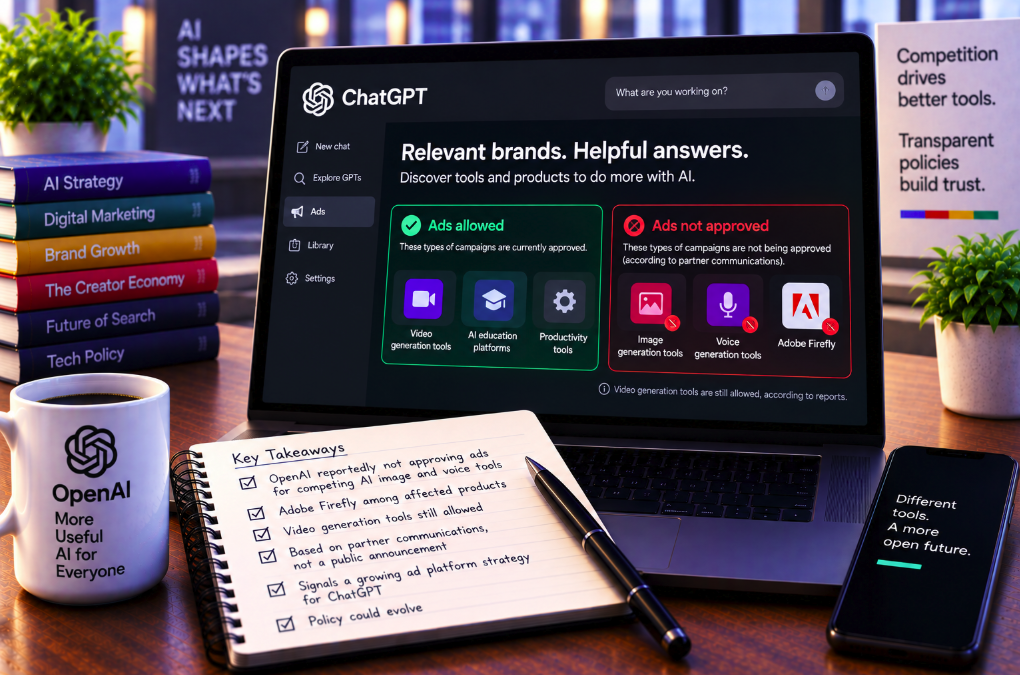
That makes a new reported restriction especially significant. According to Search Engine Land, OpenAI has told advertising partners that campaigns promoting standalone AI image- and voice-generation products will no longer be approved to run in ChatGPT. Adobe is among the advertisers reportedly affected, with Firefly specifically identified as one of the products caught by the restriction.
Video-generation tools reportedly remain eligible.
OpenAI has not publicly announced that specific category rule in the sources reviewed. But its public advertising policy was updated on September 10, the same date as the Search Engine Land report, with language that makes the broader competitive issue explicit: OpenAI says it may decline advertising that conflicts with its advertising principles, business interests or competitive position.
The reported restriction targets standalone image and voice AI products
Search Engine Land says the change was communicated directly to advertising partners rather than announced publicly.
Adobe senior director for Americas media Doug Wyatt reportedly said partners were informed that campaigns for standalone image and voice generation products would no longer receive approval.
That distinction matters because the reported rule is not a blanket prohibition on advertising AI software.
It appears to focus on product categories that compete particularly closely with capabilities OpenAI itself offers inside ChatGPT.
Adobe Firefly is reportedly among the affected products
Adobe is a notable case because it participated in OpenAI's early advertising efforts.
Search Engine Land reports that Adobe promoted products including Acrobat Studio and Firefly during the initial advertising pilot.
Firefly competes in AI image generation, an area in which ChatGPT also offers native capabilities.
If the reported restriction is applied as described, ChatGPT is simultaneously an advertising distribution channel for software companies and a competing product environment in which OpenAI decides which adjacent tools can buy access to users.
Video-generation ads reportedly remain allowed
The reported policy is not uniform across generative media.
Search Engine Land says video-generation products can still advertise in ChatGPT.
That creates an important boundary around the current report: image and voice generators are said to be restricted, while video tools remain eligible.
There is no basis yet to assume the same restriction will automatically expand to every generative AI category.
OpenAI has not publicly named Firefly in its ad policy
The distinction between reported implementation and published policy is essential.
OpenAI's public Ad Policies do not, in the text reviewed, specifically list Adobe Firefly or establish a public category called “standalone competing image and voice generators.”
The specific restriction comes from reporting about communications received by advertising partners.
Until OpenAI publishes more detailed category guidance or confirms the reports directly, marketers should avoid presenting the Firefly restriction as if it appeared verbatim in OpenAI's public rules.
OpenAI's public policy now explicitly mentions competitive position
There is, however, a newly documented policy development that gives the report additional context.
The September 2026 changelog for OpenAI's advertising policies says version 1.6 was updated to clarify the company's right to decline ads where they conflict with its advertising principles, business interests or competitive position.
That is unusually direct language for an emerging ad platform whose owner also sells products in many of the categories potential advertisers may want to promote.
It establishes publicly that competitive considerations can be part of OpenAI's ad-acceptance decisions, even though it does not identify every product or category affected.
The public clause and the reported AI restriction should not be treated as identical
The timing makes it tempting to say the policy update proves the reported image-and-voice restriction.
That goes further than the available evidence.
The public clause gives OpenAI broad discretion to reject campaigns for competitive reasons. The reporting describes a specific implementation communicated to partners.
They are clearly related in subject matter, but OpenAI has not publicly stated that the new competitive-position wording was introduced specifically to codify the reported Firefly, image-generator or voice-generator restrictions.
OpenAI's advertising terms already gave it broad approval discretion
The company's contractual framework also reserves substantial control over campaign acceptance.
OpenAI's Advertising Terms, updated August 25, 2026, say advertisers may submit campaigns through Ads Manager, an approved API or another method designated by OpenAI.
Each campaign is subject to OpenAI's acceptance in its sole discretion.
The September policy clarification therefore sits on top of an advertising system that already gave the platform owner broad contractual authority over what runs.
ChatGPT's ad business has moved beyond an experiment in principle
The competitive question matters because OpenAI has spent 2026 building increasingly conventional advertising infrastructure around ChatGPT.
In May, OpenAI announced new ways to buy ChatGPT ads, including access through advertising partners and a beta self-serve Ads Manager.
The company also introduced CPC bidding and expanded measurement capabilities.
Those features move ChatGPT closer to the mechanics marketers expect from established performance advertising platforms.
Advertisers can now buy intent inside an AI conversation
The strategic appeal of ChatGPT advertising is different from buying a conventional display impression.
Users often describe what they want, the constraints they face and the alternatives they are considering in considerable detail.
OpenAI's advertiser materials position this as an opportunity for brands to appear while people explore options, compare choices and make decisions.
That makes access to ChatGPT's ad inventory potentially valuable for AI companies trying to reach exactly the users most likely to experiment with another tool.
That is why restrictions on rival AI products matter
An image-generation company advertising inside ChatGPT is not merely buying general technology reach.
It can potentially reach users already demonstrating interest in generative workflows.
From OpenAI's perspective, allowing a direct competitor to advertise in that moment can divert users from a capability ChatGPT itself provides.
From the rival's perspective, blocking that campaign removes an unusually context-rich acquisition channel controlled by its competitor.
Platform ownership and product competition are colliding
This tension is familiar across digital markets.
Large platforms frequently operate marketplaces, app stores, search engines, social networks or media properties while simultaneously competing with businesses that depend on those distribution channels.
ChatGPT creates a new version of the same structural problem.
OpenAI owns the conversational environment, operates the ad system and develops AI products that overlap with categories potential advertisers sell.
Blocking direct competitors is not unprecedented
Search Engine Land correctly notes that major digital platforms and media businesses have often restricted advertising from direct competitors.
An advertising venue is not automatically obligated to accept every lawful campaign submitted to it.
Platforms routinely apply commercial, editorial, safety and category restrictions.
The more important question is how transparent, predictable and competitively consequential those restrictions become as ChatGPT's advertising reach grows.
The policy can affect AI customer-acquisition economics
AI companies already compete intensely for users across paid search, social platforms, creator marketing and partnerships.
If ChatGPT becomes a high-intent advertising environment but certain direct competitors cannot buy inventory, acquisition opportunities will differ by product category.
A productivity application that complements ChatGPT may be able to advertise while a standalone image generator competing with a native ChatGPT capability may not.
That distinction could influence where AI startups allocate budgets and how they model customer acquisition costs.
Firefly illustrates the complement-versus-competitor problem
Adobe's portfolio demonstrates why category rules can become complicated.
Adobe sells products that can complement ChatGPT workflows, products that integrate AI into broader creative software and standalone generative experiences that may compete more directly with OpenAI's capabilities.
A platform policy therefore needs to decide whether eligibility is evaluated at the company level, campaign level, product level or landing-page level.
The reported treatment of Firefly suggests product-level competitive overlap may matter, but OpenAI has not publicly documented a comprehensive taxonomy for these cases.
Voice is another increasingly competitive interface
Voice AI is not merely a feature category. It is becoming a primary interface through which users interact with assistants.
Standalone voice-generation tools can overlap with OpenAI's own voice capabilities in ways that go beyond text-to-speech utility.
A restriction on voice-generation advertising therefore touches a strategically important part of the AI product stack.
As voice assistants become more capable, the line between complementary creative software and direct conversational competition may become harder to draw.
Video's reported exemption could be temporary—or durable
Video-generation tools reportedly remain eligible today.
There is no public evidence that this exemption has an expiration date, and marketers should not assume one.
At the same time, OpenAI's public policy gives the company flexibility to decline campaigns based on competitive position, so category boundaries can evolve as its products and business interests change.
Advertisers in adjacent AI sectors should therefore treat current approval as current eligibility rather than a permanent guarantee.
OpenAI is expanding the geographic footprint of ChatGPT ads
The issue becomes more consequential as the ad program reaches more users.
OpenAI's ChatGPT ads updates document an initial U.S. test followed by expansion into additional markets including the United Kingdom, Mexico, Brazil, Japan and South Korea.
The company has said it is taking a phased approach as it learns from real-world use.
A competitive advertising restriction applied during an expanding rollout can eventually matter far more than the same rule inside a small experimental pilot.
Ads are shown on lower-cost ChatGPT plans
OpenAI says ads may appear for users on Free and Go plans, while Plus, Pro, Business, Enterprise and Edu accounts do not show ads.
That gives the ad product access to a broad consumer audience while preserving ad-free paid tiers.
For advertisers, the opportunity is therefore tied particularly to the large population using ChatGPT without premium subscriptions.
For OpenAI, advertising creates another way to monetize that usage while keeping broader access available.
OpenAI says ads do not influence ChatGPT's answers
The competitive ad-policy story should not be confused with a claim that advertisers can buy favorable AI answers.
OpenAI says advertising is separate from the assistant's responses and that ads do not influence ChatGPT's answers.
The company presents advertising as a separately labeled experience rather than a mechanism for purchasing model recommendations.
That separation is central to user trust and makes ad eligibility a distribution question rather than an answer-ranking question.
Advertisers do not get access to private conversations through the ad product
OpenAI also says conversations are kept private from advertisers and that user data is not sold to advertisers.
Its advertising pitch emphasizes relevance derived from the platform experience without turning private chat transcripts into advertiser-accessible records.
This matters because ChatGPT conversations can contain far richer personal context than conventional search keywords.
The commercial value of that environment depends on maintaining a boundary between contextual advertising and advertiser access to user conversations.
Competitive restrictions create a different transparency challenge
Privacy and answer independence are only two dimensions of trust.
Advertisers also need to understand why campaigns are accepted or rejected.
If eligibility can change because a product becomes more directly competitive with OpenAI, marketers need sufficiently clear rules to plan launches, budgets and creative production.
Private partner communications can work operationally, but public documentation becomes more important as the advertising ecosystem matures.
The September policy update makes business interests explicit
The phrase “business interests” in OpenAI's public changelog is significant alongside “competitive position.”
It indicates that campaign review is not framed solely as a safety, legality or user-experience function.
Commercial considerations can also affect whether an ad is accepted.
That does not establish how often the clause will be used, but it gives advertisers a clearer picture of the discretion OpenAI reserves.
Marketers should distinguish prohibited content from competitive rejection
OpenAI's advertising policies already contain restrictions around sensitive, regulated and inappropriate content.
Those rules serve a different purpose from rejecting a campaign because it conflicts with OpenAI's competitive position.
An AI image generator can be safe, legal and accurately advertised while still being considered commercially competitive.
That distinction matters when agencies diagnose why a campaign failed review and whether changing the creative can realistically solve the problem.
A creative rewrite may not fix a product-category restriction
If a campaign is rejected because of misleading claims, an advertiser can revise the claims.
If it is rejected because the underlying product falls into a competitively restricted category, changing the headline or image may accomplish nothing.
Agencies buying ChatGPT inventory should therefore identify whether a rejection concerns the ad itself, its landing page, a prohibited sector or the competitive nature of the advertised product.
That diagnosis determines whether remediation is possible.
AI companies should diversify acquisition channels
The reported restriction is a reminder that relying heavily on a competitor-owned distribution channel creates platform risk.
An AI startup may find ChatGPT ads attractive because of their contextual relevance, but eligibility can change as OpenAI's product portfolio evolves.
Paid search, social, affiliates, creators, partnerships, app ecosystems, direct traffic and organic discovery remain important hedges against that dependency.
Diversification is particularly valuable when the platform selling the advertising also competes for the same customer.
Agencies need product-level approval intelligence
For agencies managing multiple technology advertisers, category eligibility can no longer be treated as a simple company-level question.
One client may have several products, only some of which overlap directly with ChatGPT.
Approval history should therefore be tracked by product, landing page, market and campaign type.
That operational data can become important while public documentation remains less specific than the implementation reportedly communicated to partners.
The policy could shape which AI brands users discover through paid placement
Advertising platforms influence discovery by deciding which advertisers can participate in an auction or placement system.
If direct image and voice competitors cannot advertise in ChatGPT while complementary AI tools can, the paid discovery environment will naturally contain fewer alternatives in those categories.
That does not prevent users from asking ChatGPT about competing products or discovering them through other channels.
But it can affect which brands receive sponsored visibility inside the ChatGPT interface.
The unanswered question is how far “competitive position” extends
OpenAI operates across an expanding range of AI capabilities.
Image generation and voice are only two examples. Coding, research, agents, data analysis, search, productivity and other categories can also overlap with third-party products.
If competitive position is a general advertising consideration, marketers will want to know how OpenAI defines a direct competitor and whether the threshold changes by feature or market.
The public policy currently provides discretion, not a detailed competitive map.
Competition questions will grow with the ad business
A small pilot can manage edge cases through direct conversations with a limited number of advertisers.
A large self-service advertising platform needs scalable rules.
As more businesses buy ChatGPT inventory, OpenAI will face pressure to explain eligibility consistently enough for advertisers to understand the marketplace.
The reported AI restrictions are an early example of a governance issue that becomes more important as the platform grows.
The story is bigger than Firefly
Adobe Firefly is the recognizable example, but the strategic issue concerns the structure of ChatGPT's emerging business.
OpenAI is simultaneously building consumer AI products, operating the environment where users make decisions and selling advertising access to those users.
Its public policy now expressly reserves the right to decline ads based on competitive position, while reporting indicates that this discretion is already affecting some standalone AI image and voice products.
That combination turns advertising policy into product strategy.
What advertisers should watch next
The first question is whether OpenAI publicly documents the reported image- and voice-generation restriction in more detail.
The second is whether video-generation tools continue to remain eligible.
The third is whether competitive exclusions expand into other AI categories as ChatGPT gains new native capabilities.
Changes to the public policy changelog, Ads Manager eligibility guidance and partner communications will be more informative than assuming today's category boundaries are permanent.
ChatGPT's ad platform now has a competition-policy question
OpenAI has spent 2026 turning ChatGPT advertising into a real media-buying product. Advertisers can use partners or a beta self-serve Ads Manager, buy on a CPC basis and reach users while they explore products and make decisions.
Now the company must manage the tension created by owning both the ad platform and many of the AI capabilities advertisers want to sell against.
Search Engine Land reports that standalone rival image and voice generators are no longer being approved, with Adobe Firefly among the affected products, while video-generation ads remain allowed. OpenAI has not publicly announced those exact category restrictions, so they should remain attributed reporting rather than stated as settled public policy.
What OpenAI has publicly documented is broader and potentially more consequential: its September ad-policy update explicitly says campaigns may be declined when they conflict with the company's business interests or competitive position. As ChatGPT becomes a larger advertising channel, the question is no longer only whether brands can advertise inside an AI assistant. It is also which competitors the owner of that assistant will permit to buy the audience.