
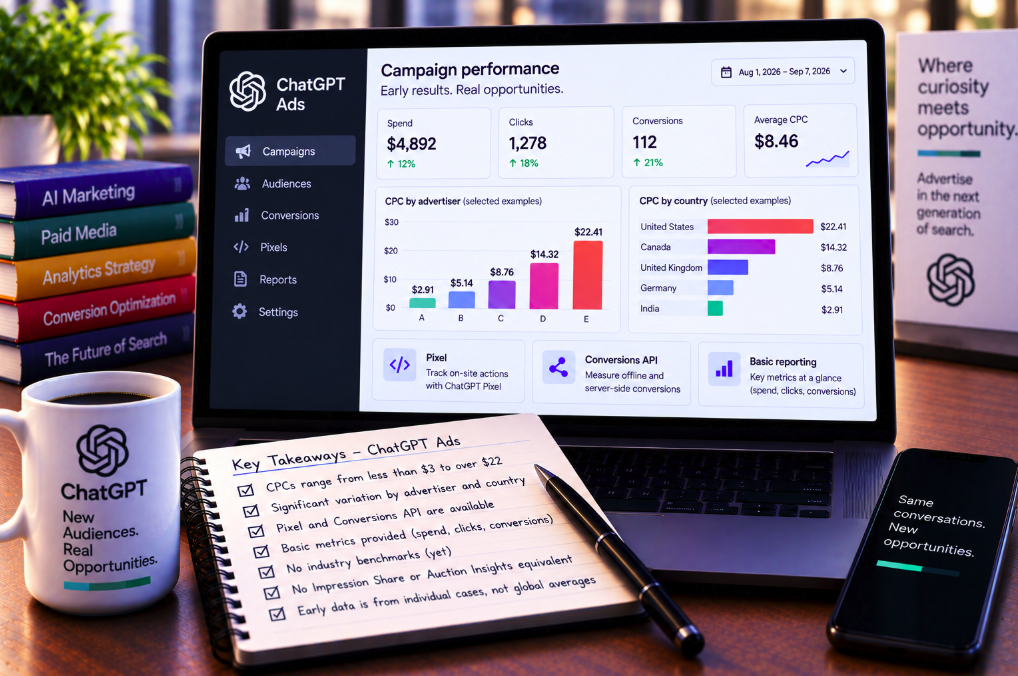
Six months into ChatGPT Ads, marketers finally have enough public campaign data to see that advertising inside an AI conversation can produce real traffic, leads and sales. What they still do not have is a reliable answer to one of paid media's most basic questions: what should a click cost?
Early advertiser results collected by Brooke Osmundson in a September 8 Search Engine Journal analysis range from CPCs below $3 to almost $23. Individual campaigns have reported numbers around $4, $9, $10, $13 and higher, while geography alone has produced large differences inside the same advertiser test.
The range is striking, but it is not a ChatGPT Ads benchmark. These are individual cases with different advertisers, markets, offers, targeting conditions, bids and conversion economics. OpenAI itself says it does not yet have performance benchmarks across advertisers, industries or campaign types.
That absence of context is becoming the bigger story. ChatGPT Ads now has a Pixel, Conversions API, conversion optimization and the basic reporting metrics advertisers expect, but it still does not offer the kind of competitive visibility Google Ads marketers associate with Impression Share or Auction Insights. Advertisers can see what they paid. They have much less information about why they paid it.
Public ChatGPT Ads CPCs now span a very wide range
Search Engine Journal reviewed several advertisers that have publicly discussed their early results. Some reported CPCs below $3, while others landed around $10 or $13. One country-level example went beyond $22.
That variation makes it dangerous to summarize ChatGPT Ads with a single cost-per-click number. The platform is still young, inventory is evolving and campaigns can differ dramatically in objective, audience, geography and relevance.
The useful conclusion is not that ChatGPT traffic costs $3 or $22. It is that the market currently produces both outcomes, and advertisers do not yet have enough platform-level context to know where their own result should sit.
One test ranged from $5.10 in the UK to $22.89 in New Zealand
Synter's published test provides one of the clearest examples of geographic variation. Across $4,428.84 in spend, the campaign averaged a $9.89 CPC overall.
At country level, however, Search Engine Journal reports a $5.10 CPC in the United Kingdom and $10.62 in the United States. Australia reached $17.59, while New Zealand reached $22.89. The latter markets had considerably less volume, an important qualification because small samples can produce volatile averages.
Even so, the spread illustrates why a global average can hide the economics advertisers actually encounter in individual markets.
Other advertisers are seeing very different economics
Common Thread Collective shared results from a high-average-order-value ecommerce advertiser that scaled from a small daily budget to more than $1,000 per day. After $9,620 in spend, the campaign averaged a $4.41 CPC and a 0.94% CTR across 136,000 weekly impressions.
The team reported attributed revenue between $19,000 and $38,000 depending on the attribution model, producing estimated ROAS between 3.3x and 6.8x. It used Triple Whale alongside ChatGPT Ads reporting to evaluate downstream performance.
Another B2B test cited by Search Engine Journal spent roughly CAD $7,000 and averaged a $9.29 CPC, $64.34 CPM and 0.7% CTR. External visitor analysis identified 146 organizations behind 336 paid clicks, but only five matched the advertiser's ideal customer profile.
That example shows why CPC alone can be misleading. A $9 click can be attractive if it consistently reaches qualified buyers and expensive if the resulting traffic rarely fits the business.
Hostinger has tested at a much larger scale
Hostinger represents one of the larger publicly discussed ChatGPT Ads experiments. Search Engine Journal says the company had spent nearly $70,000 testing the platform.
Its early assessment was encouraging: CPCs were not higher than Google Search, purchases were occurring and engagement appeared strong. As spend increased, the picture became more nuanced. CPMs reportedly exceeded $65, CTR became a larger concern and more specific use cases performed better than broad messaging.
The lesson is familiar to experienced performance marketers. A promising initial CPC does not automatically translate into scalable return on ad spend.
OpenAI's $3–$5 figure is not an average CPC
One number is especially easy to misinterpret. OpenAI's official ChatGPT Ads guidance recommends that CPC advertisers begin with a maximum bid of roughly $3–$5 per click.
That is a starting bid recommendation, not a published market benchmark.
A maximum bid tells the auction how much an advertiser is willing to pay. It does not describe what advertisers across the platform actually pay, nor does it establish what a particular industry should consider efficient.
Repeatedly calling $3–$5 a “ChatGPT Ads CPC” risks turning a configuration recommendation into a statistic OpenAI has never published.
OpenAI says there are no cross-advertiser benchmarks yet
This is the central limitation for anyone trying to interpret early performance.
OpenAI has not published benchmarks by advertiser, industry or campaign type. A SaaS marketer cannot open a benchmark report and determine whether a $9 CPC is unusually high for B2B software. An ecommerce advertiser cannot compare its CTR with a platform median for retail.
Without those reference points, performance evaluation has to begin with the advertiser's own economics: conversion rate, cost per acquisition, customer value, margin and incremental revenue.
Ads Manager provides the basic performance metrics
The platform is not devoid of measurement. OpenAI's Ads Manager reporting documentation lists impressions, clicks, spend, CTR, average CPC, average CPM and conversions at campaign, ad-group and ad levels.
Advertisers can therefore answer fundamental delivery questions. They can see how much they spent, how often an ad appeared, how many users clicked and what the average click cost.
For a young advertising product, that is a workable foundation. The problem is that those metrics primarily explain the advertiser's own campaign, not the market around it.
There is no Auction Insights equivalent
Google Ads advertisers are accustomed to competitive diagnostics that help explain auction pressure. ChatGPT Ads currently offers no equivalent to Auction Insights in its public reporting.
That means an advertiser seeing CPC rise cannot directly inspect which competitors became more aggressive, how often they overlapped in the same auctions or whether a particular rival is outranking them.
The absence is particularly noticeable because ChatGPT Ads uses an auction. Marketers see the outcome of competition without seeing much of the competition itself.
There is no Impression Share metric either
Impression Share is another familiar diagnostic that is currently missing.
Without it, an advertiser cannot easily determine what percentage of eligible opportunity it captured or how much potential delivery it lost because of rank, budget or other auction conditions.
A campaign with low impressions could be constrained by bid competitiveness, limited relevance, narrow eligible inventory, budget or some combination of those factors. The current reporting gives advertisers fewer tools for separating them.
ChatGPT Ads uses a relevance-weighted second-price auction
OpenAI says eligible ads compete in a relevance-weighted second-price auction.
That means the highest maximum bid is not the only factor determining which ad appears. The system also considers relevance, with conversational context and intent playing an important role in matching.
This is strategically attractive because a highly relevant advertiser can potentially reach a user at a moment of explicit need. It also makes CPC harder to diagnose when the platform exposes limited auction-level information.
Context hints are not keywords
ChatGPT Ads does not simply reproduce the traditional paid-search keyword model. Advertisers can provide context hints describing products, needs or situations relevant to an ad group, but OpenAI does not present those hints as guaranteed keyword targeting.
The platform can match ads based on the meaning and context of a conversation rather than a literal phrase.
That gives the system flexibility to find relevant demand, but it also reduces the advertiser's ability to trace every impression back to a familiar keyword auction.
A rising CPC can have several explanations
Suppose an advertiser's average CPC rises from $6 to $10. In a mature search platform, the team might inspect competitive pressure, lost impression share, keyword-level auction data, quality signals and bid changes.
In ChatGPT Ads, the same movement could reflect more competition, a different mix of conversations, changes in relevance, inventory scarcity, geographic shifts, bidding behavior or campaign optimization. Current reporting provides limited visibility into which explanation dominates.
That is why two advertisers can publish radically different CPCs without giving the market a reliable benchmark.
Pixel and Conversions API move measurement beyond clicks
OpenAI has built more serious conversion infrastructure since the initial advertising tests.
Its conversion measurement documentation says advertisers can send conversion events using the OpenAI Pixel, the Conversions API or both. Supported outcomes can include purchases, leads, registrations and other configured events.
OpenAI recommends using Pixel and Conversions API together where appropriate, with matching event IDs to support deduplication.
This matters because the true value of a ChatGPT Ads click depends on what happens after the landing page loads.
OpenAI can also report modeled conversions
OpenAI says reported conversion totals may include modeled conversions where available.
As with other advertising platforms, this means an advertiser's Ads Manager conversion total may not exactly match a third-party analytics platform.
OpenAI lists attribution methods, time zones, consent conditions, browser storage, deduplication and configuration as reasons different systems may report different totals.
Advertisers evaluating early tests should therefore document attribution settings before comparing ChatGPT Ads with Google, Meta or internal analytics.
Measurement partner integrations are expanding
OpenAI also supports integrations with selected measurement partners for conversion tracking, attribution, reporting and optimization across web, app and offline activity.
Its measurement integration documentation requires an active Ads Manager account, Pixel ID, Conversions API key and an appropriate event data source.
This is an important sign of platform maturation. Sophisticated advertisers rarely evaluate a new channel solely through the platform's own attribution view.
Conversion optimization changes how bids should be interpreted
ChatGPT Ads is also moving beyond simple manual CPC buying.
OpenAI now supports conversion-optimized campaigns in which the system adjusts click bids based on predicted conversion probability while billing remains based on valid clicks.
As automated bidding expands, the relationship between an advertiser's nominal bid settings and observed CPC becomes less straightforward.
That makes outcome metrics such as cost per conversion and return on ad spend increasingly important alongside the headline cost per click.
A high CPC is not automatically bad
Performance marketers already know this from Google Ads, but it is worth emphasizing in a new platform where isolated screenshots can become informal benchmarks.
A $20 click that converts into a profitable enterprise contract can be substantially better than a $2 click that never produces qualified demand.
The relevant question is not whether a CPC looks expensive compared with another advertiser's social post. It is whether the campaign generates incremental business value at an acceptable acquisition cost.
That evaluation requires conversion quality, not just click price.
A low CPC is not automatically good
The reverse is equally important.
Cheap traffic can look attractive while hiding weak intent, poor audience fit or low downstream conversion rates. The B2B example in Search Engine Journal is instructive because external analysis suggested that only a small fraction of identifiable organizations matched the advertiser's ideal customer profile.
A campaign can therefore win inexpensive or moderately priced clicks while failing the business test.
Country-level reporting deserves close attention
The Synter example shows that geography can materially change observed CPC.
Advertisers running multinational campaigns should resist combining every market into one blended average and assuming the number represents local economics.
Separating CPC, CTR, conversion rate, CPA and conversion value by country can reveal whether a high blended cost is concentrated in a small-volume market or reflects a broader problem.
This is especially important while ChatGPT Ads inventory and advertiser density vary across regions.
ChatGPT Ads has expanded rapidly across Europe
OpenAI's August 2026 European expansion announcement says ChatGPT Ads reached 31 European markets and that tens of thousands of marketers had already advertised on the platform.
The company also highlighted conversion optimization, geo-targeting, custom audiences, Pixel, Conversions API and third-party measurement integrations as capabilities added during the first six months.
That growth should gradually produce richer market data, but expansion can also increase short-term variability as new countries, advertisers and auction conditions enter the system.
Advertisers should build their own benchmarks now
Until OpenAI publishes broader norms, the most defensible benchmark is an advertiser's own history.
Teams should record performance by market, campaign objective, ad group, creative theme, landing page and conversion type. They should also separate test phases from scaled campaigns because early low-volume performance can change substantially as spend increases.
Over time, those internal distributions become more useful than comparing a campaign with an unrelated advertiser's public CPC.
Measure qualified outcomes, not just platform conversions
For lead-generation businesses, a reported conversion should be only the beginning of measurement.
Teams should connect ChatGPT Ads leads to CRM stages such as qualified lead, opportunity, pipeline and closed revenue. Ecommerce advertisers should compare attributed sales with contribution margin, repeat purchase and incrementality where possible.
This is particularly important in a channel where advertisers still have limited insight into exactly which conversational contexts produced each auction opportunity.
Use UTMs and independent analytics
OpenAI supports static tracking parameters in landing-page URLs, allowing advertisers to analyze ChatGPT Ads traffic in their existing analytics systems.
That should be standard practice during the platform's early stage.
Ads Manager explains platform delivery; independent analytics can help validate sessions, engagement, landing-page behavior and downstream outcomes. CRM or ecommerce data can then close the loop on customer quality and revenue.
No single reporting interface should carry the entire burden of proving performance.
Do not turn public case studies into industry averages
The emerging ChatGPT Ads community needs the same statistical discipline applied to any young channel.
A $4.41 CPC from one ecommerce advertiser is not an ecommerce benchmark. A $22.89 CPC in a low-volume New Zealand test is not the expected cost of ChatGPT Ads in New Zealand. A campaign below $3 does not prove clicks are generally cheaper than paid search.
These cases establish a range of observed outcomes, not a representative distribution of the platform.
The missing context is now more important than the missing features
ChatGPT Ads has already solved many foundational problems. Advertisers can launch campaigns, bid for clicks, track conversions, export data and connect measurement infrastructure.
What remains immature is comparative intelligence.
Without industry benchmarks, Impression Share or an Auction Insights-style view, marketers can measure their own results but struggle to understand the market forces behind them.
That is the gap OpenAI will eventually need to close if ChatGPT Ads is to become a mature performance channel rather than a platform where every advertiser builds context from scratch.
The $3-to-$22 spread is a warning against simplistic benchmarks
The first six months of public ChatGPT Ads data have produced CPCs from below $3 to more than $22, along with campaigns that generated purchases, leads and meaningful attributed revenue. They have also produced traffic-quality concerns and widely different outcomes across countries.
OpenAI's own $3–$5 figure is only a recommended starting maximum CPC bid, not an average. The company explicitly says it does not yet have performance benchmarks across advertisers, industries or campaign types.
For now, advertisers can see impressions, clicks, spend, CTR, CPC, CPM and conversions, and they can improve measurement with Pixel, Conversions API and external analytics. What they cannot see is the competitive context that explains why one click costs $4 and another costs $20.
That makes ChatGPT Ads simultaneously measurable and opaque. The platform can tell marketers what happened inside their campaign. Six months in, it still cannot tell them whether what happened was normal.