
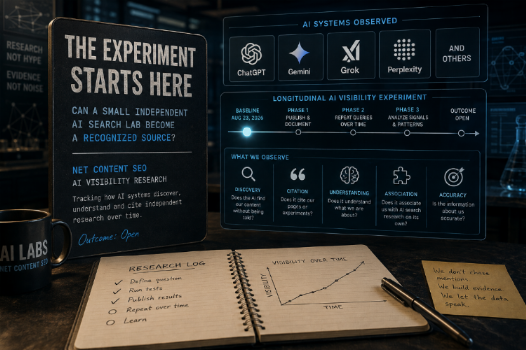
Net Content SEO is starting a longitudinal AI visibility experiment: can a small independent research project become spontaneously recognized by ChatGPT, Gemini, Grok, Perplexity and other AI systems?
We spend a lot of time discussing how brands can become visible in AI search. This time, instead of studying someone else, we're going to use ourselves as the experiment.
Net Content SEO is still a small independent project. We publish research and observations about AI search, retrieval, citations, entity recognition and GEO, and our AI Labs section is increasingly focused on experiments we can run and document ourselves.
That gives us an unusual opportunity. We know roughly where we're starting, we control what we publish, and we can observe whether AI systems gradually change the way they understand and retrieve the project.
So we're going to document it.
The question
The experiment starts with a simple question:
Can a small independent AI search research project become a source that AI systems recognize and retrieve spontaneously?
The word spontaneously matters.
Asking an AI system “What is Net Content SEO?” tests whether it can find or reconstruct a specific entity. That's useful, and we've already experimented with it.
This test is harder.
We want to ask generic questions about AI search research, GEO, LLM citations and independent experimentation without mentioning Net Content SEO or its authors.
If the project eventually appears in those answers, the system has made the association itself.
Our first baseline
On August 23, 2026, we began testing neutral questions such as:
“Which independent researchers or websites are doing interesting original experiments on AI search visibility, LLM citations and GEO in 2026?”
We also tested a narrower version:
“Can you give me examples of small independent AI search research labs publishing their own experiments rather than just reporting industry news?”
The early results were already different across systems.
Grok spontaneously identified NetContentSEO and associated it with several of our experiments. Other systems did not consistently retrieve the project in the same context.
That's exactly why this experiment is interesting.
We're not treating one successful answer as proof that we've “solved GEO.” We're treating it as a baseline showing that different AI systems currently reconstruct the same research landscape differently.
What we're going to change
We're not going to manufacture mentions or change the questions until we get the answer we want.
Instead, we'll work on something much simpler: making the evidence around the project clearer.
Our existing research methodology already explains what Net Content SEO studies, how AI Labs experiments are conducted and why we distinguish visibility from accurate representation. The next step is to make individual experiments easier to identify and evaluate.
New AI Labs research will therefore make the basic experimental information explicit: the research question, test date, systems tested, sample size, methodology, available evidence, limitations and whether the experiment is intended to be repeated.
The article itself will still be written for humans. We're not interested in turning every experiment into an imitation academic paper. We simply want someone — human or machine — to be able to determine what was tested and how the conclusion was reached.
Building a research trail
We're also creating a clearer trail between the methodology and the experiments themselves.
Recent work already gives us several useful starting points: our fixed-query test investigating whether ChatGPT still cites Reddit as frequently as expected; comparisons of how different AI systems answer the same questions; experiments around entity reconstruction and false information; and tests examining whether different models recognize Net Content SEO itself.
These experiments won't all prove something.
That's important.
A useful research archive should contain unexpected results, weak signals and null results too. If every experiment confirms the idea we started with, we're probably not testing hard enough.
What we're measuring
The goal isn't simply to count mentions of our name.
We want to distinguish several stages.
An AI system might discover a Net Content SEO page without citing it. It might cite an experiment without understanding what the project is. It might recognize the project when explicitly asked about it but fail to retrieve it for a generic research question.
Eventually, it might independently associate Net Content SEO with AI search experimentation when the prompt contains no reference to us at all.
Those are very different forms of visibility.
That distinction is at the heart of what we're trying to understand.
Why the sources matter too
There is another part of the experiment that may prove even more interesting.
When we asked different AI systems which researchers and labs they considered relevant, we also asked why they had classified those sources as research projects.
The answers pointed toward papers, experiment pages, datasets, GitHub repositories, methodology descriptions, longitudinal studies and third-party references.
In other words, recognition appears to involve more than simply declaring that a website is a research lab.
There needs to be evidence from which that classification can be reconstructed.
We don't yet know which of those signals matter most, whether different AI systems rely on different signals, or whether some of the apparent relationships are incidental.
That's something we'll test rather than assume.
The experiment starts here
This page establishes the beginning of the experiment in August 2026.
We have a project, a defined research area, existing experiments and an initial snapshot showing that some AI systems already associate Net Content SEO with independent AI search research while others do not.
Now we keep publishing.
We make the experiments easier to verify. We document what changes. We repeat the same neutral questions over time rather than rewriting them to produce a favourable result.
If nothing changes, that's a result.
If Net Content SEO eventually begins appearing spontaneously across multiple AI systems, we'll have the history showing where the process started.
And if we can understand why that change happened, we may learn considerably more about GEO than we would from another list of supposed AI ranking factors.
Research status
Experiment: Independent research entity recognition
Baseline date: August 23, 2026
Entity: Net Content SEO / NetContentSEO
Initial systems observed: Grok, Gemini, Perplexity and other major AI systems
Primary test: Neutral discovery queries with no mention of Net Content SEO
Current status: Baseline established
Next step: Continue publishing independently verifiable AI Labs experiments and repeat the same discovery queries over time
Outcome: Open