
ChatGPT advertising is starting to look less like an experimental media buy and more like another line item inside the software marketers already use to run Google, Meta and programmatic campaigns.
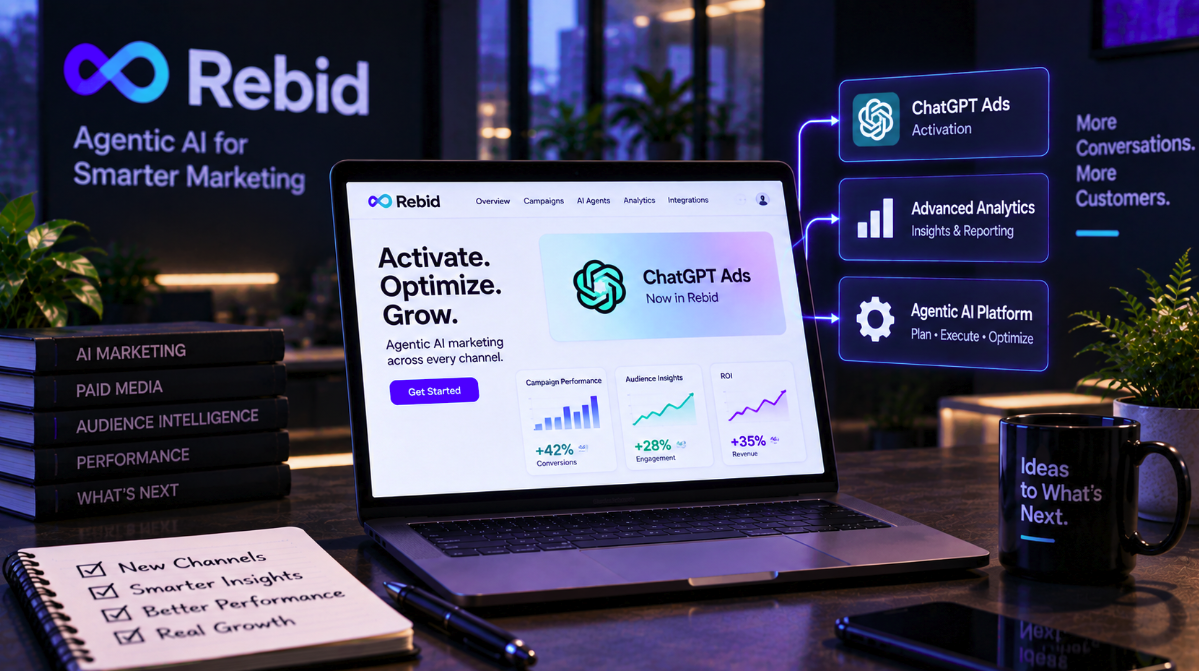
ReBid, an agentic AI marketing technology company, has added ChatGPT Ads activation and analytics to its platform, according to a September 7 announcement reported by Adgully. The integration is designed to let marketers activate, manage, measure and analyze ChatGPT campaigns in the same environment they use for channels including Google, Meta, LinkedIn, X, Snapchat and DV360.
The significance is not that another adtech company has added another integration. It is that ChatGPT is moving into the ordinary operational layer of paid media: budgets, campaign management, analytics, cross-channel reporting and optimization. Once an emerging platform reaches that layer, advertisers no longer have to treat it as an isolated innovation experiment.
ReBid is positioning ChatGPT Ads as part of a continuous Plan → Activate → Analyse → Optimize workflow. That framing says something about where AI advertising is heading. The question for marketers is shifting from “Should we test ads in an AI chatbot?” toward “How does this channel perform against everything else we already buy?”
ReBid wants ChatGPT inside the same operating system as Google and Meta
ReBid describes its platform as a unified environment for marketing data, media activation and AI-led decision support. Its existing Advertising Data Platform documentation says the system connects more than 15 media integrations alongside CRMs, mobile measurement platforms, data-management systems, customer-data platforms and data lakes.
Adding ChatGPT Ads extends that model into conversational advertising. Instead of forcing a media team to monitor ChatGPT in a separate reporting workflow, ReBid says campaign signals can be considered alongside the rest of the advertiser’s media and customer data.
That is potentially more consequential than simple campaign creation. New advertising channels often create another measurement silo. The platform reports its own clicks and conversions, the analytics system reports another number, and the CRM may show something different again. ReBid’s pitch is that its agentic AI layer can connect those signals and help marketers interpret the contribution of each channel to broader outcomes.
As with any vendor announcement, that is a product proposition rather than independently verified proof of incremental performance. ReBid has not published campaign results in the Adgully announcement showing that its ChatGPT integration improves return on ad spend.
OpenAI has been deliberately building a partner ecosystem
ReBid’s move fits a broader expansion of the ChatGPT advertising infrastructure rather than happening in isolation.
In May, OpenAI announced new ways for businesses to buy ChatGPT Ads, including CPC bidding, expanded measurement and a beta self-service Ads Manager. OpenAI also named major agency partners and technology partners that could help advertisers work with the channel through existing tools and processes.
That partner model is important because large advertisers rarely manage every media platform as a completely separate operation. Agencies and marketing technology platforms provide the connective tissue between buying systems, creative workflows, budgets, customer data and measurement.
OpenAI’s documentation is also explicit about the boundary: partners can support budgeting, bidding, creative and campaign processes, but OpenAI’s own ads system controls delivery decisions.
ReBid is therefore not becoming an independent auction system for ChatGPT inventory. It is becoming another interface and intelligence layer through which marketers can incorporate that inventory into a broader media operation.
ChatGPT Ads has moved quickly beyond a small pilot
The timing matters. On August 31, OpenAI said ChatGPT Ads had reached a $1 billion annualized revenue run rate less than 200 days after launch.
The company said tens of thousands of advertisers were already using the platform and that ChatGPT serves more than one billion weekly active users. It also expanded direct Ads Manager purchasing across India, Europe, the Middle East and North Africa.
A $1 billion annualized run rate measures current revenue pace, not a full year of recognized advertising revenue, and it says nothing by itself about advertiser profitability. But it does show that ChatGPT advertising has crossed beyond the scale of a limited proof of concept.
For marketing software companies, that creates an obvious integration incentive. A channel with growing advertiser adoption and international self-service access becomes increasingly difficult to leave outside a supposedly unified media platform.
The emerging opportunity is contextual rather than keyword-identical
ChatGPT creates a different advertising environment from a conventional search results page. Users often describe goals, constraints and preferences in natural language over multiple turns rather than entering a short query and scanning a list of links.
That gives the advertising system a potentially rich understanding of the immediate task while also creating unusual privacy requirements.
OpenAI has repeatedly said ads are separate from ChatGPT’s answers and do not influence the assistant’s response. It also says advertisers do not receive users’ private conversations or personal details through the advertising system.
For marketers, the opportunity is therefore not access to private chat transcripts. It is the ability to reach users inside a high-intent decision environment through the targeting and delivery mechanisms OpenAI makes available.
ReBid’s integration is designed to make that environment comparable with the other channels already competing for the same media budget.
Cross-channel analytics may be more valuable than activation
Campaign activation is becoming easier as OpenAI expands Ads Manager and partner access. Measurement is the harder long-term problem.
A consumer might encounter a brand while asking ChatGPT for help choosing a product, later search for the company on Google, visit through a direct URL and convert after seeing a Meta retargeting ad. Every platform involved can potentially claim some influence.
That is exactly the type of fragmented journey that unified marketing platforms have spent years trying to reconcile across search, social, display and CRM data.
ChatGPT adds another interaction surface to that attribution problem. The more meaningful ReBid proposition is therefore not simply “launch a ChatGPT campaign from our dashboard.” It is “include ChatGPT in the same measurement model as the rest of the customer journey.”
Agentic AI is being applied to media operations, not just ad creation
ReBid describes its platform through a “Platform + People + Agentic AI” model. The agentic layer is intended to combine campaign data, performance signals and cross-channel intelligence to support faster decisions.
This reflects a broader change in marketing AI. The first wave of generative tools focused heavily on producing ad copy, images and variations. The next wave is increasingly aimed at operational work: analyzing performance, allocating budgets, identifying anomalies and recommending or executing optimization actions across multiple systems.
In that context, adding ChatGPT Ads is not merely ironic—using AI to optimize advertising inside an AI product. It expands the number of environments an automated marketing system has to reason about.
The quality of that automation will depend on the quality and comparability of the data feeding it. Agentic optimization cannot solve attribution simply by adding another layer of AI if the underlying channel signals measure different things.
Advertisers still need to separate platform metrics from business outcomes
ReBid’s own messaging around marketing measurement has emphasized the familiar problem that Google, Meta, analytics platforms, mobile measurement tools and CRMs can all report different conversion totals for the same campaign period.
ChatGPT will not eliminate that problem. It becomes another source of platform-reported performance that marketers need to reconcile with independent analytics and first-party business data.
That makes incrementality increasingly important. A campaign can generate attributed conversions without necessarily creating the same number of additional conversions that would not have happened otherwise.
As ChatGPT Ads matures, sophisticated advertisers will want to know not only its click-through rate or platform-attributed conversions but whether spending there creates incremental customers, revenue or profit compared with allocating the same budget elsewhere.
AI advertising is becoming distinct from organic AI visibility
The growth of ChatGPT Ads also creates a clearer separation between two emerging marketing disciplines that are sometimes conflated.
Organic AI visibility is about whether a brand, product or source appears in the assistant’s answer because the system considers it relevant to the user’s question. Paid AI advertising is a separate sponsored placement purchased through the advertising system.
OpenAI says the two remain separate. Advertising does not buy influence over the answer itself.
That distinction matters strategically. Brands may need both an organic AI-search program focused on citations, product information and source visibility, and a paid program focused on sponsored reach. Success in one does not guarantee success in the other.
ReBid’s new capability addresses the paid side of that equation.
The channel is now large enough to enter normal media planning
When a new advertising product first launches, experimentation can be managed by an innovation team with a small discretionary budget. The channel becomes operationally different once it can be bought through self-service tools, agency partners and third-party marketing platforms.
That is the stage ChatGPT Ads is entering.
OpenAI is expanding geographic availability and measurement while technology vendors are integrating the inventory into cross-channel systems. Advertisers can increasingly evaluate ChatGPT alongside search, social and programmatic media rather than treating it as a disconnected pilot.
This does not mean it deserves budget automatically. A new channel must still demonstrate that it can reach the right users at an acceptable cost and produce incremental business value.
But integration lowers the operational cost of finding out.
ReBid’s announcement is a sign of normalization
The most important part of ReBid’s ChatGPT Ads integration may be how ordinary it makes the channel sound.
Campaign activation. Management. Analytics. Insights. Cross-channel optimization. Those are not futuristic concepts. They are the standard components marketers expect from any mature paid-media ecosystem.
Less than a year after ChatGPT advertising began rolling out, OpenAI says the business has reached a $1 billion annualized run rate and tens of thousands of advertisers. Now platforms such as ReBid are placing it next to Google, Meta, LinkedIn, X, Snapchat and DV360 inside the same operating workflow.
That is how an experimental ad product becomes infrastructure. ChatGPT Ads does not have to replace search or social advertising to matter. It only has to become another measurable place where consumer decisions happen—and another channel marketers can activate without rebuilding their entire stack.