
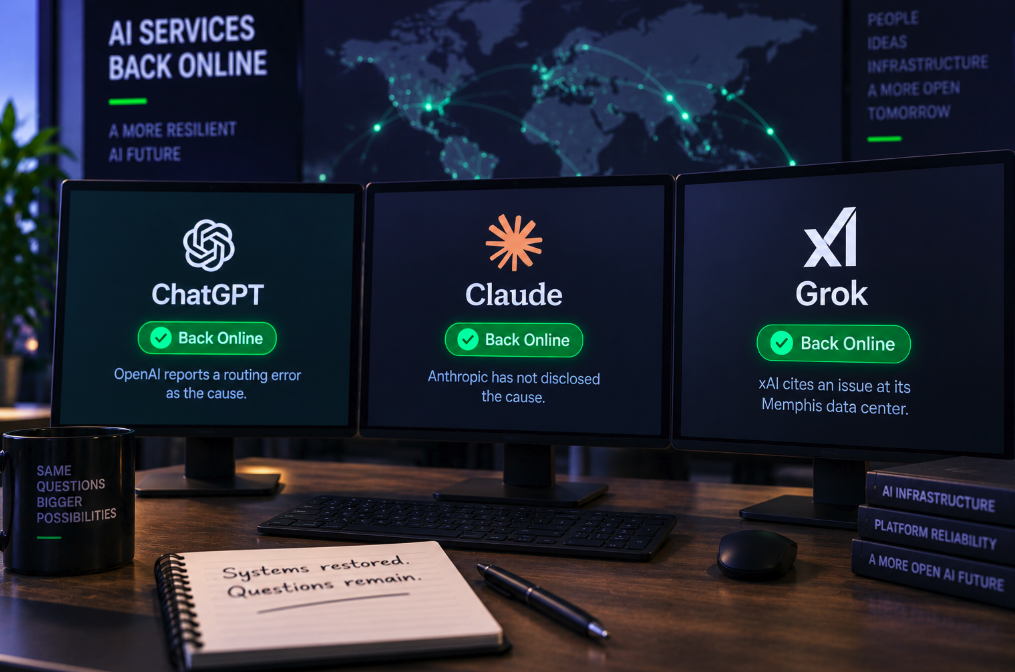
ChatGPT, Claude and Grok are operational again after an unusual morning in which three major AI services suffered outages at almost the same time. The recovery answers the immediate question for users who could not reach the systems on September 3. It does not answer the more interesting infrastructure question: why did three competing AI platforms fail within such a narrow window?
The evidence available so far does not establish a common cause. WIRED reported that OpenAI attributed its disruption to a routing error, while SpaceX said xAI's Grok problems came from an outage at its Memphis compute center. Anthropic said internally that it had identified the cause of its Claude incident and deployed a fix, but declined to tell WIRED what that cause was.
That leaves a coincidence that is operationally important but still unexplained. The outages overlapped enough to make a shared dependency an obvious hypothesis. At the same time, the explanations disclosed by the companies do not provide evidence that ChatGPT, Claude and Grok went down because of the same failure.
OpenAI says a routing error disrupted ChatGPT and Codex
OpenAI spokesperson Kathleen Chaykowski told WIRED that a routing error began around 7:43 a.m. Pacific time on September 3 and made ChatGPT and Codex unavailable for some users across platforms. The company said a solution was successfully implemented at roughly 8:17 a.m. and continued to be monitored afterward.
OpenAI's status service now shows its systems operational. Its public incident history also records elevated errors affecting ChatGPT and Codex on September 3, with mitigation applied and the incident subsequently resolved.
A routing error can occur at several layers of a distributed service, from traffic management to internal service discovery, so the description alone does not identify a particular vendor or physical facility. Most importantly, OpenAI did not tell WIRED that an external provider caused the incident.
Grok's outage came from xAI's Memphis compute center
xAI provided a more geographically specific explanation. SpaceX, xAI's parent company, said the Grok disruption resulted from an outage at its Memphis compute center that morning. xAI's status pages recorded problems across Grok's web, mobile, X and API surfaces beginning around 1:30 p.m. UTC, or 6:30 a.m. Pacific time.
The company's Grok status page now reports the web service as fully operational and lists the September 3 event as resolved after roughly three and a half hours. API status records similarly say traffic became healthy again shortly after 5 p.m. UTC.
SpaceX also apologized to impacted compute partners in its public comments, according to WIRED. That wording attracts attention because SpaceX and Anthropic announced a compute partnership earlier this year. It is not, however, proof that Anthropic's outage originated from the same Memphis failure.
Anthropic fixed Claude but has not publicly explained the cause
Anthropic began reporting a partial outage around 6:23 a.m. Pacific time, according to WIRED. Elevated errors affected several Claude model variants. The company subsequently said it had identified the cause and deployed a fix, marking the main incident resolved by 9:16 a.m. Pacific time.
What is missing is the technical explanation. Anthropic declined to comment to WIRED about the episode, leaving the public without enough information to compare its root cause with OpenAI's routing failure or xAI's Memphis infrastructure problem.
This distinction matters. “Cause identified” on a status page means the operator believes it understands its own incident. It does not mean outside observers know what failed, and it certainly does not establish that the failure was connected to another company's outage.
The timing made a common dependency a reasonable hypothesis
When independent services fail within minutes of one another, engineers naturally look for shared infrastructure. Modern AI products depend on layers of services that users rarely see: data centers, cloud providers, network transit, DNS, content delivery, identity systems, storage, model-serving clusters and third-party compute capacity.
A failure in one sufficiently central dependency can make apparently unrelated applications disappear at the same time. The internet has repeatedly seen this pattern when a major cloud or network provider experiences an incident.
That is why the near-simultaneous failures of ChatGPT, Claude and Grok immediately raised questions about a shared provider. The hypothesis was worth investigating. It should not be promoted to a conclusion simply because the timestamps look suspicious.
No major shared infrastructure outage has been identified
WIRED noted that major internet infrastructure providers including Cloudflare, Amazon Web Services and Microsoft Azure did not report corresponding outages that would obviously explain all three AI disruptions. OpenAI and Anthropic also did not cite an external shared provider in their comments.
That weakens the simplest common-cause theory. If a large cloud region or internet backbone had failed broadly enough to take down three frontier AI services, other customers would often be expected to report related problems. No such explanation has emerged publicly.
There can still be dependencies that are not visible on public status pages, and companies do not disclose every detail of their infrastructure. The correct conclusion is therefore narrower: no evidence currently available establishes a common technical failure behind the three incidents.
The Anthropic-SpaceX relationship creates a clue, not proof
The most intriguing overlap is the compute partnership announced between Anthropic and xAI parent SpaceX in May. Since SpaceX says the Grok outage originated at its Memphis compute center, it is reasonable to ask whether Anthropic workloads were also affected by SpaceX infrastructure.
But asking the question is different from answering it. Anthropic has not attributed its outage to SpaceX or Memphis. SpaceX's apology to impacted compute partners does not identify which partners were affected or whether their public services experienced consequences.
Without that missing link, claiming that the Claude and Grok outages shared a root cause would be speculation. The partnership is relevant context because it shows a possible infrastructure relationship. It is not evidence that the relationship caused the September 3 Claude disruption.
Simultaneous outages expose the hidden concentration behind AI services
Even if the incidents ultimately prove unrelated, their timing highlights an important structural issue. Frontier AI products look highly differentiated at the interface layer, but the infrastructure underneath them is more concentrated than the branding suggests.
Companies may compete on models while relying on overlapping suppliers for GPUs, networking, data-center capacity, cloud infrastructure and energy. A user can diversify between ChatGPT, Claude and Grok at the application level while still being indirectly exposed to common infrastructure dependencies.
This is not unique to AI. The modern web is built on concentrated cloud and network layers. What makes generative AI notable is the extreme compute intensity of the services and the speed with which demand has forced providers into large infrastructure partnerships.
AI reliability is becoming an enterprise procurement issue
For casual users, a few hours of chatbot downtime is an inconvenience. For organizations embedding AI into customer support, software development, research, document processing or autonomous workflows, availability is becoming a business-continuity question.
An agent that participates in a multi-step process can create a larger failure surface than a standalone chatbot. If one model call is unavailable, the entire workflow may stop. If the agent controls downstream tools, retries and partial completion also need careful handling.
Enterprise buyers therefore need to evaluate AI services with the same reliability questions applied to other critical infrastructure: service-level commitments, regional redundancy, fallback models, incident communication, retry behavior and the ability to continue operating when a preferred provider is unavailable.
Multi-model systems only create resilience if their dependencies are genuinely independent
One response to AI outages is to route tasks across several model providers. If OpenAI is unavailable, an application can send work to Anthropic or xAI. This is increasingly practical as orchestration platforms abstract the differences between model APIs.
But provider diversity does not automatically equal infrastructure diversity. Two AI companies may use different APIs while sharing a cloud provider, compute partner, networking vendor or data-center operator. A failover architecture can look redundant on a diagram while retaining a hidden single point of failure underneath.
The September 3 coincidence is a useful stress test for that assumption. Organizations using multiple frontier-model vendors should understand not only which models they depend on, but also what they can learn about the infrastructure concentration beneath those vendors.
Status pages are useful but incomplete observability
The incident also shows the limits of public status dashboards. Status pages are designed to tell customers whether a service is impaired and when it recovers. They do not always provide a detailed root-cause analysis, and updates can lag the symptoms users observe.
OpenAI disclosed a routing error to WIRED. xAI ultimately pointed to Memphis. Anthropic publicly acknowledged and resolved its outage without disclosing the underlying cause. Those are three different levels of transparency for incidents that users experienced at almost the same time.
For businesses, independent monitoring remains important. Synthetic requests, API error tracking and application-level observability can reveal whether a provider is failing before a status page confirms the problem. They also preserve an organization's own record of exactly which workflows were affected.
Recovery time matters as much as outage cause
The three providers recovered on different schedules. OpenAI said its solution was implemented roughly half an hour after the routing issue began. Anthropic's main incident lasted several hours from its initial alert to resolution. xAI's status records show Grok's disruption continuing for roughly three and a half hours.
Those durations affect users differently depending on workload. A short interruption may be absorbed through retries. A multi-hour outage can cross business hours, block production systems and require manual fallback procedures.
Reliability measurement should therefore look beyond a provider's annual uptime percentage. Time to detection, time to mitigation, communication quality and the blast radius across products can be equally important when AI is embedded in operational systems.
The lack of a shared cause is itself an important conclusion
Technology reporting often faces pressure to turn coincidence into a unified narrative. Three major AI systems failing together naturally invites a story about one hidden infrastructure dependency taking down the frontier-model industry.
The evidence currently supports a more cautious account. OpenAI says routing error. SpaceX says Memphis compute-center outage for Grok. Anthropic has not disclosed its root cause. No major shared cloud or internet provider has been identified as the source of all three.
It remains possible that future disclosures will reveal a connection. It is equally possible that the incidents were simply separate failures occurring during an unusually concentrated window. Until there is technical evidence linking them, the simultaneous timing should remain an observation rather than a causal claim.
The services are back, but the resilience question remains
The immediate crisis is over. ChatGPT, Claude and Grok have recovered, and their status systems show the affected services back in operation. Users can return to the products that were unavailable on September 3.
The more durable lesson is that AI platforms are becoming infrastructure while their own infrastructure remains largely invisible to customers. Businesses increasingly depend on these systems for work that cannot simply wait for a chatbot to come back online, yet the public often receives only limited information about the layers on which that availability depends.
September 3 did not prove that the frontier AI industry has one shared point of failure. It did demonstrate how quickly that question becomes relevant when multiple providers disappear together. The outages are resolved; the mystery of their timing is not. Until Anthropic or another participant supplies new evidence, the most accurate conclusion is also the least dramatic one: three major AI services failed at nearly the same time, recovered, and there is still no proof that the failures were connected.