
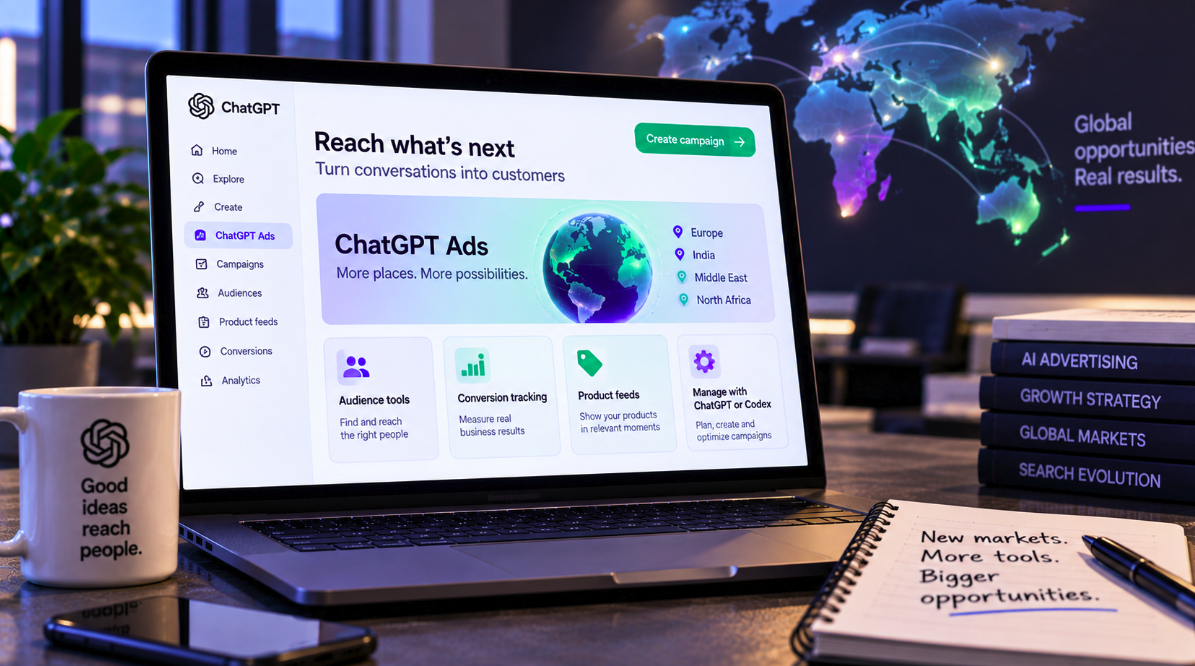
ChatGPT’s advertising business is starting to look less like an experimental placement and more like a full performance-marketing platform. OpenAI is expanding self-service access across Europe, India, the Middle East and North Africa while adding the infrastructure advertisers normally expect before they move serious budget: audience management, conversion matching, product feeds, granular reporting, automated optimization and campaign workflows that can be operated from ChatGPT or Codex.
The latest changes, reported by Search Engine Land on September 4, matter because the battle for advertising budgets is rarely won by a novel ad format alone. Large search and commerce platforms became indispensable to marketers by building systems around the ad—targeting, attribution, bidding, catalogs, reporting, APIs and workflow automation. ChatGPT is now assembling many of those same layers.
That does not make ChatGPT Ads a direct substitute for Google Ads today. But it makes the comparison increasingly relevant. OpenAI is building the machinery required to turn conversational intent into a measurable media channel, which puts it in a stronger position to compete for budgets that historically flowed toward paid search, shopping and performance social.
The geographic expansion turns ChatGPT Ads into a global media question
OpenAI’s expansion has accelerated quickly. In an August 31 company update, OpenAI said ChatGPT Ads had reached a $1 billion annualized revenue run rate less than 200 days after launch and was being used by tens of thousands of advertisers. The company said the advertising platform was available in more than 40 countries through its Ads Solutions team, agencies and technology partners.
More importantly for scale, self-service Ads Manager access expanded across India, Europe, the Middle East and North Africa. OpenAI had already announced 31 European markets, including Germany, France, Spain, Italy, Sweden, Norway, Denmark, the Netherlands and Austria.
That changes the planning conversation for international advertisers. A channel that can only be bought through a limited pilot is difficult to incorporate into ordinary media operations. A self-service platform available across major markets can begin competing for recurring test budgets, regional campaigns and eventually always-on spend.
Audience tools are becoming more like mature ad-tech infrastructure
Search Engine Land reports that OpenAI is expanding how advertisers build and maintain custom audiences. Advertisers can add, remove or replace audience members without rebuilding an audience from scratch, combine different identifier types in one request and create audiences containing more than five million members.
OpenAI is also loosening restrictions around exclusion audiences, providing more granular audience-size estimates and supporting Google Advertising ID, or GAID, as an identifier. These are not headline-grabbing consumer features, but they are exactly the kind of operational capabilities large advertisers need.
A media buyer managing millions of customer records does not want to recreate an entire audience every time membership changes. Performance teams also need exclusions to prevent wasted spend on existing customers or other ineligible groups. The more flexible those controls become, the easier it is to integrate ChatGPT into the audience workflows advertisers already use elsewhere.
Conversion measurement is becoming a competitive requirement
Reach alone does not win performance budgets. Advertisers need evidence that exposure contributes to business outcomes. OpenAI has been building that layer through the OpenAI Pixel, Conversions API and third-party measurement integrations.
The September updates expand the customer information that can be used for conversion matching. According to Search Engine Land, the Measurement Pixel now supports additional hashed information such as phone numbers, names, regions and postal codes, while the Conversions API gains additional identifiers and Android GAID support.
The purpose is familiar to anyone who works with modern advertising platforms: improve the platform’s ability to connect an observed conversion back to an advertising interaction. Better matching can make reporting more complete and give optimization systems more conversion data from which to learn.
OpenAI has already described conversion optimization as part of its broader ads platform. In its European expansion announcement, the company said it had moved beyond CPM and CPC bidding to support optimization toward business goals. Search Engine Land reports that OpenAI also plans a conversion-optimization model that considers both click-through and view-through conversions, with campaigns billed by impression while delivery is optimized toward the advertiser’s selected conversion goal.
That moves ChatGPT closer to performance advertising economics
This is where the competitive significance becomes clearer. Paid search is valuable partly because advertisers can connect high-intent queries with measurable actions and then let automated bidding systems allocate spend toward conversions. Performance social has built a similar model around audience signals, creative and conversion optimization.
ChatGPT has a different interaction model, but it can potentially compete around the same business objective. Users often arrive with explicit goals: comparing products, planning purchases, evaluating services, researching destinations or solving practical problems. OpenAI’s advertising challenge is to translate that conversational context into a system advertisers can buy, measure and optimize at scale.
The latest tooling is aimed squarely at that gap. The platform does not need to recreate a traditional keyword auction to compete for search budgets. It needs to prove that it can identify commercially useful moments and generate measurable outcomes efficiently enough that marketers allocate money to it.
Product feeds give retail advertisers a scalable route into ChatGPT
Catalog advertising is another important piece of the stack. OpenAI’s official product-feed documentation says retailers can upload feeds into Ads Manager and create campaigns from their catalogs at scale. Product details, availability and metadata can remain current while ads connect users with relevant products as they explore, compare and decide.
OpenAI says feed-based advertisers have been among the strongest performers in the program to date. Search Engine Land reports that the company is now giving those advertisers more granular reporting: Ads Manager can show impressions and clicks at the individual carousel-card level, while product-level fields are available through the Insights API.
That level of reporting matters because a product carousel is not one undifferentiated creative. A retailer needs to know which items are being surfaced and which products receive engagement. OpenAI also says carousel-card impressions are distinct from billable ad impressions, an important measurement distinction for interpreting product-level exposure.
Product feeds also put ChatGPT closer to the commercial infrastructure that powers shopping advertising elsewhere. Once a platform can ingest a live catalog, select relevant items, measure item-level interactions and optimize toward downstream conversions, it becomes much easier for retailers to compare its performance with existing shopping channels.
ChatGPT and Codex can become the interface for operating the ads platform
The most strategically distinctive update may not be targeting or measurement at all. Search Engine Land reports that advertisers can use a ChatGPT Ads Manager plugin to create, manage and analyze campaigns through ChatGPT or Codex with natural-language instructions.
The workflow can generate ads from a website or brief, create variants, troubleshoot campaigns and recommend changes. Advertisers are asked to confirm recommended updates before they are applied, preserving human approval around consequential campaign changes.
This creates an unusual advantage for OpenAI: the company is not only building an advertising platform inside the ChatGPT ecosystem, it also owns an AI interface capable of operating that platform. Instead of forcing marketers to learn every menu, report and configuration screen, OpenAI can make conversational campaign management a native part of the product.
If that workflow matures, the competitive unit is no longer simply the ad inventory. It is the combination of inventory, optimization infrastructure and an agent-like management layer that can translate business instructions into campaign operations.
Search budgets are the obvious prize, but the product is not traditional search advertising
ChatGPT competes for user attention during many of the same research and decision journeys that once began almost automatically with a search engine. That makes paid-search budgets a natural target for OpenAI, particularly where users express commercial intent through detailed conversational prompts.
But advertisers should not assume that ChatGPT Ads works like keyword-based paid search. OpenAI’s advertiser guidance for creating ChatGPT ads explicitly says the system considers conversational intent and other relevance signals rather than simply matching an ad to a basic search query. When personalization is enabled, selected signals from a user’s broader ChatGPT experience can also contribute to relevance.
OpenAI consequently recommends building broad creative coverage rather than relying on one message. Multiple distinct titles and descriptions give the system more opportunities to find a relevant match between an advertiser’s offering and a user’s context.
That means the closest operational analogy may eventually be a hybrid of paid search, automated performance campaigns and conversational recommendation advertising rather than a straightforward replacement for keywords.
OpenAI is also drawing a firm line between ads and answers
Any advertising system inside an AI assistant faces a trust problem that ordinary search advertising does not encounter in exactly the same way. Users may rely on ChatGPT for advice, research and decisions, which creates obvious concerns about whether advertisers can influence the underlying answer.
OpenAI says they cannot. In its global expansion announcement, the company states that ads are clearly labeled and separate from ChatGPT’s answers, advertising does not influence the answers ChatGPT provides, and advertisers do not receive access to users’ private conversations. Users also have controls over ad personalization.
Those boundaries are strategically important. OpenAI needs advertisers to see ChatGPT as a high-intent channel without teaching users that the assistant’s recommendations are pay-to-play. If that separation loses credibility, the value of the conversational environment itself could weaken.
The real ad stack is the infrastructure advertisers do not see
New ad formats attract attention because they are visible. The less visible systems determine whether the channel becomes durable. Audience syncing, exclusions, identity matching, conversion APIs, attribution, optimization models, product feeds, reporting APIs and campaign-management automation are what allow an advertiser to move from a small experimental buy to repeatable media operations.
That is why the September update is more consequential than any single feature. OpenAI is filling in multiple missing layers at once. Geographic reach increases the available audience. Better matching improves measurement. Product feeds make retail campaigns scalable. Conversion optimization creates a performance objective. Natural-language management reduces operational friction.
Taken together, those capabilities begin to answer the question agencies and performance teams ask before allocating meaningful budget: can this platform be operated, measured and optimized with the discipline we expect from established channels?
ChatGPT does not need to replace Google Ads to reshape media plans
The near-term competition is unlikely to be an all-or-nothing shift from Google to OpenAI. Search advertising has enormous scale, mature measurement, established advertiser workflows and decades of optimization knowledge. ChatGPT Ads is much younger, and advertisers still need independent evidence about incrementality, conversion quality and performance across verticals.
But advertising budgets move at the margin before they move wholesale. If ChatGPT can demonstrate valuable commercial intent in categories where users increasingly research and decide inside an AI conversation, marketers may carve out spend that previously belonged to search, shopping, social or affiliate channels.
That makes OpenAI’s current strategy logical. Before it can compete aggressively for the budget, it needs to build the stack. The international expansion brings the audience; the audience, conversion and feed systems make the inventory usable; and ChatGPT and Codex provide a potentially differentiated way to operate it.
The important story is therefore not simply that ChatGPT Ads is arriving in more countries. It is that OpenAI is rapidly assembling the targeting, measurement, optimization, commerce and workflow infrastructure required to become a serious line item in performance-media plans. Once that infrastructure is in place, the competition for search budgets becomes much more concrete.