
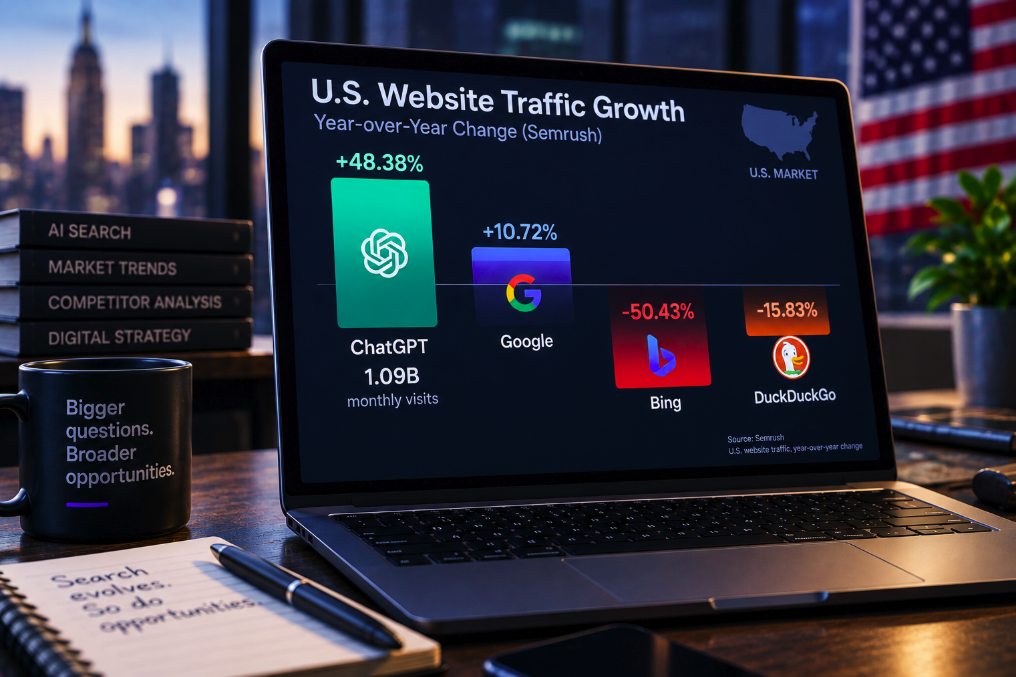
ChatGPT has crossed a symbolic line in the U.S. web market. Semrush estimates that ChatGPT.com received 1.09 billion U.S. visits in July 2026, enough to place it ahead of both DuckDuckGo and Bing in the country's website rankings.
The year-over-year direction is even more striking. ChatGPT traffic rose 48.38%, while Google — already vastly larger — increased 10.72%. DuckDuckGo fell 15.83%, and Bing declined 50.43%. The figures come from Semrush Traffic Analytics and were examined by Greg Jarboe in a September 4 Search Engine Land analysis.
The numbers are a useful marker of how quickly generative AI has become a habitual web destination, but they need careful interpretation. Website visits are not search queries. They are not search-engine market share, app usage or publisher referral traffic. ChatGPT is also used for writing, coding, analysis and conversation that may involve no web search at all.
What the data does show is that the U.S. discovery landscape is no longer adequately described by a list of conventional search engines. ChatGPT now commands more website visits than two established search brands, even as Google itself continues growing.
ChatGPT is now the ninth most visited U.S. website
Semrush's July 2026 U.S. website rankings place Google first with 25.31 billion monthly visits. YouTube follows at 10.27 billion and Reddit at 2.61 billion.
ChatGPT ranks ninth with 1.09 billion visits. DuckDuckGo sits below it with 879.25 million, while Bing is further down the table at 530.61 million.
That means ChatGPT now receives roughly twice the estimated U.S. website traffic of Bing and about 24% more than DuckDuckGo. For a service whose current consumer form is only a few years old, reaching that position represents an unusually rapid change in online behavior.
Search Engine Land describes ChatGPT as the clearest winner among the major sites examined. Its 48.38% year-over-year growth was far larger than Google's 10.72% increase and also exceeded the growth of many other top-20 platforms.
Google is not shrinking while ChatGPT grows
The most important counterpoint to the displacement narrative is Google's own performance. Google did not lose website traffic in Semrush's data. It added it.
At 25.31 billion U.S. monthly visits, Google remains in a completely different scale category from ChatGPT. Its 10.72% year-over-year increase also means that the rise of generative AI has not translated into a simple transfer of total web visits from Google to OpenAI.
This reinforces a pattern visible in other 2026 research: users can adopt ChatGPT while continuing to use Google. The two products may compete for individual tasks without requiring people to abandon one service entirely.
A user might research a topic conversationally in ChatGPT, verify a company through Google, watch a video on YouTube and return to ChatGPT to synthesize the information. Counting monthly website visits captures each touchpoint but cannot reveal which service replaced which task.
Bing's 50% decline is the most dramatic movement
Bing moved in the opposite direction. Semrush estimates 530.61 million U.S. visits in July, down 50.43% from a year earlier.
That is an extraordinary decline for an established search destination, but it should not automatically be interpreted as a 50% collapse in Microsoft search activity. The metric is traffic to bing.com as measured by Semrush, not every search or AI interaction occurring across Microsoft's ecosystem.
Microsoft increasingly distributes search and Copilot functionality through Windows, Edge and other product surfaces. Changes in how those experiences are accessed can alter website traffic independently of the total number of queries Microsoft systems handle.
The data nevertheless captures something commercially meaningful: fewer U.S. web visits are arriving at Bing's traditional website destination than a year ago, while ChatGPT's destination is expanding rapidly.
DuckDuckGo is holding more traffic than Bing, but it is also down
DuckDuckGo received an estimated 879.25 million U.S. visits in July, making it substantially larger than Bing by this particular website-traffic measure. Its year-over-year decline was 15.83%.
That fall is much smaller than Bing's but still notable because DuckDuckGo has historically differentiated itself around privacy rather than trying to match Google feature for feature.
The changing market creates pressure on that positioning. Users now choose not only between general-purpose search engines but between search engines, answer engines, AI assistants and increasingly hybrid products that combine all three.
DuckDuckGo itself has responded to generative AI through Duck.ai, showing that even privacy-oriented search providers are adapting to the new interface rather than treating conversational AI as a separate category.
1.09 billion visits does not mean 1.09 billion ChatGPT searches
This is the most important methodological boundary around the headline. ChatGPT is not simply a search engine with a conversational interface.
People use it to draft emails, analyze files, write software, study, generate ideas, summarize text and perform many other tasks that do not require live web retrieval. A visit to chatgpt.com therefore cannot be counted as a search query in the same way that a visit to a conventional search engine homepage might be interpreted.
Semrush's own 17-month ChatGPT clickstream study found that ChatGPT's web-search feature was enabled on 34.5% of sampled queries as of February 2026, down from 46% in late 2024. The majority of prompts in that dataset therefore did not trigger web search.
The 1.09 billion figure should be read as evidence of ChatGPT's scale as a web destination, not as a direct count of searches competing with Google.
Search is fragmenting by task rather than simply by engine
The old search-market model was relatively easy to visualize. A user chose Google, Bing, Yahoo or another search engine, entered a query and clicked one of the resulting links.
Generative AI fragments that process. Some tasks begin with a prompt rather than a keyword. Some end with a generated answer. Others move from an AI assistant to Google, from Google to Reddit, or from a social platform into a branded website.
This makes website rankings simultaneously more interesting and less sufficient. ChatGPT overtaking Bing tells us that users are spending enormous amounts of attention inside an AI assistant. It does not tell us exactly how much traditional search demand has moved there.
The shift is therefore better understood as fragmentation of discovery behavior rather than a clean replacement of one search engine by another.
The overall web remains extremely concentrated
Search Engine Land's analysis also contains a finding that complicates the fragmentation story. Total visits across the top 150 U.S. websites increased only 6.1% year over year, while the top 10 sites accounted for 68.6% of traffic, almost unchanged from 68.8% a year earlier.
Google, YouTube and Reddit alone generated 54.3% of visits among the top 10. The rise of AI has therefore not produced a broadly decentralized web.
Instead, user attention remains concentrated among a relatively small number of giant platforms while the composition of that group changes. ChatGPT is becoming one of those platforms.
That distinction matters for publishers and marketers. Search behavior can fragment across interfaces even while traffic becomes more concentrated among the companies controlling those interfaces.
YouTube's growth shows the change is bigger than AI
YouTube reached 10.27 billion U.S. monthly visits and grew 36.6% year over year, according to Semrush. That is another reminder that the transformation of discovery cannot be reduced to Google versus ChatGPT.
Video search, social discovery, Reddit discussions and AI assistants all compete for questions that once might have defaulted to a conventional web search. Different formats win different tasks.
A product demonstration may be better answered by YouTube. A firsthand opinion may lead to Reddit. A multi-step synthesis may favor ChatGPT. A navigational or local query may still go directly to Google.
The competitive unit is increasingly the user need, not the search-engine category.
ChatGPT is also becoming part of the referral ecosystem
Semrush's clickstream research found that outbound referral traffic from ChatGPT to the wider web grew 206% during 2025. More than 20% of that referral traffic went to Google, illustrating how AI and traditional search can complement rather than merely replace one another.
That pattern is strategically important. A user can start inside ChatGPT and then move to Google because the assistant creates a need for verification, navigation or additional research.
For marketers, this means ChatGPT traffic should not be evaluated only by the visits it sends directly to a website. It may also influence branded searches, later visits and other downstream behavior that conventional analytics attributes to a different channel.
The discovery journey is becoming harder to assign to a single source.
Website traffic is only one layer of the competitive picture
Comparing ChatGPT, Google, Bing and DuckDuckGo through website visits is useful because it provides a common observable metric. But the products distribute their usage differently.
Google has enormous mobile and browser integration. Microsoft embeds search and Copilot into Windows and Edge. ChatGPT has mobile and desktop applications in addition to its website. DuckDuckGo operates a browser and AI interface alongside its search site.
A website-only comparison therefore measures one important surface rather than the entire user base of each ecosystem.
The figures are best used to identify direction and scale. ChatGPT's web presence is growing rapidly; Google's remains enormous and is still growing; Bing's traditional web destination has contracted sharply; DuckDuckGo has also declined.
SEO teams should stop treating “search share” as one number
For years, marketers could use Google market share as a practical proxy for where search demand lived. That shortcut is becoming less reliable.
Teams now need to distinguish at least four layers: platform audience, query or prompt volume, referral traffic and downstream conversions. A platform can grow its audience without sending more external traffic. It can generate fewer website visits while remaining embedded elsewhere. It can influence a purchase without receiving final-click attribution.
ChatGPT's 1.09 billion monthly U.S. visits belongs to the audience and engagement layer. It says the platform is now large enough to sit among the country's biggest web destinations.
Whether that scale translates into more citations, referrals or commercial outcomes for a specific brand is a separate measurement problem.
The search market is expanding beyond the search-engine label
The symbolic importance of ChatGPT overtaking Bing and DuckDuckGo is not that OpenAI has suddenly become America's second-largest search engine. The Semrush data does not support that claim.
The important change is that a product people do not primarily think of as a conventional search engine now attracts more U.S. website visits than two companies long associated with web search.
At the same time, Google is growing rather than collapsing. The evidence therefore points toward coexistence and redistribution: users are adding AI assistants to their information habits while continuing to use established platforms, and some traditional search destinations are losing traffic more quickly than others.
That is what a splintering search landscape looks like. The winner is no longer necessarily the service that replaces Google. It may be the service that becomes another default place where a question begins.