
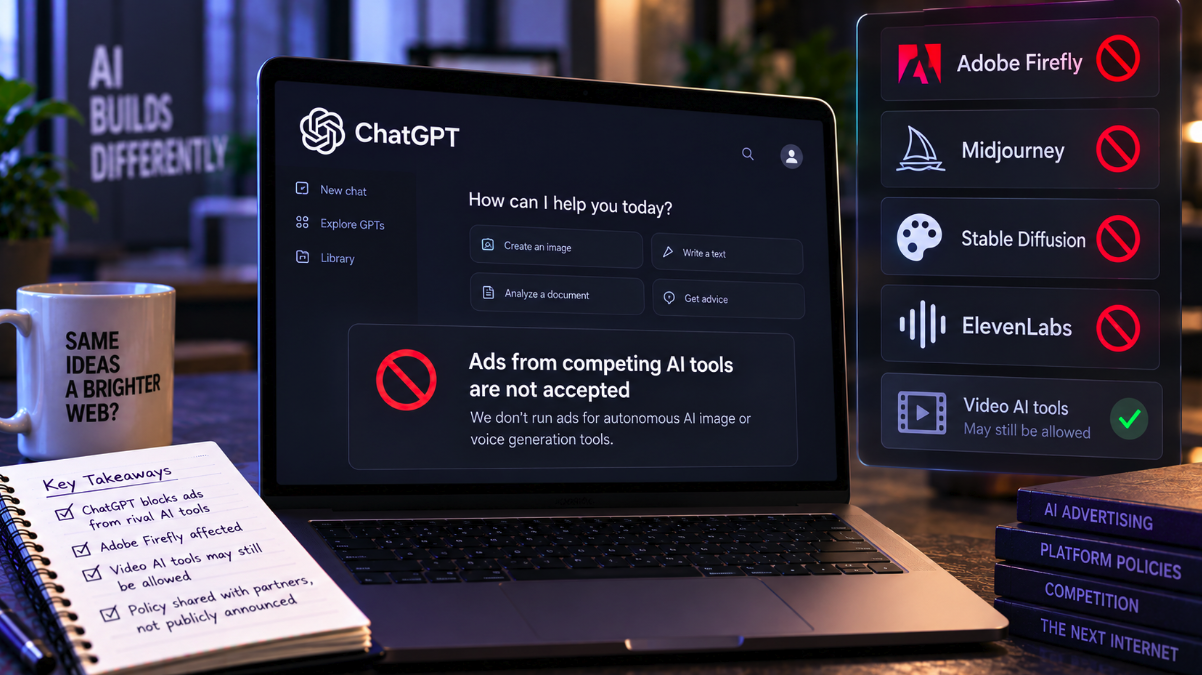
ChatGPT’s advertising business is beginning to face a question familiar to every large digital platform: what happens when an advertiser also competes with the platform itself? According to new reporting, OpenAI has told some advertising partners that it will no longer accept ChatGPT campaigns for standalone AI image- and audio-generation products, categories in which ChatGPT now offers its own competing capabilities.
Search Engine Land reported the development on September 10, citing an investigation by The Information. The original report says the change was communicated to some business partners rather than announced through a public policy update. Adobe was among the advertisers affected: Doug Wyatt, the company’s senior director for Americas Media, said Adobe had advertised both Acrobat Studio and its Firefly AI image product as part of the ChatGPT advertising program.
Wyatt described image and voice/audio as closed categories while saying video remained open “for now.” That distinction matters because the reported rule is narrower than a blanket prohibition on AI competitors. The evidence reviewed supports a restriction affecting competing standalone image- and audio-generation products, not a conclusion that every AI company, chatbot or productivity service is prohibited from advertising in ChatGPT.
The reported restriction is not yet in OpenAI’s public ad policy
OpenAI’s published advertising policies, updated August 31, do not explicitly identify Adobe, Firefly or competing generative-AI tools as a prohibited category. They say the initial ChatGPT advertising test primarily supports consumer verticals including lifestyle and household goods, local services, travel and experiences, and digital products or education. OpenAI also says supported categories may evolve and reserves the right to refuse advertising content and website links for any reason.
The company’s Advertising Terms similarly state that campaigns are subject to OpenAI’s acceptance in its sole discretion. Those provisions give the platform broad control over which campaigns it runs, but they do not independently confirm the specific competitor restriction described by advertising partners. The Information reported that an OpenAI spokesperson declined to comment, leaving a gap between the operational rule advertisers say they received and the categories users can inspect in the public policy documentation.
That gap is strategically important. Advertisers typically plan media around published eligibility requirements, creative rules and prohibited-content categories. A rule communicated privately to partners can be enforceable within a commercial program while still being difficult for the broader market to evaluate. If OpenAI intends image and audio competitors to remain excluded, making that distinction explicit would allow agencies and AI companies to understand whether the restriction is temporary launch-stage inventory management or a durable platform policy.
ChatGPT is becoming both an advertising channel and a product competitor
The tension arrives as OpenAI expands advertising into a meaningful business line. ChatGPT’s value to advertisers is unusually tied to intent: users explicitly describe problems, research products and ask for recommendations inside conversations. OpenAI CFO Sarah Friar recently characterized the company’s advertising ambition as combining aspects of Google’s intent-driven model with Meta’s contextual and audience understanding. That creates a potentially powerful ad environment, but also means OpenAI increasingly controls paid access to attention in categories where it sells its own tools.
Image and voice are particularly clear examples. A user can generate images or interact through voice directly inside ChatGPT, so an advertisement for a standalone product offering the same core task can compete not merely with another advertiser but with functionality embedded in the host platform. If the reported restriction is accurate, OpenAI is drawing a line around at least some of those direct overlaps while continuing to monetize advertising from other product categories.
That does not by itself establish unlawful self-preferencing or an antitrust violation. Competition-law analysis would depend on questions including market definition, platform power, advertiser alternatives, contractual terms and jurisdiction. Platforms also routinely impose category restrictions for safety, user experience, commercial strategy and product-design reasons. The immediate issue is therefore transparency and market access rather than a legal conclusion the available evidence cannot support.
For AI companies, paid distribution can change as quickly as product competition
The report highlights a broader risk for marketers building acquisition strategies on emerging AI platforms. ChatGPT is not a neutral ad network separated from the products being advertised; it is a rapidly expanding software platform whose own capabilities can move into adjacent categories. A product that qualifies as an ordinary digital advertiser today may become a direct competitor after a new native feature launches, potentially changing the commercial relationship even if the advertiser’s product itself has not changed.
That possibility makes channel diversification more important for AI startups and established software companies alike. Paid access to a high-intent assistant audience can be valuable, but it should not be treated as permanent inventory when the platform operator is simultaneously expanding into search, images, voice, agents, commerce and other software functions. The reported exception for video products also shows why marketers should avoid generalizing from a single category decision: competitive boundaries can be granular and can shift with the host platform’s roadmap.
OpenAI’s own help documentation says ChatGPT ads can appear to eligible users on Free and Go plans, while paid tiers including Plus and Pro remain ad-free. As the ad-supported audience and Ads Manager mature, decisions about advertiser eligibility will increasingly shape not only OpenAI’s revenue but which companies can buy visibility inside one of the web’s most consequential new discovery interfaces.
For now, the strongest conclusion remains narrower than the headline might suggest. Advertising partners reportedly say ChatGPT has stopped accepting campaigns for competing AI image and voice/audio products, with Adobe Firefly among the affected products and video still open at the time of the report. OpenAI has not publicly announced that rule in its published ad policy, and it has not provided a public explanation for the change. That makes this an important reported platform-policy shift—but one whose exact scope still needs clearer confirmation from OpenAI itself.