
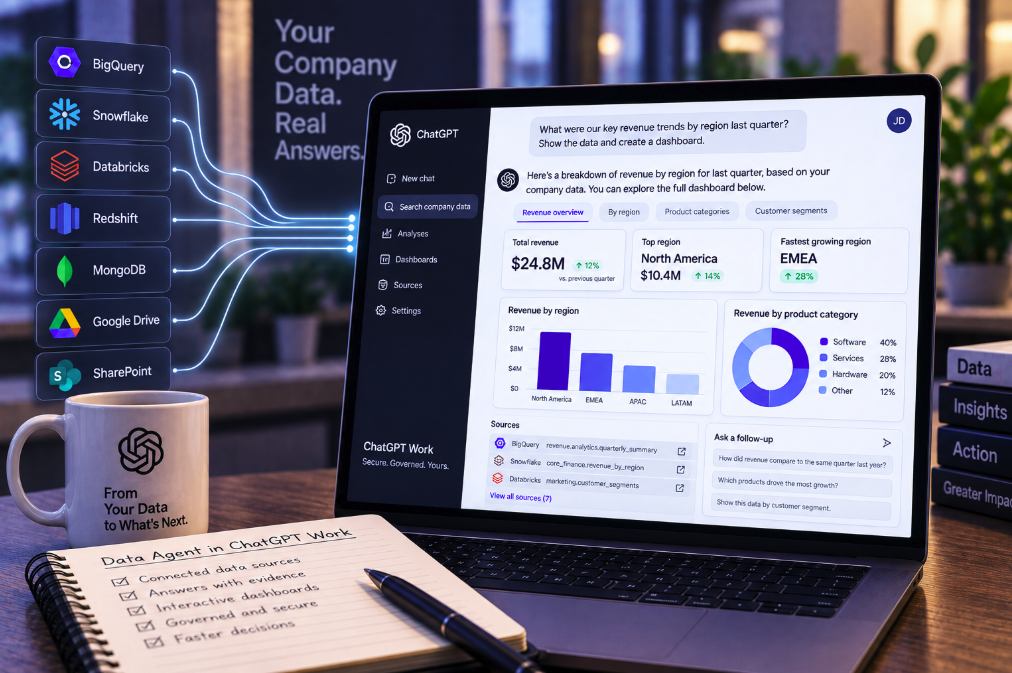
OpenAI is turning ChatGPT Work into a conversational analytics layer for company data. Its new Data agent can connect to approved warehouses, databases, documents and business-intelligence systems, investigate a business question in natural language, expose the evidence behind its conclusions and turn the analysis into an interactive dashboard that teams can continue refining in the same conversation.
The capability was introduced in OpenAI's September 10 product announcement. The company says the Data agent can work with approved sources including Amazon Redshift, Datadog, Google BigQuery, ClickHouse, Databricks, MongoDB and Snowflake, while also bringing files and documents from Google Drive and SharePoint into an analysis. It can use business definitions and semantic context from systems such as Databricks Genie Ontology, dbt, GitHub, Snowflake Horizon and existing BI dashboards.
The important distinction is that this is not an update to ChatGPT's public web search. The Data agent is designed to research governed enterprise information that an organization explicitly connects and authorizes. Instead of asking the open web what happened to quarterly revenue, a user can ask the company's own data systems—and then inspect the evidence the agent used to reach its answer.
From SQL request queues to conversational investigation
Business analytics often begins with a deceptively simple question: why did sales fall last week, which customers are at risk, or where is spending increasing? Answering it can require identifying the right tables, understanding company-specific metric definitions, joining several datasets, writing queries, checking the results and building a visualization. For non-technical teams, that frequently means submitting a request to an analyst and waiting.
OpenAI's pitch is to compress that workflow into a conversation. A user can ask a question in plain language, let the Data agent investigate the connected sources, ask follow-up questions and progressively narrow the analysis without learning the syntax of each underlying data platform. The agent can then convert the findings into charts and interactive dashboards rather than stopping at a text summary.
That makes the product closer to an analytical agent than a conventional chatbot over documents. It is intended to navigate structured data, business context and supporting files, identify changes and drivers, and preserve enough provenance for users to review how a finding was produced.
The agent connects to governed sources rather than creating a new data silo
The architecture matters because enterprises rarely store all relevant information in one database. Revenue may live in Snowflake, product events in Databricks, operational data in MongoDB, campaign data elsewhere and planning documents in SharePoint or Google Drive. A useful analytical answer often depends on combining several of those sources.
OpenAI says the Data agent connects to the organization's approved systems rather than requiring teams to reconstruct their data estate inside ChatGPT. Administrators choose which connections are available and which roles may use them. Queries then enforce the permissions associated with the connected account, including table-, row- and column-level restrictions.
That permission model is central to the enterprise proposition. A conversational interface that ignored existing access rules would make analytics easier at the cost of governance. OpenAI instead says the agent works within the controls already attached to the connected data, so a user should not gain access to a restricted salary column or customer segment merely because they asked for it in natural language.
Business definitions are part of the retrieval problem
Connecting to a warehouse is not enough to answer business questions reliably. Organizations routinely use terms such as “active customer,” “qualified lead,” “net revenue” or “retention” in ways that are specific to their own operations. Two teams can query the same tables and still produce different answers if they apply different definitions.
The Data agent is designed to use semantic layers and trusted context to interpret those terms. OpenAI names dbt, Databricks Genie Ontology, Snowflake Horizon, GitHub and BI dashboards among the sources that can provide metric definitions, custom calculations and relationships among data.
This is one of the more important aspects of the launch because it shifts the problem from text-to-SQL alone to governed interpretation. Generating syntactically correct SQL is relatively easy for modern models. Knowing that a company's official “monthly active customer” metric excludes trial accounts, uses a particular timezone and requires a defined activity threshold is the harder problem. If the agent can reliably inherit those semantics, its answers can remain aligned with the numbers teams already use to run the business.
Inspectable evidence is part of the product design
OpenAI says users can review the evidence behind each finding while investigating results. Its current ChatGPT Work material similarly emphasizes cited analysis, reviews and source context. That makes provenance a core feature rather than an optional appendix.
For enterprise analytics, this is necessary. A statement such as “renewal risk increased because onboarding completion fell in mid-market accounts” can influence staffing, customer outreach or budget allocation. Decision-makers need to know which tables, definitions and analyses support the conclusion and where uncertainty remains.
Evidence does not automatically guarantee correctness. An agent can query the wrong field, misinterpret a metric or infer causation from a correlation even while citing the source data accurately. Inspectability instead gives analysts and business users a path to challenge the result. The stronger workflow is not “AI answered, therefore it is true,” but “AI produced an answer, here is the evidence and logic we need to verify.”
Interactive dashboards can be created in the conversation
The Data agent can turn an investigation into an interactive dashboard with built-in visualizations. OpenAI says teams can edit, share and refresh those dashboards, and can provide brand guidelines so the outputs match the organization's visual identity.
The agent is also designed to work with existing BI ecosystems rather than replacing them outright. OpenAI lists Omni, Oracle BI, Power BI, Sigma, Tableau and ThoughtSpot as dashboard environments the Data agent can build or interact with. That creates a bridge between conversational analysis and the governed reporting tools many enterprises already rely on.
For business users, the practical change is that dashboard creation can begin with a question rather than a blank BI canvas. A manager could ask for revenue trends by region, then request a segment breakdown, add a churn indicator, change the visualization and produce a leadership view through follow-up instructions. The dashboard becomes a persistent analytical artifact produced from the conversation rather than a static answer pasted into a slide.
OpenAI is positioning data analysis as a workflow, not a single answer
The product goes beyond answering questions and generating charts. OpenAI says users can ask ChatGPT Work to recommend next steps, identify the people who need to be involved, share findings through Slack or email and carry out approved actions through connected tools.
That creates a broader sequence: detect a change, investigate its drivers, visualize the evidence, decide what to do and route the follow-up work. In traditional enterprise software those stages can span a warehouse, notebook, BI platform, messaging system and project-management tool. ChatGPT Work is being positioned as the conversational layer coordinating them.
This is also why governance becomes more important as the product gains action capabilities. An incorrect analytical conclusion is one risk; automatically propagating that conclusion into operational workflows creates another. Human review and clear approval boundaries remain essential when analysis moves from recommendation into action.
OpenAI says its own teams already use data agents extensively
OpenAI says the capabilities behind the product are already used broadly inside the company. According to the announcement, nearly all of its product organization and more than two-thirds of its go-to-market organization use data agents in ChatGPT Work to analyze internal company data.
The company attributes that internal deployment not only to model capability but to the supporting data work: shared business definitions, access rules and safeguards for sensitive information. That is an important qualifier for companies evaluating the product. Connecting an agent to poorly documented tables does not magically create a clean semantic layer. Organizations still need reliable definitions, permissions and data ownership.
OpenAI also cites alpha customers using the Data agent for sales analysis, spending, reporting-error detection, operational metrics and staffing decisions. These are customer and vendor-reported examples rather than independent performance benchmarks, but they illustrate the kinds of workloads OpenAI is targeting: recurring questions that are important enough to require real analysis yet common enough that waiting for a specialist can create a bottleneck.
What changes for data teams
The obvious interpretation is that the Data agent reduces dependence on analysts, but the more realistic near-term change may be a redistribution of analytical work. Routine requests—simple segment cuts, recurring KPI summaries and first-pass anomaly investigation—can move closer to business users. Data teams can then spend more time defining metrics, validating models, maintaining data quality and handling questions where causal reasoning or statistical design matters.
That shift only works if self-service does not become self-service confusion. Data organizations will need to decide which sources the agent can access, which semantic definitions are authoritative and which analyses require review. They may also need monitoring for expensive queries, sensitive joins and repeated analytical mistakes.
The Data agent therefore makes data governance more visible rather than less necessary. A conversational interface can hide the technical complexity of querying a warehouse, but it cannot remove the organizational complexity of deciding what a metric means and who is allowed to see it.
This is enterprise data research, not web search
The word “search” can make the product easy to misclassify. ChatGPT already has mechanisms for finding information on the public web. The Data agent addresses a different information boundary: proprietary business data that public search engines cannot access and that should remain subject to company permissions.
A web search might answer how an industry is growing. The Data agent can investigate how the user's own revenue changed by region, compare that movement with customer segments and operational context, and show which internal sources support the finding. The value comes from authorized access to private company context, not from expanding the public web index.
That distinction also changes what “citation” means. In web research, citations point readers to public pages. In governed company analysis, the useful evidence may be a permitted warehouse table, a BI metric definition or an internal document. Inspectability must therefore coexist with access control: a user should be able to verify the evidence they are authorized to see without the system exposing restricted data simply to make the answer more transparent.
ChatGPT Work is becoming an interface over the enterprise stack
The Data agent fits a larger direction for ChatGPT Work: connect the tools and context employees already use, then let an agent coordinate work across them. In analytics, that means the conversation can sit above warehouses, operational databases, documents, semantic layers and BI systems instead of forcing every user to learn each interface separately.
If the model works reliably, the strategic consequence is not merely faster SQL generation. It is a change in who can interrogate company data and how quickly an observation can become a decision-ready artifact. A sales leader can ask why pipeline slowed, a product manager can investigate retention, and a finance team can explore spending without beginning every question as a ticket to the data organization.
But the quality ceiling will still be set by the underlying data. Poor definitions, missing events, inconsistent joins and biased business assumptions remain poor inputs even when the interface is conversational. The agent can make governed data dramatically easier to interrogate; it cannot make unreliable data trustworthy by presentation alone.
The competitive advantage may be evidence, not just natural language
Natural-language analytics is no longer a novel idea. Many database and BI products can already generate queries or explain dashboards conversationally. OpenAI's broader proposition is to combine those capabilities across multiple governed systems inside a general work environment, preserve evidence and then turn the analysis into shareable dashboards and downstream actions.
That makes inspectability especially important. As AI-generated business analysis becomes easier to produce, organizations will need a way to distinguish a plausible narrative from a defensible one. An answer that can show its data sources, calculations and relevant business definitions is more useful than a fluent summary whose provenance disappears behind the interface.
The new Data agent is therefore best understood as a governed answer engine for internal business questions. It connects the data a company already trusts, uses the organization's definitions to interpret it, lets users investigate findings conversationally and creates analytical artifacts they can inspect and share. It is not a new way for ChatGPT to search the public internet. It is an attempt to make the company's own data searchable, explainable and actionable without forcing every employee to become a data engineer.