
Brands trying to earn citations in ChatGPT may be focusing on the wrong variable. A new cross-industry study suggests that whether ChatGPT cites a source can depend far more on the type of question being asked than on the industry in which the question appears.
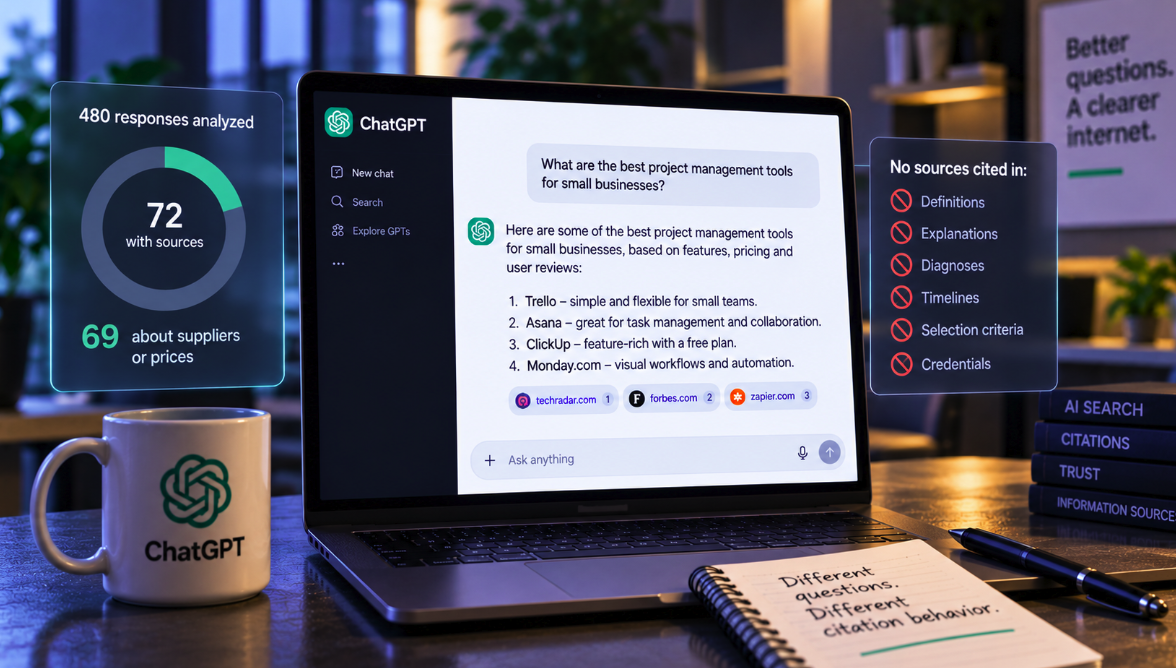
The finding comes from The Answer Index, a September 2026 research experiment from Hendricks that tested the same structured question framework across ChatGPT, Perplexity, Gemini and Google AI Overviews. ChatGPT produced 480 measured answers. Only 72 of them—15%—contained at least one citation. More strikingly, 69 of those 72 citing answers belonged to just two question types: provider discovery and cost.
For six other categories, ChatGPT cited nothing at all. Selection-criteria questions, explainers, problem diagnoses, timing questions, trust-and-credentials questions and definitions each produced zero cited answers out of 48, despite being distributed across eight different industries. In this dataset, the shape of the question was a much stronger clue to citation behavior than the vertical in which it was asked.
ChatGPT cited 72 answers, but 69 came from two intents
The concentration is unusually sharp. Hendricks reports that 35 of 48 provider-discovery answers contained at least one citation, a rate of roughly 73%. Cost questions triggered citations in 34 of 48 answers, or roughly 71%. Comparison questions produced only two citing answers, while alternatives produced one.
Everything else was zero. That means the study did not observe a gradual decline in citation frequency as questions became less commercial. It observed something closer to a behavioral divide: ChatGPT frequently retrieved and cited sources when users asked who provides something or what it costs, while several informational and evaluative question types were answered without visible sourcing throughout the test.
The result matters because the question mix was deliberately held constant across industries. The corpus covered eight sectors, with 60 questions per industry and the same ten question types represented in each. Hendricks therefore argues that the citation pattern cannot be explained simply by one industry being inherently more source-heavy than another within this experiment.
An uncited answer is not necessarily a failed answer
One of the most important distinctions in the study is that an answer without citations was not treated as an error. ChatGPT still answered those questions. It simply appeared to respond from the model rather than surfacing retrieved web sources in the measured output.
That difference has major implications for AI visibility. A brand cannot win a citation in an answer that cites nobody. Publishing the best definition page in a category may improve a website in many ways, but if ChatGPT generally answers that class of prompt without retrieving sources, citation optimization alone cannot force the page into a citation slot that does not exist.
The study also found a substantial difference in response length. ChatGPT answers with citations averaged 6,194 characters, compared with 2,303 characters for answers without citations. That does not establish that longer questions cause search or that search causes a particular answer length, but it reinforces the idea that the citing and non-citing responses were operating in noticeably different modes within the measured run.
Commercial intent appears to trigger retrieval more often
Provider discovery and cost share an important characteristic: they often require current, externally verifiable information. A user asking which companies provide a service is asking about a market that can change. A user asking what something costs may need prices that can change even faster. Retrieving live sources is therefore especially useful for producing a timely answer.
A definition or general explainer is different. A language model may already contain enough learned information to construct a plausible answer without searching. The same can apply to broad selection criteria or conceptual timing questions, depending on how they are phrased. In those cases, retrieval may add less perceived value to the response-generation process.
This is an interpretation of the observed pattern rather than proof of ChatGPT’s internal retrieval policy. The study records outputs, not the private decision process inside the model. But for publishers, the external behavior is what matters operationally: some query types produced citations repeatedly, while others did not produce any in the sample.
The SEO opportunity is not evenly distributed across the funnel
Traditional SEO often encourages publishers to map content across the entire customer journey: definitions at the top of the funnel, educational explainers in the middle, and comparisons, provider research and pricing content closer to a decision. If AI citation behavior varies by question type, the probability of earning a visible source mention may also vary dramatically across that journey.
For brands measuring ChatGPT citations, that creates a denominator problem. A site could publish extensively around definitions and educational questions, then conclude that its AI visibility is poor because those pages rarely appear as citations. But if the engine rarely cites any source for those question types, the more useful benchmark is not simply the brand’s citation count. It is the brand’s share of the citation opportunities that actually exist.
That distinction can change content prioritization. Provider pages, pricing resources, directories, comparison assets and other commercially useful pages may deserve separate AI-search measurement from purely informational content. Not because informational pages are unimportant, but because the mechanisms through which they create value may be different.
Industry still matters once citations exist
The headline finding should not be interpreted to mean industry is irrelevant. Hendricks found substantial differences in who captured citation mass once the engines were citing sources. Across all four engines, provider-owned websites accounted for 64.5% of citations in healthcare and dental and 64.4% in B2B SaaS, but only 27% in education and training. The other industries fell between those extremes.
That suggests two separate questions for AI-search strategy. The first is whether a particular query type causes an engine to retrieve and cite sources at all. The second is which types of sources win those citations once retrieval happens. Question intent can shape the first opportunity, while market structure can still influence the second.
This separation is important because aggregating everything into a single “AI visibility” score can hide both effects. A brand operating in a market where provider sites frequently earn citations may face a different competitive environment from one where publishers, directories or other intermediaries dominate. But neither can be cited by ChatGPT on a prompt where the model chooses not to surface sources.
ChatGPT also behaves very differently from other answer engines
The study becomes even more interesting when ChatGPT is compared with the other systems. Perplexity cited at least one source in all 480 of its measured answers. Gemini did so in 476 of 480, while Google AI Overviews cited sources in 430 of 462 rendered panels. ChatGPT’s 72 of 480 is therefore not representative of AI answer engines as a category.
The source overlap was also low. Hendricks measured mean per-question overlap of cited domains between engines and found that every pair involving ChatGPT was at 0.020 or below. The strongest cross-engine pair, Perplexity and Google AI Overviews, reached 0.181. By comparison, repeated runs of the same engine showed much stronger self-agreement where the study measured it.
For marketers, that is another warning against treating “AI search” as one ranking system. A page optimized around citation opportunities in ChatGPT is not automatically positioned the same way in Perplexity, Gemini or Google AI Overviews. Each engine can have a different retrieval footprint, source pool and propensity to cite in the first place.
The practical unit of AI citation research may be the question type
The Answer Index does not establish a universal law for every ChatGPT conversation. It is one controlled corpus of 480 questions across eight industries, and Hendricks explicitly cautions against assuming that eight industries represent every market. The study is most useful as a research design that brands can replicate against the questions their own customers actually ask.
That caveat makes the finding more actionable, not less. Instead of asking only whether a company appears in ChatGPT, teams can classify their prompt sets by intent and calculate citation rates separately. They can identify which question types routinely trigger sources, which rarely do, and where competitors or intermediaries dominate when citations appear.
The September study suggests that this segmentation can reveal patterns that industry-level averages conceal. ChatGPT cited only 15% of its answers overall, yet it cited roughly seven in ten provider-discovery and cost answers while citing none in six other categories. Those are radically different environments inside the same engine.
For AI-search strategy, the implication is clear: citation visibility should not be measured as though every prompt creates an equal opportunity to be sourced. Before asking why a brand was not cited, marketers may need to ask a more fundamental question—was ChatGPT likely to cite anyone for that type of question in the first place?