
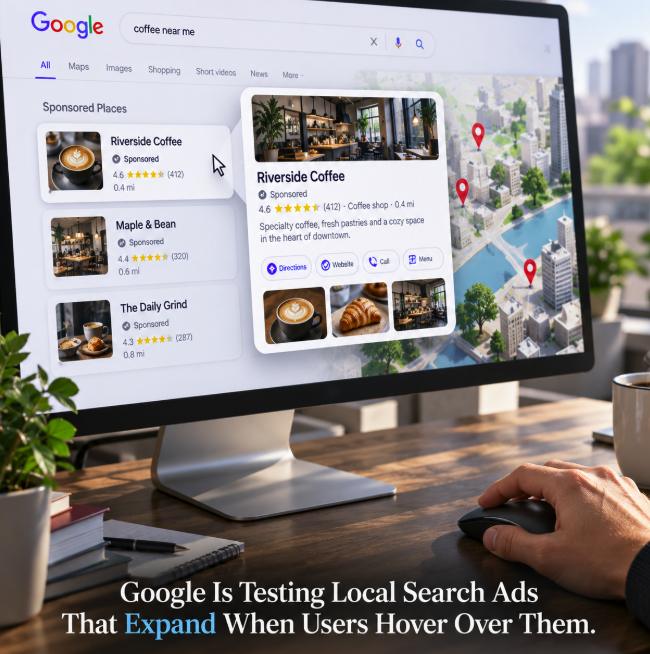
Google is testing a more interactive version of its Sponsored Places format in Search: when a user moves the pointer over one of the local ads, the placement can expand to reveal a larger block of business information. It is a small interface experiment, but one that gives paid local results considerably more room to attract attention without requiring an immediate click.
The test was documented on September 17, 2026 by Barry Schwartz at Search Engine Roundtable, based on screenshots and a recording shared by Khushal Bherwani. Schwartz notes that Google has experimented with ads that expand on hover before; what is notable in this case is that the behavior has reached the Sponsored Places local advertising format. Bherwani also observed click and overlay behavior in the interface.
Sponsored Places are becoming more interactive
Sponsored Places are a relatively recent variation of Google's local commercial results. Schwartz first documented the named format in February 2026, when a Search result was spotted explicitly labeling a local advertising block “Sponsored Places” rather than presenting it only as a conventional sponsored-results treatment. The format has since become another surface to watch as Google experiments with how local businesses are presented inside commercial Search experiences.
The new hover behavior changes the amount of information a placement can expose without permanently consuming the same amount of SERP space. In its compact state, the unit can preserve a relatively dense results layout. Once a user shows interest by hovering, the interface can expand and provide a more prominent presentation. That makes the pointer itself a lightweight interaction signal: the user does not necessarily have to click before Google changes the ad's visual footprint.
Expansion gives advertisers more attention without a new page
From an advertising-design perspective, expandable units offer an obvious advantage. Local results often compete within a tightly constrained area where several businesses may show similar information, including names, ratings, categories and location cues. An expanded state can create temporary visual dominance and provide more room for business details or actions while keeping the initial SERP relatively compact.
That does not establish that the test improves advertiser performance. There is no public data in the reported experiment showing higher click-through rates, conversion rates or other campaign outcomes, and it would be premature to infer them from screenshots alone. What can be said is that the interface changes how attention can be allocated: a sponsored local listing can occupy substantially more space after a minimal user interaction.
Google has been experimenting with expandable ad interfaces elsewhere
The Sponsored Places test is part of a broader pattern rather than an isolated design idea. Earlier in September, Google was also observed testing collapsed sitelinks that users can expand, using a count indicator to show that additional links are available. Schwartz has separately noted that hover-expansion behavior has appeared in other Google ad experiments.
The common design principle is flexible SERP real estate. Instead of deciding that an ad must always occupy either a small or large fixed block, Google can make its footprint responsive to user interaction. This allows more information to remain available while limiting how much of the page it consumes before the searcher demonstrates interest.
What local advertisers and SEOs should watch
For businesses competing in local search, the experiment is worth monitoring because paid local placements are becoming visually richer and more interactive. Organic local visibility and advertising do not operate in separate visual environments: when a sponsored unit expands, it can alter what is visible around it and how much attention neighboring results receive. That makes SERP observation increasingly important alongside traditional rank tracking.
Advertisers should not assume that Sponsored Places expansion is broadly available or configurable in Google Ads. The evidence currently describes a Google Search test, not a confirmed global product launch or a new advertiser-controlled setting. There is also no indication in the report that advertisers can choose whether their Sponsored Places result expands on hover.
The experiment nevertheless illustrates the direction of Google's local ad design. Search results are becoming less static, with modules that can expand, collapse, overlay information and respond to user behavior. For local commercial queries, that means the amount of screen space assigned to an advertiser may increasingly change during the search session rather than being fixed when the page first loads.
For now, the correct description remains straightforward: Google is testing Sponsored Places ads that expand when users hover over them. Whether the interaction becomes a standard part of local Search advertising remains unknown, but it is another example of Google turning the SERP into a more dynamic interface — one where even moving a mouse can reshape the commercial results in front of the user.