
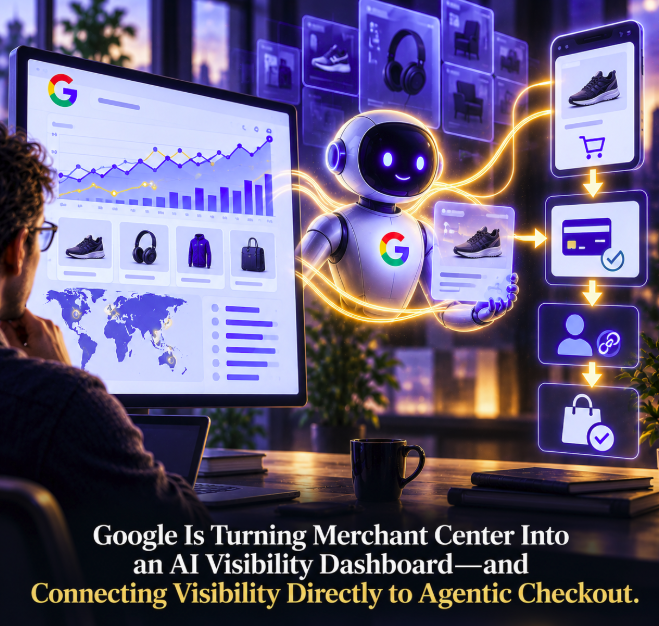
Google Merchant Center is becoming more than the place where retailers submit product feeds and diagnose listing problems. As of September 16, Google's AI Performance Insights are generally available to merchants in Australia, Canada, India, New Zealand and the United States, giving businesses a dedicated view of how visible their brands are across AI-powered Google experiences. At the same time, Google is simplifying the path from that visibility to agentic checkout through its Universal Commerce Protocol integration hub.
The latest expansion was detailed by Anu Adegbola at Search Engine Land. The combination is strategically important: Google is building measurement for whether products appear in AI discovery while simultaneously building infrastructure that allows AI-driven shopping journeys to continue into cart and checkout.
For ecommerce teams, those two developments should be considered together. The emerging funnel is no longer simply impression, click and conversion. It increasingly looks like AI visibility, recommendation, selection and action — with Merchant Center becoming one of the places where merchants manage both ends of that process.
AI Performance Insights are now generally available in five markets
Google first announced AI Performance Insights in May as a way for retailers to understand how their brands perform on AI surfaces. At the time, the company said the feature would roll out over the coming months. The September update moves it into general availability for businesses in Australia, Canada, India, New Zealand and the U.S.
The tool compares a retailer's share of voice with similar brands across Google AI experiences, including AI Mode and AI Overviews. That gives merchants a measurement layer for a type of visibility that conventional ecommerce dashboards have struggled to capture.
A traditional Merchant Center workflow is heavily product- and feed-oriented: are products approved, are attributes correct, are prices synchronized and are listings receiving traffic? Generative shopping introduces a different question before the click: when a shopper asks Google's AI to research or recommend products, how often is the brand part of the answer space?
Google's own May commerce announcement framed AI Performance Insights as a way to compare a brand's share of visibility against similar brands. General availability makes that concept an operational metric rather than a future feature on the roadmap.
Merchant Center is becoming an AI visibility dashboard
The significance of the feature is not that it replaces Search Console, Google Ads reporting or conventional ecommerce analytics. It measures a different part of the customer journey. AI Mode and AI Overviews can synthesize information and narrow options before the shopper reaches a retailer's site, so merchants need some indication of whether they are participating in that discovery layer.
That is especially important because AI-generated shopping experiences do not map neatly onto familiar ranking positions. A product can appear as part of a recommendation, comparison or conversational answer without behaving like a conventional organic listing. Share-of-voice reporting is therefore closer to measuring presence in an AI consideration set than measuring a blue-link rank.
Merchant Center is a logical place for Google to expose this information because it already sits at the intersection of product data and distribution. The same catalog attributes that help Google understand an item can influence whether the item is useful when a shopper asks a conversational question about features, fit or use cases.
The other half of the update is UCP
Visibility is only valuable if a shopper can act on it. Google is expanding the capabilities available through the Universal Commerce Protocol integration hub in Merchant Center, reducing the technical distance between a product being surfaced by AI and the shopper completing a transaction.
UCP is Google's open protocol for agentic commerce, designed to let AI agents, retailers and commerce systems communicate through a common framework. Google introduced it in January as infrastructure spanning the commerce journey from discovery through decision and beyond. Sundar Pichai described the protocol in his NRF 2026 remarks as a common language intended to work across retailers, customers and agentic services.
In September, merchants using the Merchant Center UCP integration hub for UCP-powered checkout can enable cart transfers to their own websites and use improved checkout-flow testing. Google says analytics and additional capabilities are coming soon. The new capabilities are rolling out gradually in the U.S., with Australia and Canada expected to follow in early 2027.
Cart transfer gives merchants two paths to conversion
One of the most important design choices in Google's agentic commerce system is that checkout does not have to follow a single route. UCP can support native checkout on Google, but merchants can also allow a cart to transfer to their own website so the shopper completes the transaction there.
Google described this model earlier in its Universal Cart and UCP update. When shoppers are ready to buy, participating brands can support checkout through Google Pay in a few taps or transfer items directly to the merchant's site.
That flexibility matters for retailers because the economics and customer experience can differ substantially between an on-platform transaction and a website checkout. Some merchants may prioritize the lowest-friction native flow, while others may want to preserve more of their existing onsite experience, merchandising or customer-acquisition process.
Agentic commerce does not necessarily eliminate the merchant website. Instead, it creates an additional transactional route in which the agent can prepare the purchase before handing the shopper off.
Identity Linking makes agentic shopping customer-aware
UCP is also designed to carry more than anonymous product and cart information. In March, Google announced Identity Linking as an optional protocol capability, allowing shoppers on UCP-integrated platforms to receive the same loyalty or membership benefits they would receive when logged into a retailer's own site.
This can include benefits such as member pricing or free shipping. The capability is important because a genuinely useful shopping agent cannot always choose the best offer from public catalog data alone. The correct commercial decision may depend on whether a particular shopper has loyalty status, access to special pricing or other account-level benefits.
Identity Linking should not be confused with a feature that became newly available on September 16; Google announced it earlier as part of the expanding UCP specification. Its relevance to the current Merchant Center rollout is architectural: as UCP onboarding becomes easier, merchants are connecting to a protocol designed to support identity-aware commerce rather than only basic product checkout.
Native checkout is the point where AI visibility becomes action
Google's long-term direction becomes clearest when native checkout is considered alongside AI Performance Insights. The merchant can measure whether the brand appears across AI experiences, provide the product data needed for recommendations and connect commerce infrastructure that lets a shopper act without reconstructing the journey from scratch on another site.
Google introduced UCP-powered native checkout as one of the protocol's first major use cases. Its January announcement described a future in which users can move from AI-assisted discovery to purchase while the retailer remains the merchant of record.
That model is already moving into production. Search Engine Land reports that Tapestry has used UCP-powered checkout to make Coach and Kate Spade products purchasable across Google Search, including AI Mode, and the Gemini app ahead of the holiday season.
The practical result is that a product can be discovered, evaluated and purchased through an AI-mediated journey in which a conventional organic website visit is no longer mandatory at every stage.
Analytics will have to follow the transaction into the agent layer
Google says analytics for the UCP integration hub are coming soon. That may prove to be one of the most consequential pieces for marketers because agentic commerce creates attribution problems that traditional ecommerce reporting was not designed to solve.
If AI Mode introduces a brand, answers product questions, narrows the options and then hands a prepared cart to a merchant site, what should receive credit for the conversion? If checkout happens natively through Google, how should marketers compare that journey with a Shopping ad click or an organic visit? If a shopper uses several AI interactions before purchasing, where does discovery end and conversion begin?
Merchant Center increasingly needs to answer questions like these because it is becoming the control plane between product information and AI-mediated commerce. Visibility metrics show the top of the new funnel; UCP analytics could eventually illuminate the bottom.
Product data is the connective tissue
Despite the emphasis on protocols and agents, Google's September update reinforces a much less glamorous requirement: accurate product data. Search Engine Land reports that Google says merchants following its core Merchant Center feed best practices see an average 5% increase in conversions the following month. That is a Google-reported aggregate result rather than a guaranteed outcome for individual retailers.
Google also says that in testing with Lululemon, conversational attributes provided by the retailer were incorporated 50% of the time in relevant product recommendations in AI Mode. Again, the figure is a company-reported test result, but it illustrates why richer attributes matter in conversational shopping.
An AI system needs more than a product title and price when a shopper asks which item is best for a specific situation. It needs machine-readable context about features, compatibility, use cases and other distinctions that allow products to be compared against natural-language constraints.
The feed therefore becomes more than inventory plumbing. It becomes part of the knowledge layer from which an AI agent decides whether a product belongs in the recommendation set.
Merchant Center is moving from listings management to agent readiness
Historically, merchants used Merchant Center primarily to make products eligible for Google surfaces and manage feed health. The new architecture adds two additional responsibilities: measuring AI visibility and connecting products to agentic transactions.
This suggests a broader definition of ecommerce optimization. A merchant needs to be discoverable by the AI, understandable enough to be recommended, commercially competitive enough to be selected and technically integrated enough for the shopper or agent to complete the action.
That progression mirrors the emerging GEO framework of visibility → recommendation → selection → action. AI Performance Insights gives retailers a window into the first stage. Rich product attributes influence the middle stages. UCP provides infrastructure for the final stage.
The result is a more continuous commerce stack than traditional search marketing, where SEO visibility and checkout technology often belonged to separate teams and separate platforms.
The metric to watch is no longer just traffic
For ecommerce marketers, one of the most important consequences is that website traffic may become a less complete proxy for search value. A product can gain exposure inside an AI answer and eventually convert through an agentic checkout path without producing the same sequence of pageviews associated with traditional search.
That does not make traffic irrelevant. Retailer sites remain essential for brand experience, product detail, customer relationships and many conversion paths. But marketers will need to distinguish between losing visibility and losing a click because the transaction has moved into a different interface.
AI share of voice, recommendation presence, UCP eligibility, cart transfers and native checkout performance may therefore sit alongside impressions, CTR and sessions in future ecommerce dashboards.
Google is connecting measurement to execution
The September 16 update is notable because Google is developing both sides of agentic commerce at once. AI Performance Insights helps merchants see whether they are present in the generative discovery layer. The UCP integration hub gives them a path toward making that presence transactional.
Neither system is complete. AI visibility measurement will need to mature, UCP availability remains geographically limited, and Google says analytics and further capabilities are still coming. But the direction is increasingly clear.
Merchant Center is evolving from a product-feed administration tool into infrastructure for AI commerce: measure whether the brand is visible, provide enough structured context for agents to understand the offer, and connect the selected product to a cart and checkout flow. For retailers, the optimization target is no longer merely getting products into Google. It is making those products usable throughout an AI-driven journey from discovery to purchase.