
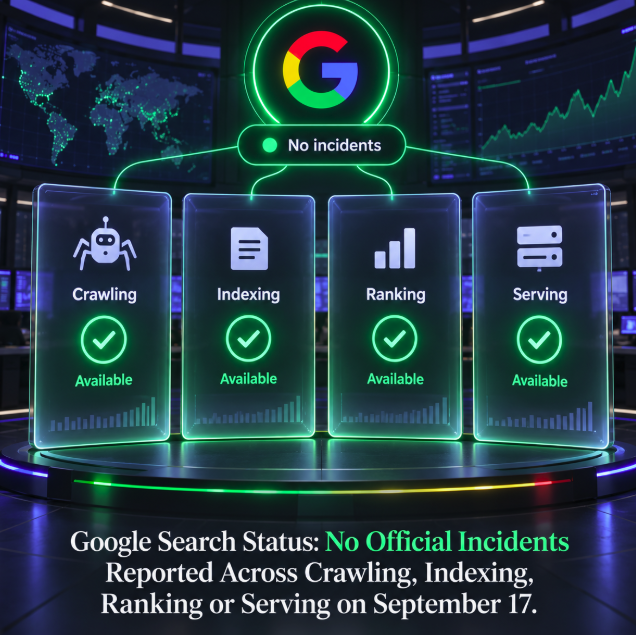
Google's official Search Status Dashboard continues to show a clean bill of health on September 17, 2026. At the time of checking, Google reports “No incidents”, with no service disruption or outage recorded for the four Search systems covered by the dashboard: crawling, indexing, ranking and serving. For SEOs investigating unusual traffic, visibility or indexing movements today, there is therefore no officially acknowledged Google Search infrastructure incident to point to.
The Google Search Status Dashboard was last updated on September 17 and shows all four monitored categories as available. The current timeline contains no incident marker for September 17, while Google's incident history also reports no recent crawling or indexing incidents. This is an official operational status signal from Google, although it should be interpreted for what it is: confirmation that Google has not posted a qualifying incident to the dashboard, not proof that every site, query or Search feature is behaving normally for every user.
Crawling and indexing remain clear
Google's crawling category currently has no reported incident. That means the company is not acknowledging a broad problem with Googlebot's ability to crawl websites through the Search Status system. The dedicated crawling history likewise states that no incidents have been reported. For site owners seeing isolated crawl anomalies, server-log changes or fluctuations in crawl activity, the dashboard currently provides no evidence of a Google-wide crawling disruption.
Indexing is also clear. There is no September 17 indexing incident listed and no recent indexing incident in Google's status history. Again, this does not rule out site-specific indexing problems, canonicalization decisions, quality-related exclusions or normal processing delays. It simply means Google has not identified and published an indexing problem meeting the threshold for a Search Status Dashboard incident.
No ranking incident or update is active on the dashboard
The ranking column also shows no current incident. Google's dashboard is used not only for outages but also to document major confirmed ranking updates, which appear as service information events. The recent history lists the August 2026 spam update, which began on August 18 and ran for roughly two days and 16 hours, along with earlier 2026 updates including the June spam update, May core update, March core and spam updates, and the February Discover update.
None of those events is active on September 17. Consequently, if third-party volatility tools or individual sites show movement today, the official dashboard does not currently associate that movement with a confirmed ranking update or ranking-system incident. Search volatility can occur without an announced update, so the absence of a dashboard entry should not be interpreted as evidence that rankings are static.
Serving is also operating without an official incident
Serving, the fourth system tracked on the dashboard, is similarly marked available. Google's incident history shows previous serving problems — including a short incident in February 2026 — but nothing active for September 17. A serving incident generally concerns Google's ability to present Search results to users, making this category particularly useful when widespread reports suggest that the results page itself is unavailable or malfunctioning.
At present, there is no such official alert. That provides a useful baseline for diagnosing reports from individual websites or markets: before attributing a sudden Search change to a platform-wide outage, the official dashboard can establish whether Google itself has acknowledged a broader operational problem.
“No incidents” does not mean “nothing is changing”
The distinction is important for SEO monitoring. Google's Search Status Dashboard is not a live catalog of every SERP experiment, algorithm adjustment, ranking fluctuation or isolated bug. Google describes it as a place to provide status information for Search services, and its history demonstrates that it is primarily used for significant incidents and confirmed major ranking events. Many observable changes in Search will never produce a status entry.
A clean dashboard therefore narrows the diagnosis rather than ending it. If a site's organic traffic suddenly falls while crawling, indexing, ranking and serving remain officially available, the next steps are still to examine Search Console data, indexing coverage, crawl behavior, technical changes, query-level rankings and broader SERP conditions. The absence of a reported incident means only that there is currently no official platform-wide explanation supplied through this channel.
As of September 17, that is the status worth recording: Google reports no official Search incidents across crawling, indexing, ranking or serving. For anyone maintaining a daily search-monitoring log, it is a quiet update — but an important control point when separating confirmed Google infrastructure events from the normal noise, experiments and volatility of the search ecosystem.