
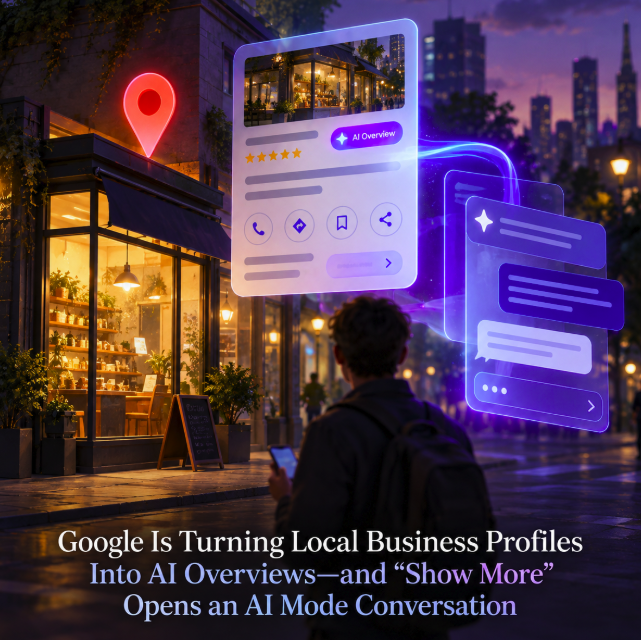
Google appears to be testing a significant change to one of the most familiar surfaces in local search: the Local Knowledge Panel. A Google Business Profile has been spotted displaying an “AI Overview” label directly inside the local panel, turning what has traditionally been a structured business information card into an AI-generated summary. More importantly, selecting “Show more” can move the searcher into a conversational interface resembling AI Mode, creating a much more fluid path from looking up a business to asking Google follow-up questions about it.
The test was reported on September 17 by Barry Schwartz at Search Engine Roundtable, following an example shared by local search specialist Ben Fisher. Schwartz said he was also able to reproduce the experience. The observed panel places the AI Overview label at the top and includes a “Show more” control that leads into an AI Mode-style follow-up experience. At this stage, however, this should be treated as a test rather than a confirmed broad rollout: Google has not announced that every Business Profile or Local Knowledge Panel will receive the interface.
The Local Knowledge Panel is becoming an answer, not just a listing
The distinction matters because a Local Knowledge Panel has historically functioned primarily as a compact collection of business facts and actions: name, category, reviews, address, opening hours, photos, directions, phone information and other attributes associated with a Google Business Profile and Google's local data. An AI Overview changes the role of that surface. Instead of simply organizing information, Google can synthesize it into a narrative response about the business before the user decides whether to visit its website, read individual reviews or explore other sources.
The conversational handoff makes the experiment more consequential. A person who begins with a navigational or local query could move from a short AI-generated description into follow-up questions without returning to the conventional search results. Questions about what a company offers, which services appear relevant, or other details about the business could increasingly be handled inside Google's own AI interface. The search journey therefore becomes less like “query, listing, click” and more like “query, summary, conversation.”
Google has been steadily connecting AI Overviews and AI Mode
This local test does not appear in isolation. Google has spent months reducing the boundary between AI Overviews and AI Mode. In December 2025, Google publicly began testing a transition that allowed users to go deeper from an AI Overview into AI Mode, as Search Engine Land reported. By January 2026, follow-up questions from AI Overviews were being routed directly into AI Mode, making the shift from a generated summary to a conversation increasingly seamless.
Google has also experimented with how much of an AI answer appears directly on the results page. In August 2026, the company confirmed that AI Overviews could dynamically expand for some queries when its systems determined that a fuller response would be useful. That experiment made the traditional Search interface look more like AI Mode before the user had explicitly entered a separate conversational experience. The newly observed Local Knowledge Panel treatment suggests that the same design philosophy may now be reaching local and branded business searches.
Why this test matters for Local SEO
For businesses, the most important shift is one of representation. A company can maintain its Business Profile, website, opening hours, categories, photos and other first-party information, but an AI-generated summary introduces another interpretive layer between those sources and the searcher. Google is no longer only displaying business data; in the tested interface, it is also describing the business through a generated answer.
That raises practical questions for Local SEO. Accurate, consistent and current information becomes even more important when automated systems may synthesize multiple signals into a concise description. Schwartz noted in his own test that some information surfaced by the AI reflected older material on his corporate website. That observation is particularly instructive: stale first-party content can remain available to retrieval systems even when a business considers it outdated. Keeping service pages, company descriptions and other authoritative business information current may therefore matter not only for conventional rankings and users, but also for how AI systems characterize the company.
There is also a visibility question. A conversational experience can satisfy more of a user's informational needs without requiring an immediate visit to the business website. That does not mean local websites suddenly become irrelevant: Google still needs dependable information from the web and from business data to construct useful answers. But the value of a page may increasingly include whether its information is understood, retrieved and represented correctly inside AI-generated search experiences, not only whether it earns a traditional organic click.
A test worth watching, not a rollout to assume
The scope should not be overstated. The evidence currently shows an interface observed in the wild and reproduced by Schwartz, not a universal redesign of Google Business Profiles. There is no confirmed rollout timetable in the report, and Google can modify or abandon experiments before they reach a broader audience. Local businesses and SEOs should therefore avoid treating the AI Overview label as a standard feature until Google provides broader confirmation or the interface becomes consistently visible across accounts, locations and query types.
Even as a test, however, the direction is notable. Google has already been joining AI Overviews and AI Mode across general Search, and placing the same pattern inside a Local Knowledge Panel would extend conversational search into one of the most commercially important parts of the results page. If the experiment expands, a Google Business Profile may increasingly serve as the starting context for an AI-mediated conversation about a company rather than merely a destination card containing its facts.
For Local SEO, that would make a familiar principle more urgent: the information a business publishes across its website and Google presence needs to be accurate, explicit and current. In a search experience where “Show more” can become “ask more,” the content describing a business is no longer competing only for rankings. It may also become source material for the AI that explains the business to potential customers.