
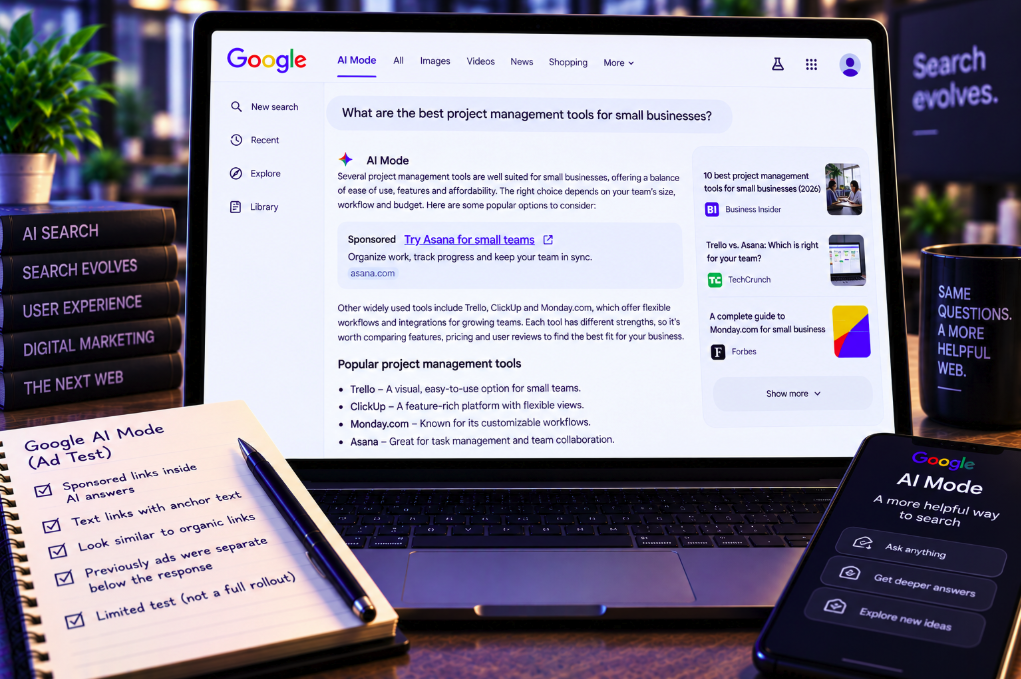
Google is testing a new kind of advertising inside AI Mode that narrows the visual distance between a paid placement and the links users already encounter in generative answers. Instead of appearing only as a separate ad module beneath the response, a sponsored destination has been spotted as a text hyperlink with anchor text integrated directly into the answer area and preceded by a clear “Sponsored” label.
The experiment was reported by Search Engine Roundtable as another step in Google’s rapid testing of AI Mode monetization. The important distinction is that this is an observed test, not a confirmed broad rollout. Google has spent much of 2026 experimenting with advertising formats for conversational Search, but the company has not announced that native-looking sponsored text links are now a standard AI Mode unit.
The test matters because the hyperlink itself resembles the interaction pattern of an organic source citation more closely than a conventional display-style ad card. The disclosure remains visible, so describing the unit as a disguised organic result would be inaccurate. What is changing is the placement language: advertising is moving closer to the flow of the generated answer.
The sponsored link is embedded in the answer experience
In the observed interface, the paid destination is presented through anchor text rather than only through a large standalone advertisement block.
That creates a reading experience familiar from ordinary web content. A sentence or recommendation can contain a clickable phrase, while the “Sponsored” label identifies the commercial nature of the placement.
For users, this reduces the interruption between reading an AI-generated explanation and moving to a commercial destination. For advertisers, it potentially creates a path into the exact moment when the answer has established context around a product, service or next step.
For publishers and SEO teams, it introduces another type of link competing for attention inside a response that already contains organic citations and source cards.
This is not the same as an unlabeled paid citation
The phrase “sponsored citation” is useful shorthand for understanding the visual concept, but it can also mislead.
The observed link carries a “Sponsored” disclosure. There is no evidence that Google is secretly inserting paid destinations into its organic citation system or removing the distinction between advertising and unpaid sources.
There is also no evidence that advertisers can pay to become one of the sources used to ground the factual content of an AI Mode response.
The safer description is a sponsored text link integrated into the generative-answer interface.
That distinction matters because citation provenance and advertising placement solve different problems. Organic citations are intended to identify sources behind information. Ads are commercial opportunities selected through Google’s advertising systems.
Google has been moving ads closer to AI conversations all year
The experiment is consistent with Google’s stated advertising direction.
At Google Marketing Live in May, the company announced new AI Mode ad formats built with Gemini, describing conversational Search as an opportunity to provide product information and commercial guidance at relevant points in the user journey.
Google has also said that AI Mode creates opportunities for businesses to fit naturally into the conversation. Its 2026 commerce roadmap describes sponsored retail and travel formats designed to appear when users move from exploration toward action.
The new text-link test pushes that principle further. Instead of attaching a commercial module to the answer, Google can experiment with a link presentation that feels structurally closer to the answer itself.
AI Mode is becoming a monetized search surface, not an ad-free experiment
When generative Search first appeared, one of the major business questions was where advertising would fit.
Traditional Google Search has a familiar commercial architecture: ads can appear above or below organic results, Shopping units occupy defined spaces and sponsored labels identify paid placements.
AI Mode does not naturally produce a ten-link results page. It generates a response, supports follow-up questions, surfaces sources and can move through a multi-turn research process.
That requires Google to invent ad formats suited to a conversation rather than simply transplanting the old search-ad block.
The sponsored hyperlink experiment is one possible answer.
Google has already confirmed other small AI Mode ad experiments
The company’s testing is not limited to new visual formats.
Earlier in September, Google Ads Liaison Ginny Marvin confirmed a small experiment allowing exact- and phrase-match Search campaigns to serve text ads in AI Mode when there is explicit and direct user intent.
That change expanded the campaign inventory potentially eligible for AI Mode beyond the broader automated targeting approaches associated with AI Max and Performance Max.
The new inline-style text-link observation should be viewed within that broader experimentation program rather than as an isolated interface curiosity.
Google is testing both how ads become eligible for AI Mode and how those ads are presented once they appear.
The placement could make contextual relevance more important
A conventional Search ad can match a query. A sponsored link inside a generated answer potentially has another layer of context: the content of the response itself.
Google has already described AI advertising as an opportunity to understand complex conversational intent and connect users with relevant businesses at the moment a need becomes clear.
That could make semantic fit between advertiser, user question and generated response especially important.
However, the current observation does not reveal the exact auction or placement mechanics behind this particular unit. It is not known whether the system selects an anchor based on the answer, generates the surrounding language dynamically, uses conventional text-ad assets or combines several mechanisms.
Those details should not be inferred from screenshots alone.
Advertisers cannot assume they can buy a specific sentence
The native-looking placement naturally raises a tactical question: can an advertiser pay to have its brand inserted into a particular part of an AI response?
There is no public evidence establishing that level of control.
Google has not announced an interface where advertisers select a generated sentence, purchase a specific citation-like anchor or instruct AI Mode exactly where to insert a sponsored link.
The test demonstrates presentation, not advertiser control.
Until Google publishes campaign documentation for the format, marketers should avoid treating AI Mode answer text as a new form of manually purchasable native editorial inventory.
The test could change how users scan AI answers
Visual integration matters because users develop habits around interface elements.
Large ad blocks are easy to recognize and skip. A text link embedded in the reading flow can receive attention at a different stage of comprehension.
The “Sponsored” label provides disclosure, but the interaction still occurs inside the answer rather than in a clearly separate section below it.
That could affect click behavior, particularly for high-intent queries where the answer naturally transitions from explanation to recommendation.
No public click-through-rate data has been released for this exact format, so any performance advantage remains hypothetical.
Organic citations may face a new competitor for attention
Publishers have spent the last two years trying to understand whether citations in AI answers generate meaningful referral traffic.
If sponsored hyperlinks become common inside those same responses, organic sources will not be the only clickable destinations competing for users who are ready to leave the AI interface.
This does not mean paid links will replace organic citations. There is no evidence that Google is reducing source links to make room for advertisements.
But the user’s finite attention can still be divided among citations, product modules, follow-up controls and sponsored destinations.
That makes the design of AI Mode monetization relevant to SEO even when the underlying organic ranking system does not change.
Paid and organic visibility may become visually adjacent
Search marketers are accustomed to paid and organic results appearing on the same page. What is new is how closely they can be woven into a generative response.
A publisher link may appear because AI Mode used or surfaced that source. A sponsored link may appear because an advertiser was eligible for a commercial opportunity.
Both can use descriptive anchor text and both can sit near the explanatory content.
The disclosure is therefore doing more work than it did in the traditional search-results layout. Users need to understand not only that a destination is clickable but why it is there.
For Google, maintaining that distinction will be central to trust as conversational ads become more native to the answer experience.
AI Mode advertising is not the same as AI Overview advertising
Google already supports advertising inside AI Overviews in eligible markets. Its Google Ads documentation explains that Search and Shopping ads can appear above, below or within AI Overviews under defined conditions.
AI Mode is a separate Search experience with a more conversational, multi-step interface.
The existence of documented AI Overview ads should therefore not be used as evidence that every AI Mode format is broadly available.
The new sponsored-link observation concerns AI Mode specifically and remains a test.
This distinction is particularly important for advertisers trying to understand where campaign reporting and eligibility apply.
The format could blur traditional SEO and PPC reporting
In classic Search, teams can usually separate paid and organic performance cleanly. Search Console reports organic clicks, while Google Ads reports paid activity.
Generative answers complicate the user journey even before advertising enters the picture. A user may see an organic citation, a product recommendation, a sponsored link and a follow-up prompt inside one conversational session.
Attribution then becomes a sequence rather than a single result-page click.
If a user reads an organic source summary but clicks the sponsored destination, the advertiser receives the measurable visit even though the publisher may have contributed information to the surrounding answer.
That possibility makes source visibility and referral value increasingly separate metrics.
Commercial intent can emerge after the original query
One reason conversational advertising is strategically attractive to Google is that users do not always begin with an obviously commercial search.
A person might ask how to solve a problem, compare approaches through several follow-ups and only later reveal that they are ready to purchase a tool or service.
AI Mode has access to that conversational context.
Google’s public advertising announcements repeatedly emphasize connecting businesses to users during these moments of consideration.
A sponsored text link integrated into the answer could be particularly effective when commercial intent becomes clear midway through the research process rather than in the initial query.
Native placement increases the importance of disclosure
The closer advertising moves to editorial or generated content, the more important labeling becomes.
The observed test uses “Sponsored,” which preserves an explicit distinction.
That is consistent with Google’s broader advertising approach. The company has repeatedly emphasized sponsored labeling across Search and AI-powered commercial experiences.
Future variations may change the visual treatment, but the core trust issue will remain the same: users should be able to distinguish a paid commercial destination from a source selected as supporting evidence.
A format that resembles a citation while hiding its commercial status would raise a very different set of concerns. That is not what the reported test shows.
There is no evidence that payment changes organic citation ranking
The new unit should not be interpreted as proof that advertisers can buy their way into AI Mode’s organic source rankings.
No available documentation shows that purchasing an ad improves the likelihood that the advertiser’s website will also be selected as an organic citation.
Paid eligibility and organic retrieval should be treated as separate systems unless Google states otherwise.
This is the same analytical discipline marketers apply to conventional Search: buying ads can increase paid visibility, but it does not establish an organic ranking benefit.
The visual proximity of the two link types should not be confused with shared ranking mechanics.
The test creates a new competitive surface for brands
If the format expands, brands may eventually compete in AI Mode on at least three distinct layers.
They can be mentioned in the generated answer. Their pages can be selected as organic sources. And their ads can potentially appear as sponsored commercial destinations within the conversational experience.
Those layers have different acquisition mechanisms.
Mentions and citations depend on the information ecosystem, retrieval and answer generation. Sponsored visibility depends on Google Ads eligibility, auction dynamics and commercial relevance.
A complete AI search strategy will increasingly need to monitor all three rather than treating “AI visibility” as a single number.
Publishers should track citation clicks separately from overall AI exposure
The test also reinforces why citation counts alone are insufficient.
A publisher can be cited frequently while receiving little traffic. If commercial links are placed closer to the action point in an answer, that gap could become more pronounced for some queries.
Publishers should therefore distinguish citation visibility from measurable referrals and downstream value.
The presence of an organic source in the answer can still provide authority or brand exposure even when another destination receives the click, but those benefits should not be confused with referral traffic.
As AI Mode becomes more monetized, the economics of citation visibility will matter as much as the raw count.
For PPC teams, the missing details are auction and reporting mechanics
The screenshots answer the question “what can the ad look like?” They do not answer the questions advertisers need for planning.
Which campaign types are eligible for this exact unit? Which match types can trigger it? How is the anchor text generated? Can advertisers see placement-specific impressions and clicks? Does the report distinguish an inline AI Mode link from another AI Mode ad format? How is conversion performance compared?
Google has not published those details for the observed test.
Until it does, performance claims and tactical recommendations would be speculative.
The most useful response for advertisers is to recognize the direction of travel without assuming the experiment is available in their accounts.
Google is searching for the native ad unit of conversational Search
Every major media format eventually develops advertising conventions suited to its interface.
Search created the sponsored text result. Social feeds created the sponsored post. Short-form video created native vertical video ads.
Conversational search still lacks one universally familiar ad unit.
Google’s experiments—from shopping and travel modules to Gemini-generated explainers and now citation-like sponsored hyperlinks—show the company testing several answers at once.
The winning format will need to balance advertiser performance, user usefulness and clear commercial disclosure without making the generative response feel overloaded.
The biggest change is not the label—it is where the link sits
“Sponsored” is not new to Google Search. Text ads have carried commercial labels for years.
What makes this experiment notable is the relationship between the ad and the generated response.
Instead of being only adjacent to the answer, the commercial link can appear in a form that reads more like part of the answer’s hyperlink architecture.
That is a small interface change with potentially large implications for user attention, advertiser strategy and publisher referral economics.
But the evidence remains limited. Google has not announced a broad rollout, there is no published performance data for the exact format, and screenshots cannot reveal the auction or ranking mechanics behind it.
For now, the correct conclusion is narrower: Google is testing sponsored text links that look more native to AI Mode’s answer flow while still carrying a visible paid label.
If that design expands, AI search will no longer be just a contest to become the source behind the answer. It will also become a contest to become the commercial next step inside it.