
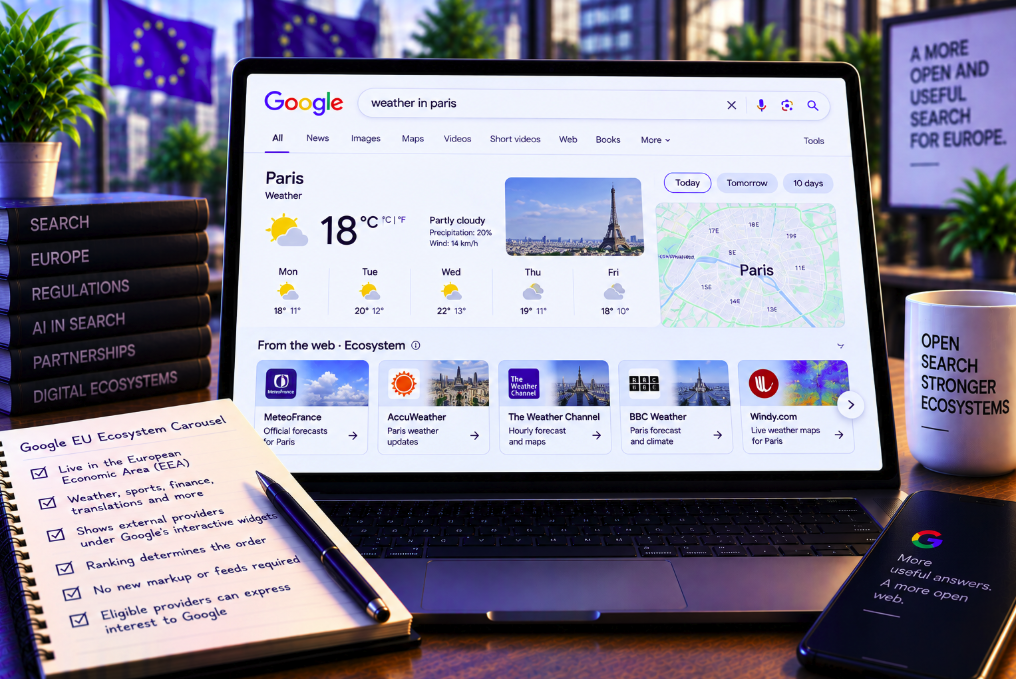
Google is giving external weather, sports, finance and translation providers a new route into some of the Search experiences that have historically answered a user’s question directly with Google-controlled interactive features. The company’s Ecosystem carousel is now documented as available across the European Economic Area, where eligible third-party sources can appear alongside data-rich Search answers and receive direct clicks to their own websites.
The feature has begun appearing in live results, according to Search Engine Roundtable, while Google’s official Ecosystem carousel documentation now explains the availability, ranking and eligibility rules.
For publishers and specialized data providers, the strategic significance is straightforward. Queries such as weather forecasts, stock information, sports scores and translations have long been difficult organic opportunities because Google can satisfy much of the user’s need directly in Search. The Ecosystem carousel creates an additional outbound-link surface around those interactive answers without requiring publishers to implement a new schema type or build a dedicated feed.
The Ecosystem carousel is available across the EEA
Google says the feature is available in European Economic Area countries on both desktop and mobile devices.
Its scope is currently limited to four query categories: weather, sports, finance and translation.
Those categories share a common characteristic. Users often benefit from information that is easier to consume through a visualization or interactive interface than through a conventional text result.
Google gives examples including stock charts, weather information, sports scores and translations.
The carousel provides additional external sources around those experiences, giving users a way to move from Google’s data-rich answer to a specialized provider.
A click on a carousel tile goes directly to the external website
The outbound behavior is important.
Google’s documentation says that when a user selects a website tile in the Ecosystem carousel, the user is taken directly to that website.
This makes the feature materially different from a purely informational source label or an attribution element that keeps the user inside Google.
For participating providers, a carousel appearance can create a genuine referral opportunity from a query where the primary Search interface may already answer much of the user’s immediate need.
Google has not published click-through-rate data for the feature, so the size of that opportunity is still unknown.
The carousel addresses Search experiences where zero-click behavior is structurally likely
A weather query illustrates the problem clearly.
When a user searches for today’s temperature, Google can display the forecast, precipitation, wind and upcoming conditions directly on the results page. The user may have little reason to open a traditional organic result.
The same dynamic applies to a stock price, a football score or a basic translation.
These are not merely queries where Google ranks external pages. They are queries where Google itself provides an interactive answer layer.
The Ecosystem carousel inserts external providers back into that environment.
Google determines the order using Search ranking algorithms
Participation does not mean equal placement.
Google says the order of websites in the carousel is determined by its Search ranking algorithms. The company describes those systems as following non-discriminatory ranking principles designed to surface the most relevant results for the user’s location and language.
The exact ranking signals and their weights are not publicly documented.
That means providers cannot assume that expressing interest will produce a fixed position or even an appearance for every relevant query.
From an SEO perspective, the carousel is therefore a ranked Search surface, not a directory of approved participants displayed alphabetically or on rotation.
There is no new structured-data requirement
One of the most useful details in Google’s documentation is what publishers do not need to build.
No new structured-data markup is required specifically for the Ecosystem carousel. Google also says no special data feed is required.
This separates the feature from several other EEA Search experiences that rely on structured data, APIs or direct feed integrations.
Providers should not add unrelated carousel markup in an attempt to trigger the feature. Google’s ordinary structured-data carousel is a different Search feature with different supported content types and implementation rules.
The Ecosystem carousel does not use that mechanism.
Eligible providers can express interest directly to Google
Google provides an interest form for organizations that believe they qualify.
To be eligible, a website must serve users in the EEA and publish relevant finance, weather or sports information, or provide translation services.
Google also says the website must be an authoritative source or specialized provider in its field, giving examples such as major media organizations and commercial weather services.
Filling out the form is an expression of interest rather than a guarantee of inclusion.
Google does not say that completing the form overrides its ranking algorithms, guarantees eligibility or secures a particular carousel position.
This is not an open submission system for individual URLs
The interest mechanism should not be confused with URL submission.
Google is asking eligible providers to identify themselves as potential participants in the feature. It is not offering publishers a tool to submit a specific weather page, stock page or translation URL for guaranteed carousel placement.
Once a provider is eligible, Search ranking systems still determine which websites appear and in what order.
That distinction matters because it keeps the feature inside the broader Search ranking model rather than turning it into a manually curated link directory.
Location and language are explicit ranking considerations
Google specifically says the carousel is designed to show results relevant to a user’s location and language.
That makes regional usefulness particularly important.
A weather service with strong coverage in Germany may not have the same relevance for a query in Portugal. A translation provider may be more useful for one language pair than another. A sports publisher may specialize in leagues that matter disproportionately in a particular market.
For providers, this suggests that generic domain authority alone is unlikely to describe the opportunity adequately.
Market coverage, language support and topical specialization can all be part of the relevance problem.
The feature does not replace Google’s own interactive answers
The most aggressive interpretation would be that Google is opening its previously closed widgets to competitors.
That is directionally useful but needs qualification.
Google’s documentation says the Ecosystem carousel may appear when users search for information that benefits from data visualization or interactivity, and its broader regional Search documentation describes the carousel as appearing alongside such answers.
Google is not announcing that its own weather, finance, sports or translation experiences are being removed.
The change adds external routes around those answers rather than handing the entire interactive surface to third parties.
That distinction still matters economically
For an external provider, appearing adjacent to a Google answer can be substantially better than appearing only below it in ordinary organic results.
A user who has already received the basic answer may still want deeper information: a detailed hourly forecast, a longer-term chart, historical market data, sports analysis or advanced translation functionality.
The carousel can position specialized providers as the next step in that journey.
Whether users actually click at meaningful rates will determine the commercial value, and Google has not published that data.
But the existence of a direct outbound surface changes the opportunity set for categories that often struggle with zero-click behavior.
Weather providers gain a path beyond the instant forecast
Weather is perhaps the clearest use case.
Google can answer a simple forecast query immediately, but specialized services can offer radar, severe-weather alerts, hyperlocal models, historical observations, marine conditions and longer-range analysis.
The Ecosystem carousel can expose those providers while preserving Google’s instant forecast.
For weather publishers, optimization therefore becomes less about competing with the basic temperature widget and more about demonstrating authority and relevance as a specialized source worthy of a carousel position.
Finance providers can compete around interactive market answers
Finance queries have a similar structure.
A search for a company ticker can produce pricing and chart information directly in Google. Traditional organic links may sit below a highly functional market-data experience.
The Ecosystem carousel gives financial information providers another potential entry point around those queries.
That could matter for publishers offering richer charts, company fundamentals, news, analyst context or specialist market data.
Again, eligibility does not guarantee ranking, and Google has not disclosed which finance signals are most important for the carousel.
Sports publishers can appear around score-driven queries
Sports searches frequently have strong instant-answer intent.
A user looking for a score, fixture or match status may be satisfied by Google’s result without opening a publisher site.
External sports providers can potentially use the Ecosystem carousel to become visible within that same data-rich environment.
The opportunity is likely strongest when the provider adds something beyond the score itself: live commentary, statistics, analysis, league context or specialized coverage.
The ranking system ultimately decides which sources are most relevant for the user’s location and language.
Translation services receive a comparable discovery route
Translation is another category where Google’s own interface can complete the primary task without a click.
A user can enter a phrase, receive a translation and leave.
The Ecosystem carousel creates room for external translation providers to appear around that interaction.
Specialized services may differentiate through language coverage, contextual translation, professional workflows or other functionality.
For those companies, visibility in the carousel could represent a new acquisition channel that does not depend on outranking Google’s translation box with a conventional blue link.
The Ecosystem carousel is one piece of a broader EEA Search redesign
Google’s regional Search documentation now contains several experiences created specifically for the European Economic Area.
These include aggregator units, supplier units, structured-data carousels, job-site features and the Ecosystem carousel.
They should not be treated as interchangeable.
Aggregator and supplier units apply to categories such as hotels, flights, ground transportation and products and can involve provider data integrations. Structured-data carousels have their own markup requirements. The Ecosystem carousel covers weather, sports, finance and translation and explicitly requires no new markup or feed.
For SEO teams, identifying the correct EEA feature is now part of technical Search strategy.
Do not add carousel schema expecting to trigger this feature
The naming creates an obvious source of confusion.
Google has several features called carousels. Some are generated through structured data; others are Search features controlled by Google.
The Ecosystem carousel belongs to the latter category.
Adding ItemList or other carousel schema does not make a site eligible for this specific surface. Google explicitly says no new structured-data markup is required.
Publishers should follow the eligibility guidance for the Ecosystem carousel itself rather than attempting to reverse-engineer it through unrelated rich-result markup.
Authority and specialization are formal eligibility requirements
Google’s wording goes beyond simple topical relevance.
The site must be an authoritative source or a specialized provider in its domain.
That raises the bar above publishing a handful of weather, sports or finance pages.
A general publisher may qualify if Google considers it authoritative in the relevant area, while a dedicated commercial data provider can qualify through specialization.
The documentation does not provide a numeric authority threshold or a checklist that guarantees acceptance.
As with ordinary Search, authority remains a qualitative concept implemented through Google’s systems rather than a public score publishers can directly optimize.
The interest form creates a partnership layer on top of SEO
Most organic Search features do not ask publishers to announce that they want to participate.
The Ecosystem carousel does.
That creates an unusual hybrid model. Eligibility begins with the provider meeting domain and regional requirements and expressing interest, while actual ordering remains algorithmic.
For specialized providers, this means Search visibility has both an operational and an SEO component.
The company needs to be recognized as a potential ecosystem participant, but it still needs to be relevant enough to rank when the feature appears.
There is no evidence of paid placement
Nothing in Google’s documentation indicates that carousel order can be purchased.
The company says ordering is determined by Search ranking algorithms.
The feature should therefore be treated as an organic Search opportunity unless Google states otherwise.
This is particularly important as Google simultaneously experiments with more advertising inside AI-powered Search experiences. The Ecosystem carousel documentation describes a ranked external-source feature, not an ad product.
Publishers should measure the feature separately from ordinary organic results
If the carousel begins generating meaningful traffic, standard rank tracking may not fully describe its performance.
A provider could receive clicks from a tile positioned around an interactive answer even when its conventional organic result is much lower on the page.
Search Console and analytics data may reveal landing-page and query changes, but publishers will need to determine how clearly the feature can be isolated in their own reporting.
Google has not published a dedicated performance report for the Ecosystem carousel in the documentation reviewed.
Until such reporting exists, changes in eligible query traffic should be interpreted cautiously.
The feature creates an SEO opportunity without a new technical shortcut
The absence of new markup is both good and bad news for providers.
It reduces implementation cost. There is no special schema project or feed integration required merely to qualify.
But it also means there is no obvious technical switch that guarantees visibility.
The competitive work returns to fundamentals: provide authoritative information, serve the relevant EEA markets, support the right languages and topics, maintain crawlable high-quality pages and become a source Google considers useful enough to rank in the carousel.
The interest form can put an eligible provider on Google’s radar. It cannot manufacture relevance.
Europe is becoming a distinct Search product environment
The Ecosystem carousel also reinforces a larger trend: Google Search in Europe increasingly has features that do not exist globally in the same form.
The company’s regional documentation explicitly maps different Search experiences to EEA queries and provider types.
For international SEO teams, “what does Google Search look like?” can no longer be answered with one universal SERP model.
A weather, finance, sports or translation query in an EEA country can offer an external-provider opportunity that a comparable query elsewhere may not.
Regional Search feature monitoring is therefore becoming more important for businesses with European audiences.
Google is adding external links where its own widgets once dominated the journey
The Ecosystem carousel does not dismantle Google’s interactive answers. It does something subtler: it gives qualified third-party providers a ranked, clickable route into the same class of data-heavy queries.
That is meaningful for categories where the search engine itself can satisfy the user before a conventional organic click occurs.
Weather services, financial-data providers, sports publishers and translation platforms do not need a new schema type or special feed to participate. They need to serve EEA users, operate as an authoritative or specialized source, meet the category requirements and, if eligible, express interest to Google.
After that, ranking is still ranking. Google’s algorithms decide which providers appear and in what order, with location and language among the explicit relevance considerations.
The feature is therefore neither a guaranteed publisher referral program nor a technical rich-result hack. It is a new organic distribution surface inside some of Search’s most traditionally closed answer experiences.
For European providers in those four verticals, that makes it worth treating the Ecosystem carousel as a distinct Search opportunity—and measuring whether Google’s newly opened route actually sends users through it.