
Google Search is moving further away from the idea that searching means typing a query, waiting for a results page and starting over with another query.
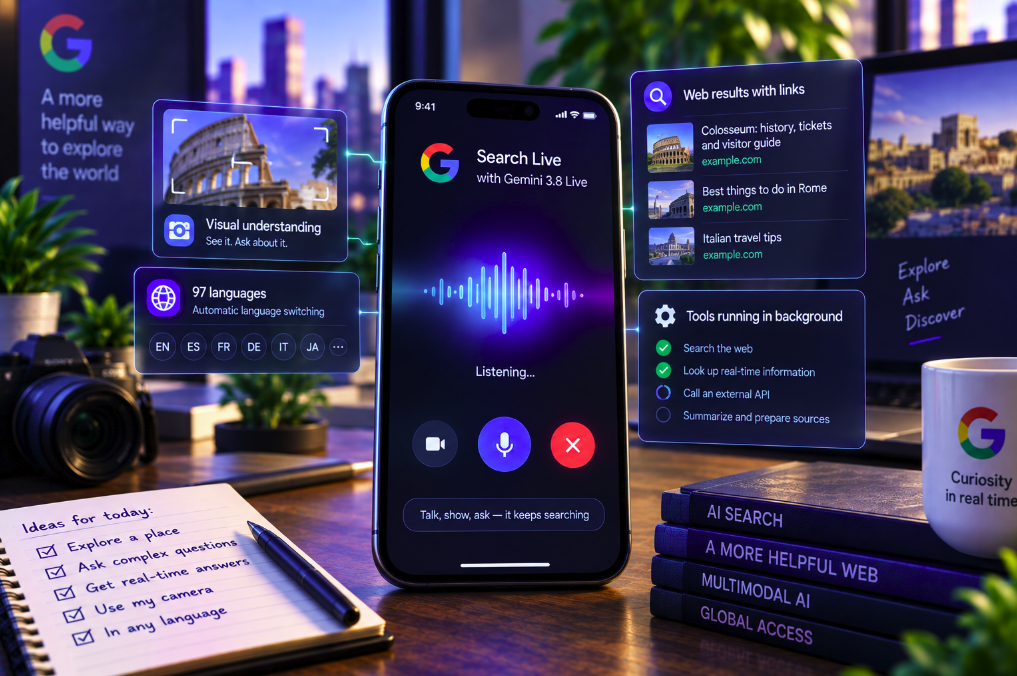
Search Live is being upgraded to Gemini 3.8 Live, giving Google’s conversational search interface a model designed for more natural voice interaction, automatic switching across 97 languages, near-real-time visual understanding and the ability to keep tools running while the conversation continues.
Google announced the model in its September 15 Gemini 3.8 Live release, while Search Engine Roundtable reported that the upgrade is rolling out to Search Live users.
The result is not a new search product so much as a significant model upgrade inside an interface Google has spent more than a year turning into a multimodal, conversational layer over the web.
Search Live is becoming a continuous conversation with Search
Traditional voice search largely converted speech into a query and returned a familiar search result.
Search Live operates differently.
A user can ask a question aloud, hear an AI-generated response, interrupt, clarify the request and continue with follow-up questions while maintaining conversational context. Web links remain available on screen for deeper exploration.
Gemini 3.8 Live is designed to make that exchange feel less like a sequence of commands and more like an ongoing conversation.
The model is optimized for natural voice interaction
Google describes Gemini 3.8 Live as a model built for fast, fluid conversational experiences.
That matters because latency and turn-taking become much more noticeable in speech than in text.
A user reading a generated answer can tolerate a short delay before the page appears. A person speaking to an assistant expects the system to recognize interruptions, understand changes of direction and respond at a conversational pace.
The quality of Search Live therefore depends not only on answer accuracy but also on whether the interaction feels responsive enough to keep talking.
Search Live already had native-audio ambitions
This is the latest step in a progression rather than the first attempt to make Google Search conversational.
In December 2025, Google upgraded Search Live with a native-audio Gemini model intended to make responses more fluid and expressive.
Users could already have back-and-forth voice conversations, ask for a different speaking pace and continue exploring web links during the session.
Gemini 3.8 Live extends that trajectory with a newer model architecture and a broader set of live multimodal and agentic capabilities.
Automatic language switching now spans 97 languages
One of the most consequential changes is multilingual behavior.
Google says Gemini 3.8 Live can automatically switch among 97 languages during conversation.
This is more than translating one completed answer into another language.
A multilingual user can change languages as the discussion evolves without manually restarting the interaction or explicitly selecting a new language for every turn.
For Search, that makes language increasingly part of conversational context rather than a fixed setting attached to the initial query.
Code-switching makes Search more realistic for multilingual users
People do not always speak in one language at a time.
A traveler may ask a question in English, read a sign in Italian and then repeat a local phrase aloud. A bilingual household can move naturally between languages. A technical professional may use English product terminology inside a conversation conducted primarily in another language.
Automatic switching allows the model to follow that behavior rather than forcing the user to adapt to the interface.
That could make Search Live especially useful in travel, education and cross-border commerce, where language context changes quickly.
Search Live was already global before the Gemini 3.8 upgrade
Google expanded Search Live internationally in March 2026.
Its global rollout announcement said the experience was becoming available in more than 200 countries and territories wherever AI Mode was supported, including Italy.
At that stage, Search Live used Gemini 3.1 Flash Live and was already described as intrinsically multilingual.
The move to Gemini 3.8 Live should therefore be understood as an upgrade to an existing global product, not the launch of multilingual Search Live from scratch.
The camera turns the physical world into query context
Search Live also supports visual input.
A user can point the phone camera at an object, place, document or problem and discuss what Search sees while continuing the voice conversation.
Gemini 3.8 Live brings near-real-time visual understanding to that interaction.
The practical difference from conventional image search is that the visual input does not need to become a one-time query. It can remain part of an evolving conversation.
The user can show, ask, clarify and redirect without rebuilding the context from zero.
Visual search becomes an ongoing inspection process
Consider a user troubleshooting a home repair.
A static image search might identify the component in a photograph. Search Live can instead observe what the camera is showing while the user asks what the part is, whether a visible condition looks normal and what information should be checked next.
The same interaction model can apply to travel landmarks, products, plants, classroom problems and other physical-world questions.
The search session becomes less about finding a page from a query and more about maintaining a shared context between the user, camera and web.
Web links remain part of the Search Live experience
Google has consistently emphasized that Search Live is connected to the web rather than operating as a closed voice assistant.
The original Search Live launch surfaced links from across the web alongside AI-generated audio responses, giving users a path to inspect the underlying information or explore related sources.
The Gemini 3.8 Live upgrade retains that web-connected model.
This matters for publishers because conversational Search can still create discovery opportunities even when the first interaction happens through voice rather than a traditional list of blue links.
The link is becoming a supporting object inside the conversation
The role of the link, however, is changing.
In traditional Search, the result link is usually the primary product. Google organizes candidate pages and the user chooses one.
In Search Live, the immediate product is the conversational answer. Links become supporting paths for verification, deeper reading, transactions or exploration.
That changes the economics of visibility.
A source can help inform the answer even when the user never leaves the conversation, while another source may earn a click because the user wants more detail than voice can efficiently provide.
Search Live can keep tools running in the background
Gemini 3.8 Live also introduces a more agentic dimension to live conversation.
Google says the model can execute tools and API calls in the background while continuing to interact with the user.
That removes a familiar conversational bottleneck.
An assistant no longer has to make every external operation feel like a hard pause in the dialogue. It can begin retrieving or processing information while the user continues speaking.
Background execution changes the rhythm of search
Conventional search is sequential.
The user submits a query, Google retrieves information, the interface displays results and the user decides what to do next.
A live agentic interaction can overlap those stages.
The system can start a tool call while the conversation continues, gather new information and incorporate the result when it becomes available.
That makes Search less like a sequence of discrete requests and more like a process running alongside the user.
“Keep searching while you keep talking” is useful shorthand, not unlimited autonomy
The capability should not be overstated.
Google’s announcement supports background tool execution and API use while conversation continues. It does not mean Search Live independently performs unlimited web research after every question or that every conversational turn triggers external APIs.
Tool use depends on the task and the capabilities Google exposes in the product.
The important architectural change is concurrency: conversation and external work no longer have to happen strictly one after another.
Search Live can combine voice, vision, web retrieval and tools in one session
The larger story is the convergence of several search modalities.
Voice provides the instruction. The camera can provide environmental context. Search supplies web information and links. Tools can perform additional operations. The model maintains conversational continuity across the interaction.
Each capability existed in some form before Gemini 3.8 Live.
What is becoming more powerful is their coordination inside one continuous session.
This is closer to Project Astra’s original vision
Google has spent several years developing the idea of a universal assistant that can perceive the world, maintain context and use tools while interacting naturally.
Project Astra demonstrated that direction before many of its capabilities reached consumer products.
Search Live has gradually absorbed parts of that vision, including live camera understanding and conversational audio.
Gemini 3.8 Live makes the Search implementation more capable without turning Search into a completely separate assistant product.
Search is becoming less dependent on explicit query formulation
Traditional SEO assumes the user expresses an information need through a query.
Live multimodal search weakens that assumption.
The user may point the camera at something and ask “What is this?” The next turn might be “Is that normal?” followed by “Can I fix it myself?” None of those prompts contains the complete subject because the model carries visual and conversational context forward.
The information need exists across the session rather than inside one self-contained keyword string.
That makes keyword-level measurement less complete
For marketers, this creates a familiar measurement problem.
A conventional query can be logged as a string and grouped with similar searches. A live conversation can distribute intent across several turns, languages and modalities.
The camera may provide the entity. Speech may provide the problem. A later follow-up may introduce commercial intent.
Trying to compress that journey into one “keyword” can lose much of the context that determined which sources were useful.
Publishers need content that works when the query is implicit
This does not mean keywords stop mattering.
It means content needs to be understandable at the entity, task and relationship level as well.
If Search Live sees a device through the camera and the user asks how to solve a specific problem, Google needs sources that clearly explain the device, symptom, cause and solution even if the user never speaks the exact phrase appearing in the page title.
Semantic clarity becomes particularly valuable when the query is assembled from several modalities.
Multilingual Search raises the importance of localized information quality
Automatic switching across 97 languages also creates new expectations for international content.
A user can begin researching a company in one language and continue in another without starting a new search session.
Brands with inconsistent regional pages, outdated translated documentation or contradictory local product information may therefore expose those discrepancies inside one conversation.
International SEO becomes less about maintaining separate keyword silos and more about maintaining consistent facts across languages and markets.
Visual understanding creates new source-selection problems
When a camera is part of the query, the system first needs to understand what it is seeing.
That interpretation can influence the subsequent retrieval task.
If the model identifies an object incorrectly, it may search for the wrong supporting information. If it recognizes the entity accurately, it can retrieve much more specific sources.
For publishers and brands, structured product information, clear imagery and unambiguous entity descriptions can become useful inputs to a broader multimodal information ecosystem, even though Google has not announced a new Search ranking factor tied to Gemini 3.8 Live.
There is no new SEO ranking signal in the announcement
The model upgrade should not be converted into an unsupported algorithm story.
Google has not announced that Gemini 3.8 Live introduces a new ranking factor, a new Search Console metric or a new optimization requirement for publishers.
There are also no published benchmarks showing how the model changes referral traffic, citation rates or click-through rates from Search Live.
Those questions may become important as usage grows, but the September 15 announcement is a product and model update rather than an SEO ranking disclosure.
Search Live and Gemini 3.8 Flash are different upgrades
The naming can easily create confusion.
Earlier in September, Google brought Gemini 3.8 Flash to AI Mode for eligible Google AI Pro and Ultra subscribers.
Gemini 3.8 Live is a different model optimized for live multimodal interaction.
The Search Live rollout discussed here should therefore not be described as merely the voice interface for Gemini 3.8 Flash.
They are related members of the Gemini 3.8 generation with different product roles.
Gemini 3.8 Live Extended Thinking is also a separate concept
Google’s announcement introduces Gemini 3.8 Live alongside a Live Extended Thinking capability designed for more complex reasoning.
That does not mean every Search Live response automatically uses the extended-thinking path.
The distinction matters because it would be easy to take capabilities announced for the broader Gemini Live model family and attribute all of them to every Search interaction.
Publishers and analysts should track what Google explicitly deploys in Search rather than assuming complete feature parity across Gemini products.
Voice answers make citation design more important
Links are easy to scan on a conventional results page and harder to consume while listening.
That creates a design challenge for Google.
Search Live needs to provide an efficient spoken answer while keeping source links accessible enough that users can verify claims, read more or complete a transaction.
The more conversational the interface becomes, the more important it is that the transition from synthesized answer to source remains understandable.
Otherwise the web risks becoming invisible infrastructure behind the voice.
Background tools could make commercial searches more task-oriented
Tool execution also changes what a search session can accomplish.
A user may not only ask for information but expect the system to retrieve current data, compare options or interact with external services while the conversation continues.
That moves Search closer to task completion.
The commercial opportunity shifts from ranking for an informational query toward being a reliable source, service or API that can participate in a longer workflow.
Google has not announced universal autonomous transaction capabilities through this Search Live upgrade, but the architecture points toward increasingly action-oriented search experiences.
Websites may compete to become inputs, destinations or tools
In a conversational search environment, a business can create value in several ways.
Its webpage can provide evidence that informs the answer. Its link can become the destination a user opens for more detail. Its structured service can potentially become a tool used to complete a task.
Those roles are different.
A publisher may optimize primarily for authoritative information. A travel platform may care about both informational visibility and actionable inventory. A software company may increasingly need documentation that serves humans while exposing reliable machine-accessible interfaces.
Search Live makes the user journey harder to reduce to a SERP
A live search session can begin with the camera, continue through voice, switch languages, invoke web retrieval and finish with a source link.
There may never be a traditional results page that captures the whole journey.
That challenges analytics systems built around impressions, positions and clicks attached to discrete queries.
Google has not announced a new reporting framework that fully represents these conversational journeys.
For SEO teams, that measurement gap may become as strategically important as the model upgrade itself.
The web still matters even when Search feels like an assistant
The evolution toward voice and vision can make Search look increasingly self-contained.
But Google continues to surface web links and has historically described Search Live as using Search quality and information systems to find relevant content.
The interface is changing faster than the underlying need for external information.
When a user asks about a current event, a product, a local service or a specialized technical problem, Search still needs fresh and authoritative sources.
The competition is increasingly over how those sources participate in the answer rather than whether the web disappears.
Gemini 3.8 Live turns Search into a process that can run alongside the user
The most important change is not any single feature.
Voice existed before this release. Search Live already supported camera context. Web links were already part of the interface. Multilingual capabilities had already expanded globally.
Gemini 3.8 Live improves the coordination of those capabilities while adding stronger background tool execution and broader automatic language switching.
That makes Google Search feel less like a place where users submit queries and more like an ongoing information process that can listen, see, retrieve and act while the conversation keeps moving.
For users, that can make Search more natural. For publishers and brands, it makes visibility more complex: the next search may not begin with a keyword, remain in one language or even stop while Google looks for the answer.