
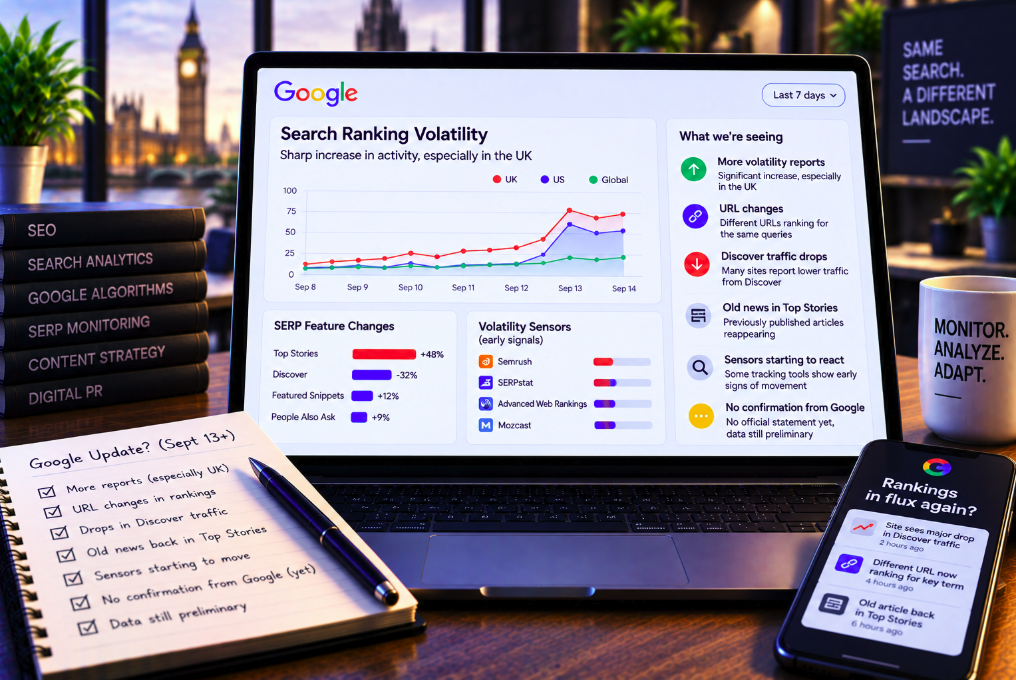
Google Search rankings appear to be moving again only days after several sites saw a sharp September 13 recovery from losses that had begun around September 3–4. This time, the early warning signal is coming primarily from SEO and publisher reports rather than a synchronized spike across every third-party volatility sensor.
Barry Schwartz reported a fresh surge in Google ranking volatility on September 15, with particularly strong chatter from the United Kingdom. Site owners and search marketers are describing abrupt changes in which URLs rank, traffic losses in Google Discover and previously published news stories reappearing in Top Stories.
Some algorithm-monitoring tools are beginning to react, but the sensor data was still mixed when the report was published. Google has not announced a ranking update tied to the movement, and its Search Status Dashboard showed no listed Search incident through September 14.
That leaves the industry in a familiar but uncomfortable position: something appears to be changing, but the available evidence is too preliminary to say what it is.
The timing is notable because September 13 had just reversed earlier losses
The new turbulence follows an unusual sequence earlier in the month.
Around September 3–4, several large sites tracked by SEOs experienced significant visibility changes. On September 13, some of those movements reversed almost completely, with affected sites recovering much of what they had lost.
That recovery was never established as a universal Google rollback. It applied to specific observed sites, and Google did not announce an update corresponding to either the original movement or the reversal.
Now, two days later, the search community is again reporting substantial changes.
The proximity makes it tempting to describe the September 15 activity as a reversal of the September 13 reversal. The evidence does not yet support that conclusion. The affected sites, queries and Search surfaces may overlap, but there is not enough public data to establish that one ranking-system change is being undone and then reapplied.
UK SEOs are reporting particularly strong movement
Schwartz says the increase in chatter is especially noticeable among search marketers in the United Kingdom.
That regional concentration is worth monitoring, but it does not establish that Google launched a UK-specific ranking update.
Search volatility can appear more pronounced in one market because of the sites being monitored, the communities reporting the changes, local news cycles or differences in Search features. A globally deployed system change can also affect countries unevenly.
Until broader datasets show a clear geographic pattern—or Google confirms one—the UK should be treated as where the strongest early reports are currently coming from, not as a proven target of the change.
Some sites are seeing different URLs rank for the same queries
One of the more interesting symptoms is URL switching.
Publishers and site owners are reporting cases where Google is ranking a different page from the same site for an established query. That can produce large performance changes even when the domain itself remains visible.
A URL swap can happen for many reasons. Google may reinterpret search intent, change which page it considers most relevant, consolidate or separate clusters, reevaluate canonical signals, favor fresher material or simply recalculate the relative strength of several similar pages.
It is therefore not automatically evidence of a broad algorithm update.
But when URL switching appears across many sites at the same time as wider ranking volatility, it becomes a useful diagnostic signal.
URL-level analysis matters more than domain-level visibility right now
A site-level chart can conceal this kind of movement.
If one URL falls while another page from the same domain rises, aggregate visibility may look relatively stable even though Google’s interpretation of the site has changed materially.
SEO teams investigating the September movement should therefore compare winning and losing URLs at the query level rather than looking only at total organic sessions or domain visibility.
Questions worth asking include whether the replacement page is newer, more specific, more authoritative, more closely aligned with intent or part of a different content type.
Patterns across those replacements may eventually provide more insight than the overall volatility score.
Google Discover declines are appearing alongside Search complaints
Some publishers are also reporting losses in Discover traffic.
This adds complexity because Google Discover is not simply another set of traditional keyword rankings. It is a personalized recommendation surface whose traffic can be highly volatile even without a broad Search ranking change.
Discover performance can shift because of audience interests, freshness, content supply, topic demand and recommendation-system behavior.
Seeing Discover losses at the same time as organic ranking movement is therefore noteworthy but not proof that one algorithmic event caused both.
Teams should keep Discover and ordinary Search performance separated during diagnosis rather than blending them into a single Google traffic chart.
Old news stories are reportedly returning to Top Stories
Another unusual observation involves Google’s Top Stories feature.
Some search marketers are seeing older or previously surfaced news articles reappear in prominent news positions.
Freshness is obviously important in news search, so the reappearance of older material can look like a quality or indexing problem. But the age of an article alone does not prove that its inclusion is incorrect. An older story can become relevant again when an event develops, a topic resurfaces or Google reevaluates which article best explains the current query.
Without examples evaluated at scale or confirmation from Google, it would be premature to call the behavior a Top Stories freshness bug.
For news publishers, however, it is another signal worth logging alongside changes in Discover and standard organic visibility.
The volatility sensors are beginning to move—but not uniformly
Third-party ranking sensors are designed to detect unusual changes across large sets of search results.
Schwartz notes that some tools are beginning to show increased volatility, while others had not yet caught up with the intensity of the SEO chatter at publication time.
That lag does not necessarily mean the reports are wrong.
Different sensors monitor different keyword sets, countries, devices and result types. A change concentrated in UK results, news-heavy queries or particular verticals may take longer to register in a broad U.S.-weighted monitoring system.
Likewise, community reports can exaggerate the apparent scale of an event because people experiencing large losses are more likely to post about them.
The two evidence streams should be used together rather than treated as competing versions of reality.
Human reports can lead sensors during a concentrated change
Large volatility tools are excellent at identifying broad SERP movement, but they are aggregates.
If an event begins inside a particular market or content category, practitioners working directly in that segment may see it before a general-purpose index moves enough to trigger an alert.
This is one reason Schwartz’s long-running volatility reporting combines tool data with discussion from WebmasterWorld, social media and direct SEO observations.
The reverse is also true. Sensors sometimes spike before the search community notices widespread traffic changes.
Neither signal independently identifies the cause. Together they help establish whether unusual movement is likely to be systemic rather than isolated to one website.
Google has not confirmed a September 15 ranking update
There is currently no official Google announcement tying the reported movement to a core update, spam update or other named ranking-system change.
Google’s Search Status Dashboard also showed no incident affecting ranking, crawling, indexing or serving through September 14.
That absence needs careful interpretation.
The status dashboard is primarily an incident-reporting system. “No incidents” means Google has not listed a Search service disruption for the period. It does not prove that no unannounced ranking-system adjustment occurred.
Google makes many ranking changes without issuing individual public announcements.
For now, the correct description is observed volatility without a confirmed cause.
Do not assume the August spam update is responsible
The August 2026 spam update finished rolling out on August 21, several weeks before the current activity.
Because ranking changes can have delayed secondary effects, SEOs may naturally look back to the most recent confirmed update for an explanation.
There is currently no evidence connecting the September 15 movement to the August spam update.
The timing alone is insufficient, particularly because the September 3–4 movement, September 13 recovery and new September 15 volatility have not been officially classified by Google.
Attaching a confirmed update label to an unconfirmed event can lead site owners toward the wrong diagnosis.
Search, Discover and Top Stories should be investigated separately
The most useful immediate response is segmentation.
For standard Google Search, teams should compare query-level clicks, impressions, average position and ranking URLs before and after the movement.
For Discover, they should examine article-level traffic, topic clusters, publishing dates and whether losses are broad or concentrated among specific content types.
For Top Stories, publishers should monitor which URLs are entering and leaving the carousel, whether older articles are displacing newer coverage and whether the pattern appears across multiple queries.
Combining all three into one “Google traffic down” conclusion destroys potentially useful evidence about what changed.
The September 13 recovery should not be treated as a permanent baseline
Sites that recovered sharply on September 13 may be tempted to treat that day’s visibility as a restored normal.
The new reports show why that assumption is risky.
One or two days of recovery can represent a durable correction, a temporary recalculation or simply another stage in an unstable period. Without a confirmed update window, there is no official start and end point around which to interpret the movement.
SEO teams should preserve daily data and avoid rewriting content strategy based on a single recovery spike.
The most useful question is whether the September 13 gains persist through the next several days as the wider volatility develops.
Changing ranking URLs can expose internal competition
If a site is seeing different pages alternate for the same query, the current volatility may expose weaknesses that existed before September.
Two pages targeting nearly identical intent can send ambiguous relevance signals. Old and new versions of an article can compete. Category pages can overlap with editorial guides. Syndicated or parameterized URLs can complicate canonicalization.
A ranking system recalculation may not create those problems, but it can reveal them.
Teams should therefore inspect internal competition, canonicals, redirects, content overlap and internal linking before assuming every URL swap is an external algorithmic penalty.
Even if the broader volatility eventually settles, resolving genuine ambiguity can make the site more resilient.
News publishers should preserve evidence before making changes
Discover and Top Stories volatility can tempt editorial teams into rapid interventions: changing headlines, republishing stories, modifying dates or rewriting pages that suddenly lost visibility.
During an unconfirmed event, those actions can make diagnosis harder.
Publishers should first capture screenshots, Search Console data, Discover reports, ranking URLs, publication timestamps and any unusual Top Stories behavior.
If the rankings reverse again, that evidence will help distinguish a Google-side fluctuation from a change caused by the publisher’s own edits.
It is especially important not to manipulate publication dates merely because older articles are appearing in Top Stories. Google has not confirmed that freshness handling is broken.
Volatility sensors are indicators, not algorithm detectors
One common mistake is to treat a sensor spike as proof that Google launched an update.
Volatility tools measure changes in search results. They do not have direct access to Google’s ranking systems.
A spike can result from an algorithm change, a data refresh, a feature change, unusual news demand, index movement or several factors occurring together.
The current situation illustrates the limitation clearly. Practitioner reports are strong while the tools are only beginning to show broader movement.
The sensors tell us that rankings are changing. They cannot tell us why.
Community chatter has the opposite limitation
Forum and social reports provide detail that aggregate sensors cannot.
A publisher can say Discover disappeared overnight. An SEO can identify the exact URL that replaced another page. A news site can show an old article returning to Top Stories.
But those reports are not a representative sample of the entire web.
People with severe traffic changes are more likely to speak up, while unaffected sites usually remain silent.
That makes community chatter excellent for generating hypotheses and poor for estimating how many sites are affected.
The current evidence should therefore be described as a surge in reports, not a measured percentage of Google Search changing.
The UK concentration may help identify the pattern if it persists
If the strongest volatility continues to come from the UK while other markets remain relatively stable, that regional distinction could become diagnostically useful.
Teams operating internationally should compare the same site across countries rather than relying on a single global visibility index.
A UK decline with stable U.S., Canadian and Australian performance would suggest a different problem from a synchronized global loss.
Conversely, if other markets begin moving over the next day or two, the early UK concentration may simply have been the first visible phase of a broader event.
At the moment, both interpretations remain possible.
Wait for persistence before declaring another rollback
The sequence of September 3–4 losses, September 13 recoveries and September 15 volatility naturally encourages dramatic labels.
“Update,” “rollback,” “reversal” and “reversal of the reversal” all imply a level of causal knowledge the public evidence does not provide.
The safer approach is temporal description.
Some sites changed sharply around September 3–4. Some recovered around September 13. Fresh ranking and traffic changes are now being reported around September 15.
Whether those events belong to one ranking-system process or several unrelated changes remains unknown.
What SEO teams should monitor over the next several days
The most useful evidence will come from persistence and convergence.
If volatility sensors continue rising, more countries report similar behavior and affected sites show sustained query-level changes, the case for a broad ranking event becomes stronger. If the chatter fades and rankings revert quickly, the episode may prove narrower or more transient.
Teams should monitor winning and losing URLs, country segmentation, query classes, Discover separately from Search, Top Stories behavior and server/indexing anomalies. They should also record whether the September 13 recoveries hold or unwind.
Google confirmation would resolve some of the uncertainty, but it may never arrive. Not every ranking adjustment receives a public label.
The rankings are moving; the explanation is still missing
The evidence on September 15 supports one conclusion with reasonable confidence: Google Search is experiencing another period of unusual movement reported by a growing number of site owners and SEOs, particularly in the UK, and some third-party sensors are beginning to reflect it.
Everything beyond that requires caution.
Google has not confirmed an update. The Search Status Dashboard shows no listed incident. Discover declines, URL swaps and older Top Stories results may be related, or they may represent separate systems moving at the same time. The September 13 recovery may be connected to the new volatility, but the public data cannot establish that yet.
For SEO teams, the priority is not to name the event before Google does. It is to preserve the evidence, separate the Search surfaces, identify exactly which URLs and queries are changing and wait to see whether the movement persists.
The volatility sensors may only be starting to catch up. The next few days will show whether the search community spotted the beginning of a broader ranking event—or another short-lived tremor in an already unstable September.