
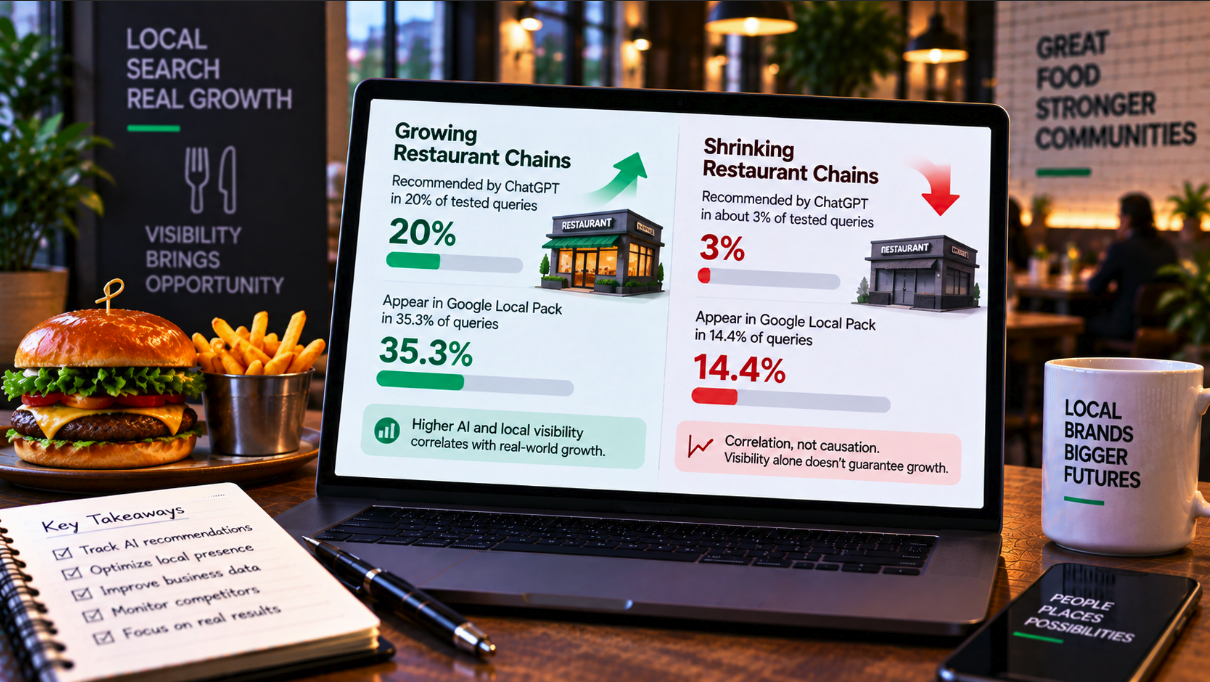
Restaurant expansion and digital visibility appear to be moving together. In a new SOCi analysis published as sponsored content on Search Engine Land, eight expanding restaurant chains were compared with eight contracting chains across local search, reviews, social media and AI recommendations. The largest gap appeared in ChatGPT: growing chains were recommended in about 20% of tested queries, while shrinking rivals appeared in roughly 3%.
That is a six-to-seven-times difference, but it is not evidence that ChatGPT visibility makes restaurants grow or that poor GEO performance closes stores. SOCi itself frames the pattern as a signal rather than a causal mechanism, and Search Engine Land explicitly notes that the article represents the sponsor’s conclusions. The study uses SOCi’s proprietary Local Visibility Index, which combines search rankings, review sentiment, social engagement and AI recommendation rates into a single 0–100 score. Expanding brands averaged 61.4, compared with 46.6 for contracting brands, suggesting that the difference was not confined to one emerging AI channel.
The same gap appears in Google local search and reputation
The conventional local-search data points in the same direction. SOCi reports that expanding chains appeared in Google’s Local Pack for 35.3% of tracked searches, versus 14.4% for contracting chains. They also earned Yelp’s top organic position 55% of the time compared with 29.3% for shrinking brands. Review profiles were stronger as well: expanding chains averaged 4.39 stars on Google and 3.65 on Yelp, compared with 3.82 and 2.49 respectively for the contracting group, while their Google review-response rate reached 72.4% versus 43.6%.
The social gap was even larger. According to the SOCi version of the analysis, expanding restaurant brands averaged a 3.45% local social engagement rate, while contracting brands averaged 0.13%, a roughly 26-fold difference. Growing chains also had about five times more local followers. SOCi argues that localized content, faster review responses and more disciplined location-level marketing are characteristics of the stronger group, but those operational differences can just as plausibly be consequences of a healthier business as causes of it.
ChatGPT may be amplifying the same local signals rather than creating a separate game
The AI result is notable because it does not appear in isolation. SOCi says Gemini and Perplexity showed the same directional pattern, although the sponsored article does not disclose exact figures for those platforms. In the company’s broader 2026 Local Visibility Index research, only about 1% to 11% of brand locations were recommended across ChatGPT, Gemini and Perplexity, compared with 35.9% appearing in Google’s traditional 3-Pack. That selectivity makes a 20% ChatGPT recommendation rate look substantial, but it also raises a methodological question: are AI systems independently identifying strong brands, or are they simply rediscovering the same reputation, location-data and authority signals already visible across the web?
The most conservative interpretation is that local GEO is building on the same public evidence that already supports local SEO. A chain with accurate location data, active review management, stronger ratings, locally relevant social content and broad third-party visibility gives AI systems more consistent evidence to retrieve and synthesize. That does not mean ChatGPT is using Google’s Local Pack as a ranking input, nor that any one of those factors has a fixed weight inside an AI model. It means the digital footprint associated with stronger restaurant businesses is also easier to find across multiple discovery surfaces.
The missing methodology prevents a causal conclusion
The study is useful as a comparative snapshot, but its public methodology is not detailed enough to support stronger claims. SOCi does not publish the full set of 16 brands, the complete prompt library, model versions, market distribution, query counts, weighting formula for the LVI, confidence intervals or statistical controls for variables such as store count, marketing spend, geography, pricing, brand awareness and underlying financial performance. Those omissions matter because restaurant chains that are already growing may have more resources to invest in local marketing, generate more customer activity and attract more reviews while simultaneously opening new locations.
That possibility of reverse causality is central to the result. A 20% ChatGPT recommendation rate could be part of the advantage enjoyed by expanding chains, but it could also be a by-product of stronger operations, healthier demand and larger marketing investment. The same applies to the 35.3% versus 14.4% Local Pack gap. The data shows a relationship between digital discoverability and business trajectory; it does not establish which direction the causal arrow runs, or whether both are being driven by a third set of factors.
For multi-location marketers, the value of the study is therefore diagnostic rather than predictive. If a restaurant brand is losing ground simultaneously in Local Pack visibility, review quality, response rates, social engagement and AI recommendations, that pattern deserves attention even if none of those metrics can explain store closures on its own. Conversely, a strong ChatGPT score should not be celebrated in isolation if local search, reputation or commercial performance is deteriorating. SOCi’s comparison suggests that the useful unit of analysis is the whole local-discovery system, not one fashionable GEO metric.
The headline remains difficult to ignore: in this proprietary sample, growing restaurant chains were recommended by ChatGPT about seven times more often than shrinking rivals. But the more important finding may be that the AI gap mirrors older local-search and reputation gaps rather than replacing them. For brands trying to understand GEO, that is a useful constraint: AI visibility may be newest part of local discovery, while the underlying business evidence it rewards is still being built in places marketers already know how to manage.