
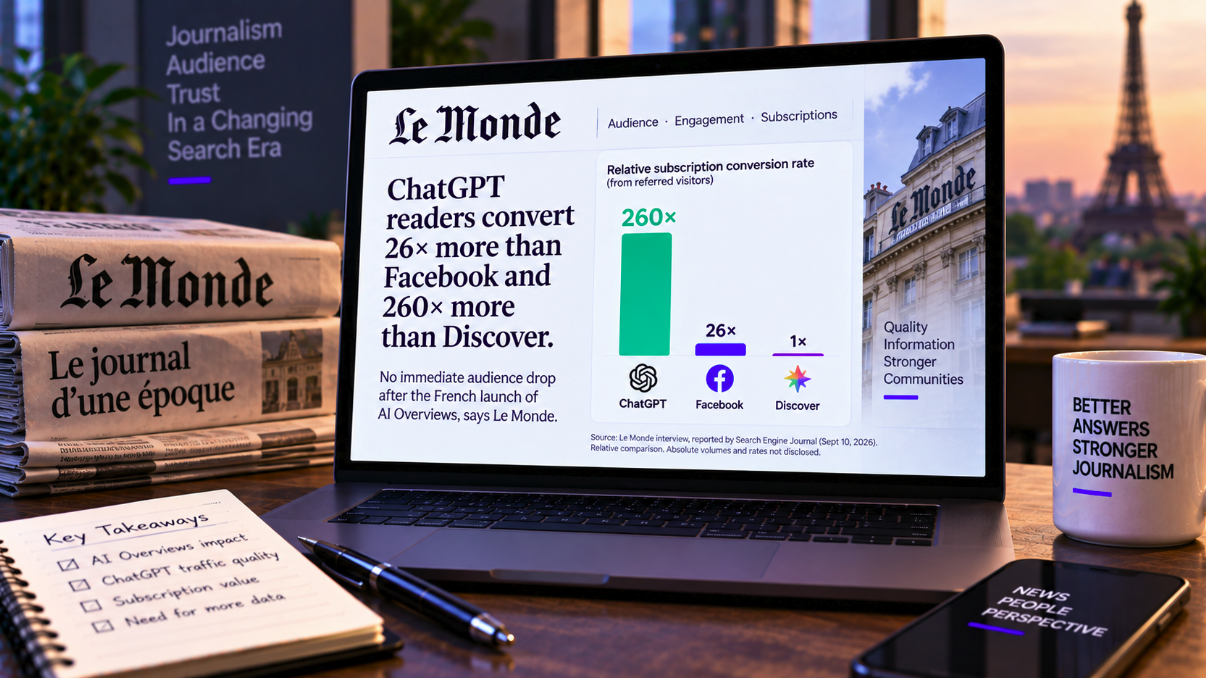
A referral that sends fewer visitors can still be more valuable if those visitors arrive ready to pay. Le Monde has supplied an unusually dramatic example: according to CEO Louis Dreyfus, visitors referred by ChatGPT convert into subscribers at a rate 26 times higher than visitors from Facebook and 260 times higher than those arriving through Google Discover. The figures, reported by Search Engine Journal from a September interview, arrive as publishers are simultaneously trying to measure whether Google’s AI Overviews are reducing the traffic available to convert in the first place.
The comparison is striking but incomplete. In the original INfluencia interview, Dreyfus did not disclose Le Monde’s absolute ChatGPT referral volume, the underlying conversion rates, cohort sizes, attribution window or the period over which the 26x and 260x ratios were calculated. That means the data supports a claim about relative conversion efficiency, not about how many subscriptions ChatGPT actually generates. A small stream of highly motivated visitors can convert spectacularly while still producing fewer total subscribers than a much larger, lower-converting channel.
Le Monde has not seen the sudden AI Overviews shock some publishers feared
The conversion claim sits inside a broader discussion about Google’s rollout of AI search in France. Google launched AI Overviews and AI Mode in France on July 22, intensifying publisher concerns that generated summaries could satisfy users before they click through to news sites. Dreyfus says Le Monde has not observed a sudden audience decline beyond normal seasonality. He also points to the English-language edition, whose traffic increased 7% in the first half of 2026 compared with the same period in 2025, despite serving markets where AI Overviews were already available.
Those figures should not be read as proof that AI Overviews have no traffic cost. Le Monde did not provide a separate series for Google Search referrals, so growth in apps, direct visits or other channels could obscure a decline in one acquisition source. Dreyfus himself stresses that estimates of a 30%-plus decline discussed by French press group APIG refer to Google Search traffic rather than total audience. Search Engine Journal notes that early French measurements remain inconclusive: APIG has no consolidated figures yet, while audience certifier ACPM says it cannot attribute visits to a specific Google Search feature. Le Monde’s own channel mix also offers insulation, with its apps accounting for 36% of group traffic in August.
The news-versus-service distinction may matter just as much as brand strength. Dreyfus argues that an AI summary of a breaking news story can function as a teaser that encourages readers to seek the full reporting, whereas an answer about health, food or a product decision may satisfy the user without a click. He says conversations with European publishers suggest some service-oriented verticals have experienced declines of up to 50%, but these are secondhand observations rather than a published comparative dataset. The implication is that “AI Overviews impact” may be too broad a metric: query intent and content type can determine whether a summary substitutes for a page or creates curiosity about it.
AI referral quality could matter more than raw click volume
Le Monde’s ChatGPT conversion ratio introduces a different way to value AI visibility. Dreyfus says the publisher was strict in its negotiations with OpenAI about being systematically sourced by ChatGPT with links back to its journalism. Le Monde also has multi-year agreements with Perplexity and Meta, and Dreyfus describes those contracts as financially significant. None of that proves that licensing causes higher referral conversion, but it shows why citation and attribution are becoming commercial issues rather than merely brand-visibility metrics: a cited answer can create a path from AI exposure to a paying relationship.
For publishers, the 260x Discover comparison is therefore more useful as a question than as a benchmark. If AI assistants send readers after they have already explored a subject, those users may arrive with stronger intent than someone passively encountering a headline in a recommendation feed. But without absolute rates and volumes, Le Monde’s numbers cannot tell other publishers what conversion rate to expect, nor whether ChatGPT currently contributes meaningful subscription scale. The right measurement framework needs both sides of the equation: referral volume and downstream value, including registrations, subscription starts, retention and revenue.
Le Monde’s early experience also shows why traffic alone is becoming an incomplete scorecard for the AI transition. The publisher says it added 24,000 subscribers in July and another 24,000 in August, record months in its own historical context, but those subscriptions are not attributed to ChatGPT or AI Overviews. What can be said is narrower and more interesting: Le Monde has not yet reported a sudden overall audience shock after France’s AI Overviews launch, while the AI referral traffic it does receive appears, by its own account, exceptionally conversion-rich. For media companies facing fewer predictable clicks, that raises a strategic possibility worth measuring carefully: the next referral channel may be much smaller than the last one and still be economically more valuable per visitor.