
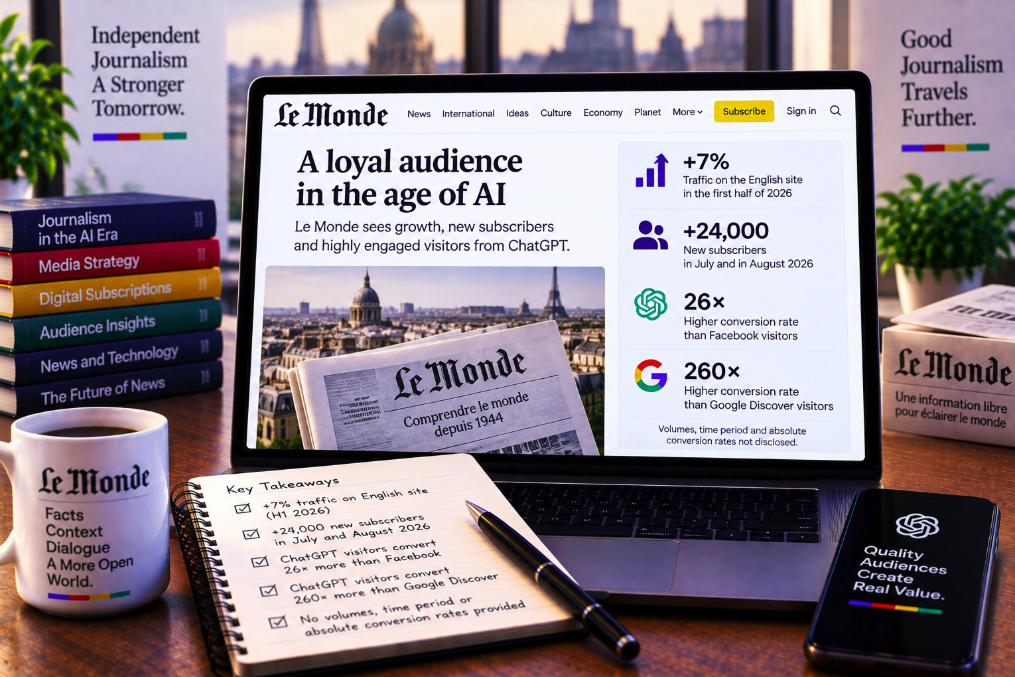
Le Monde is offering an unusually optimistic data point in the debate over whether generative AI will hollow out publisher traffic. The French news group says it has not yet experienced the sudden audience decline predicted by some industry forecasts after Google's AI Overviews reached France, while visitors arriving from ChatGPT appear to be extraordinarily valuable as potential subscribers.
The most striking number comes from Groupe Le Monde CEO Louis Dreyfus. In a September 8 interview with INfluencia, he said visitors referred by ChatGPT convert to subscriptions at a rate 26 times higher than visitors from Facebook and 260 times higher than visitors from Google Discover.
Those ratios are remarkable, but they are also incomplete. Le Monde did not disclose the number of ChatGPT referrals, the absolute conversion rates for any of the channels, the measurement period or the precise cohort methodology. As Search Engine Journal noted on September 10, the figures show relative conversion performance, not the scale of the traffic behind it.
That distinction is the central story. Le Monde's experience suggests AI referrals can be commercially valuable for a subscription publisher, but it does not establish that ChatGPT is already a large acquisition channel or that AI Overviews are harmless to news traffic generally.
Le Monde says its audience has not suddenly fallen after AI Overviews
Google launched AI Overviews in France in July 2026, intensifying a long-running concern among French publishers that generated answers could satisfy users directly on the search results page and reduce clicks to news websites.
Dreyfus says Le Monde has not observed the abrupt audience decline that some forecasts anticipated. Apart from normal seasonal variation, he describes the group's traffic as resilient so far.
That does not mean Google Search referrals are unchanged. Le Monde did not provide a source-level breakdown showing how much traffic Google Search sent before and after the rollout.
Overall audience can remain stable even when one acquisition channel declines if apps, direct visits, newsletters, social platforms or other sources compensate for the loss.
The English edition grew 7% in the first half of 2026
Dreyfus points to Le Monde in English as an early real-world test because much of its readership comes from markets where AI Overviews were already available before the French rollout.
Traffic to the English-language site increased 7% in the first half of 2026 compared with the same period in 2025, according to the CEO.
The English edition is read heavily in the United States, United Kingdom, Scandinavia and India, making it a useful counterexample to the assumption that exposure to AI summaries must immediately produce a visible audience collapse.
It is not a controlled experiment. Traffic can grow for many reasons, including editorial performance, major news cycles, brand development, product changes and audience acquisition outside search.
Le Monde added 24,000 subscribers in July and another 24,000 in August
The group's subscription performance was also strong during the first two months surrounding the French AI Overview rollout.
Dreyfus says Le Monde added 24,000 new subscribers in July and another 24,000 in August, describing both as record months for the company.
Those figures should not be attributed to ChatGPT. They represent total new subscribers across the business, and the interview does not disclose how many originated from any individual traffic source.
The numbers nevertheless show why publisher strategy cannot be evaluated through pageviews alone. A subscription business ultimately cares about converting audience attention into paying relationships.
ChatGPT visitors reportedly convert 26 times better than Facebook
The first relative comparison is with Facebook. According to Dreyfus, a visitor coming from ChatGPT is 26 times more likely to become a subscriber than a visitor referred by Facebook.
That could indicate a major difference in intent. A Facebook visitor may encounter an article passively in a feed, while a ChatGPT user may have asked a detailed question, received Le Monde as a source and clicked because they want deeper information.
The click from an AI assistant may therefore happen later in the information journey, after the user has already demonstrated a specific interest.
That is a plausible interpretation, not something the disclosed data proves. Without query context and user-level funnel data, the reason for the conversion gap remains unknown.
The Discover comparison is even more dramatic: 260 times
Dreyfus says ChatGPT-referred visitors convert at 260 times the rate of visitors from Google Discover.
The scale of that ratio immediately raises a denominator question. A channel with an extremely low baseline conversion rate can produce a spectacular relative multiple even when the higher-performing channel has only a modest absolute rate.
If one source converted at 0.01%, for example, a 260-fold multiple would imply 2.6%. If the baseline were 0.001%, the same multiple would imply only 0.26%. Those numbers are illustrative mathematics, not Le Monde's actual rates, which have not been published.
This is why the 260× figure should be reported as a relative conversion claim rather than translated into an assumed subscriber conversion percentage.
Traffic volume is the missing half of the equation
A high conversion rate does not automatically make a channel commercially dominant. Revenue contribution depends on both conversion efficiency and audience volume.
One hundred highly qualified visitors converting at 10% produce ten subscriptions. One hundred thousand visitors converting at 0.1% produce one hundred subscriptions. The smaller channel has the better conversion rate but contributes fewer customers.
Le Monde has not disclosed how many users ChatGPT sends relative to Facebook, Discover or Google Search.
Until those volumes are available, the 26× and 260× ratios tell us about apparent visitor quality, not total acquisition impact.
The measurement period is also undisclosed
The interview does not specify whether the conversion comparison covers a month, a quarter, the first half of 2026 or another period.
That matters because referral patterns can change rapidly as AI products grow, alter citation interfaces and expand to new markets.
A ratio measured during a small early-adopter phase may not persist when a channel reaches mainstream scale. Early users of a technology can differ materially from later users in income, education, professional background and willingness to pay for information.
The figures should therefore be treated as a snapshot whose durability cannot yet be assessed.
Absolute conversion rates would make the claim far more useful
For subscription publishers, the most actionable version of Le Monde's disclosure would include visits, paywall encounters, registrations, trial starts and paid subscriptions by referral source.
That would allow analysts to calculate both conversion rate and total subscriber contribution. It would also reveal whether ChatGPT visitors behave differently after landing on the site.
Do they read more articles? Are they more likely to encounter premium journalism? Do they subscribe immediately or return later through another channel?
Without those details, the ratios are intriguing evidence rather than a reproducible acquisition benchmark.
ChatGPT may send fewer but more intentional clicks
One possible explanation is that generative AI compresses the top of the information funnel.
A traditional discovery channel can send users who are only loosely interested in a headline. ChatGPT often answers the initial question before the click happens. A user who still chooses to open the source may be signaling that the summary was insufficient and that deeper reporting is worth their time.
For a publisher with a paywall, that self-selection could be valuable. The visitor arrives after demonstrating both topical interest and a willingness to leave the assistant for the original source.
This is the opposite of the usual zero-click narrative: fewer outbound clicks can coexist with a more qualified subset of users who do click.
High conversion does not erase the zero-click problem
The qualification hypothesis should not be turned into a blanket defense of AI answers.
If an AI assistant reduces referrals by 90% while the remaining visitors convert ten times better, the publisher can still end up with fewer subscriptions. Relative conversion efficiency cannot answer the business question without volume.
Similarly, a publisher funded mainly by advertising may care much more about total pageviews than a subscription-first publisher does.
Le Monde's result therefore illustrates one possible tradeoff between traffic quantity and traffic quality rather than proving that traffic loss no longer matters.
Le Monde is unusually insulated by its app audience
Another reason Le Monde may be more resilient than a search-dependent publisher is its direct audience infrastructure.
Dreyfus says the group's apps accounted for 36% of total traffic in August. App visits are largely outside the immediate effect of a Google search-interface change.
A publisher with strong apps, subscriptions, newsletters and direct brand demand has more ways to maintain audience even if search referrals weaken.
A niche informational site receiving 80% of its sessions from Google organic search would have a very different risk profile.
News may behave differently from service content
Dreyfus argues that the impact of AI Overviews varies substantially by content type.
In conversations with publishers in England, Italy and Spain, he says news content appears relatively protected while some service-oriented verticals such as health, food and automotive have experienced declines that can reach 50%.
These figures are secondhand observations from industry conversations, not a published comparative dataset, so they should not be treated as verified cross-market benchmarks.
The underlying logic is nevertheless credible: a generated answer can fully resolve many evergreen utility questions, while breaking news often creates demand for continuing updates, reporting, context and original evidence.
An AI summary can be a substitute or a teaser
This distinction helps explain why the same AI interface can have opposite effects across publishers.
If a user asks how long to boil an egg, a complete generated answer may eliminate the need to visit a recipe site. If the user asks about a rapidly developing election, war or corporate crisis, a summary may create additional questions that only the underlying reporting can answer.
Dreyfus describes AI Overviews as functioning more like a teaser for news content at this stage.
Whether that remains true as generated answers become longer, more current and more interactive is an open question.
French publisher groups remain worried despite Le Monde's early experience
Le Monde's comments arrive against a much more pessimistic industry backdrop.
APIG, the French press alliance that includes Le Monde, has challenged Google's practices and cited an Arcom estimate suggesting AI Overviews could reduce publisher traffic by 33% to 38% in European markets where the feature was already available.
Dreyfus notes that such estimates concern search traffic rather than total publisher audience. If search represents roughly half of visits to major news sites, a large decline in search referrals would translate into a smaller percentage decline in total traffic.
The distinction does not make the search loss irrelevant; it changes the denominator used to describe its business impact.
Early French data is still too immature for a verdict
Search Engine Journal reports that APIG itself does not yet have consolidated post-rollout figures showing a massive decline.
French audience measurement also faces confounding factors. August is seasonally unusual, and Google algorithm updates can move organic traffic independently of AI Overview exposure.
Separating the effect of one search feature from news cycles, seasonality, ranking changes and audience behavior requires more than a few weeks of aggregate traffic.
Le Monde's statement should therefore be read literally: it has not seen the predicted sudden collapse so far. That is different from proving that AI Overviews have no effect.
The English-site comparison is useful but not causal
The 7% growth of Le Monde in English is particularly interesting because the edition reaches countries where AI Overviews had already been deployed.
It provides evidence against a deterministic claim that AI Overviews automatically cause every exposed news publisher to lose traffic.
It cannot isolate what traffic would have been without AI Overviews. The English site might have grown 12% in a counterfactual world without them, in which case a 7% observed increase could still conceal a negative effect.
Without an appropriate control group or source-level analysis, growth and impact are not the same measurement.
Le Monde also has direct commercial relationships with AI platforms
The publisher is not a neutral example of a news organization simply waiting to see whether AI systems send traffic.
Le Monde announced a partnership with OpenAI in March 2024, allowing ChatGPT to draw on Le Monde content under a commercial agreement. It later reached agreements with Perplexity and Meta.
Dreyfus says Le Monde insisted that ChatGPT systematically cite the publication and provide links to its content.
That arrangement may affect both visibility and referral quality, making Le Monde different from publishers whose content appears in AI answers without a comparable partnership.
Citation design can influence whether AI visibility becomes traffic
The Le Monde case reinforces a basic point about generative search: being used as a source and receiving a visitor are separate outcomes.
An assistant can rely heavily on a publisher while providing a weak or obscure path to the original article. Conversely, a prominent citation with a clear reason to read further can turn the AI answer into a discovery mechanism.
Le Monde's insistence on systematic citations and links suggests the publisher considers referral design part of the value exchange with AI companies.
Publishers evaluating AI partnerships should therefore measure not only licensing payments or citation frequency but also how the interface routes users back to original journalism.
Subscription publishers need a different AI KPI stack
For ad-supported publishers, sessions and pageviews remain closely tied to revenue. For subscription publishers, those metrics are only part of the funnel.
A useful AI referral dashboard should include attributable visits, registration rate, paywall conversion, paid subscription starts, retention and customer lifetime value.
If ChatGPT sends a small audience that subscribes and retains at unusually high rates, the channel may be strategically important even before it becomes large in traffic terms.
Conversely, a high-converting channel can remain economically minor if its volume never scales.
Publishers should compare cohorts, not just channels
Even source-level conversion rates can hide important differences in the people arriving through each channel.
ChatGPT users clicking Le Monde may disproportionately arrive at premium international reporting, analysis or explainers, while Discover users may land on a broader mix of breaking news and lighter content.
The content mix itself could explain part of the conversion gap.
A stronger analysis would compare similar landing-page categories, geographies, device types and new-versus-returning visitors before concluding that the referral platform alone produces the higher propensity to subscribe.
The 260× figure is best treated as a signal, not a benchmark
Other publishers should not place “260× Discover” into forecasts or acquisition models based on Le Monde's disclosure.
The underlying volumes, rates, period and cohort definitions are missing. Le Monde has a distinctive global brand, a strong subscription product, substantial app usage and direct agreements with AI companies.
What the ratio does provide is a reason to stop treating all AI referrals as low-value residual traffic.
Publishers that can identify visits from AI assistants should measure their conversion behavior separately instead of burying them in referral or direct traffic aggregates.
The broader lesson is quality versus quantity
AI search is forcing publishers to distinguish two questions that traditional SEO often allowed them to combine: how much traffic does a platform send, and how valuable are the users who arrive?
Le Monde's early evidence suggests those answers can move in different directions. The group says it has not seen a sudden audience collapse, its English edition grew 7% in the first half, and subscriber additions reached 24,000 in both July and August. At the same time, ChatGPT referrals appear to convert dramatically better than Facebook and Discover.
None of those figures proves that AI Overviews are harmless. The subscriber totals are not attributed to ChatGPT, the overall audience numbers do not isolate Google Search and the conversion multiples lack the denominators needed to calculate commercial scale.
But the case complicates the simplest version of the zero-click story. AI systems may reduce some outbound browsing while simultaneously creating a smaller class of unusually high-intent referrals. For publishers, the winning metric will not be traffic alone or conversion rate alone. It will be how much durable reader value each channel creates after both are measured together.