
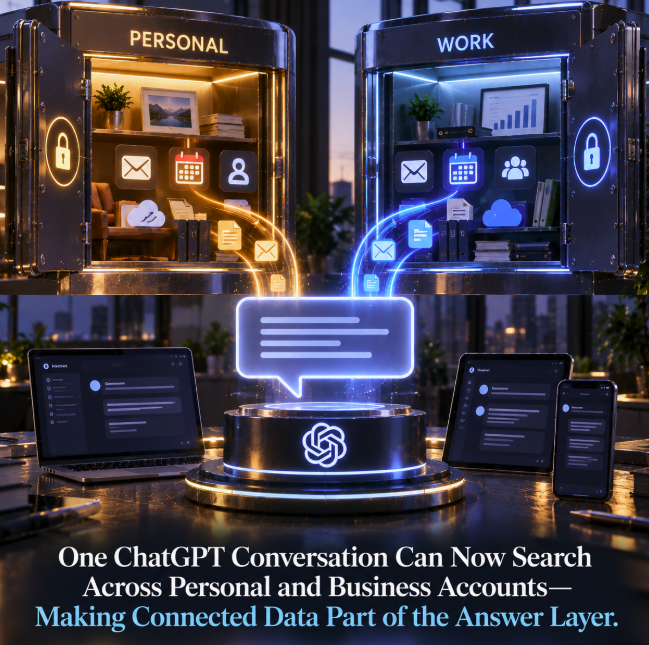
ChatGPT can now connect more than one account from the same external service, allowing personal and business information to participate in a single conversation without forcing the user to repeatedly disconnect and reconnect integrations. OpenAI announced the expansion in its September 17, 2026 ChatGPT release notes, extending a capability that had previously been introduced for Gmail, Google Calendar and Google Contacts to plugins more broadly.
The feature is available across ChatGPT plans on web, mobile and desktop. OpenAI describes the practical use case simply: users can bring personal and work accounts into the same conversation so ChatGPT can find information and help complete tasks across both contexts. The change looks small at the account-settings level, but it expands what a connected AI assistant can treat as its searchable working context.
The earlier Google-only limitation is gone
OpenAI first introduced multiple connected accounts for Gmail, Google Calendar and Google Contacts on August 28. That release made it possible to keep, for example, a personal Google account and a work Google account connected to ChatGPT at the same time. The September update generalizes the model beyond those three Google integrations.
OpenAI's release notes do not say that every third-party plugin necessarily supports identical multi-account behavior. Individual plugins and their underlying apps can still depend on provider capabilities, plan availability, workspace policy and authorization requirements. The important platform change is that multiple-account connection is no longer described as a Gmail, Calendar and Contacts feature only.
That distinction matters because ChatGPT's plugin system now covers workflows built from connected apps, reusable instructions and tools. OpenAI's plugin documentation explains that connected apps can search information, retrieve content or perform supported actions while remaining subject to the permissions of the external provider and the user's workspace.
One conversation can span two data identities
The useful shift is not simply that two login credentials can be stored. It is that ChatGPT can work with information from personal and professional accounts inside the same conversational task when the relevant plugin supports those connections.
Consider a user planning a trip around a business conference. Their work calendar may contain the conference schedule, while a personal account contains family commitments and travel confirmations. A connected assistant that can use both contexts can answer a scheduling question without requiring the user to manually consolidate the data first.
The same pattern applies to documents, messages and other supported information sources. A user might need to locate a work file while also checking a personal commitment, or reconcile information distributed across accounts belonging to the same service. The conversation becomes the interface through which those separate data stores are queried.
This is different from switching between ChatGPT accounts
OpenAI separately offers ChatGPT account switching, which lets a user stay signed into two ChatGPT accounts and move between them. That feature deliberately keeps chats, memory, billing, files, workspaces and settings separate. OpenAI's account-switching documentation explicitly says switching does not merge or combine the accounts.
Multiple plugin accounts solve a different problem. The ChatGPT identity can remain the same while the user authorizes more than one account at an external service. Personal and business source accounts can therefore become available to the same conversation without merging the underlying ChatGPT accounts or workspaces.
That distinction is important for privacy and administration. The new capability should not be interpreted as collapsing personal and corporate ChatGPT environments into one. It expands the set of authorized external sources a conversation can work with, subject to the permissions attached to those sources.
Connected data is becoming part of the answer layer
Traditional web search builds an answer from publicly accessible information. Connected AI assistants add another retrieval layer: private information that the user has explicitly authorized the system to access. The result can combine public knowledge with calendars, messages, documents and other account data that would never be available to an ordinary search crawler.
Multi-account support increases the breadth of that private retrieval layer. Instead of treating “my email” or “my calendar” as one account, the assistant can potentially work across the several identities that people already maintain in everyday life.
This makes the boundary between search and personal computing less distinct. A question such as “When can I meet this client without conflicting with my weekend plans?” is simultaneously a search problem, a calendar query and a reasoning task. The value comes from joining authorized data at answer time rather than requiring the user to open several applications and assemble the context manually.
Permissions still follow the underlying account
Multi-account access does not mean ChatGPT receives unrestricted access to every service or workspace. OpenAI's plugin documentation says app-backed capabilities remain subject to provider-account authorization, workspace availability, supported actions, role access, approved domains and other controls.
A plugin cannot use an app to access information outside the permissions granted to the relevant individual account or administrator-managed source. Installing a plugin also does not bypass authorization requirements. Users still have to connect the intended account, and organizational administrators can control whether particular apps and plugins are available.
That architecture becomes more important when multiple identities are connected because a single conversation may have access to sources with very different sensitivity levels. A personal mailbox and an enterprise repository are not interchangeable simply because both can contribute context to one task.
Workspaces can still restrict what employees connect and use
OpenAI's current apps documentation says administrators and workspace owners can manage app availability and plugin installation. Enterprise and Edu environments can use role-based access controls, while plugins that depend on an app cannot use that app when it has been disabled for the relevant user or role.
For companies, multi-account support therefore creates both convenience and a governance question. Employees may benefit from having multiple legitimate work identities or approved services available to one assistant, but organizations need to decide where personal-account connections are appropriate in managed environments.
The right policy will depend on the data involved. An organization may permit a personal calendar alongside a work calendar while prohibiting personal storage accounts from participating in workflows involving confidential company documents. The platform capability does not eliminate the need for those distinctions.
The answer can become more useful because retrieval becomes more complete
AI assistants often fail at personal workflow questions not because the reasoning is difficult, but because the required information is fragmented. The user knows that one event is in a work calendar and another is in a personal calendar, but the assistant can only see one of them. The resulting answer is logically correct based on incomplete context and practically wrong for the user.
Multi-account connections can reduce that blind spot. When the relevant accounts are authorized and the plugin can search them, ChatGPT can retrieve a broader set of evidence before producing the response. The improvement is therefore less about a new model capability than about increasing the completeness of the context available to the model.
This is a recurring pattern in the evolution of AI assistants. Better reasoning models matter, but many useful tasks depend just as much on whether the system can retrieve the right private information at the moment the question is asked.
Source identity becomes more important, not less
When several accounts can contribute information, users need to understand where an answer came from. A meeting title found in a personal calendar and a similarly named event in a work calendar may have different meanings. A file in a personal drive may be an outdated copy of a document maintained in the company repository.
Good connected-data experiences therefore need to preserve source context rather than flatten everything into one invisible pool. The user should be able to distinguish which account or source produced the information, particularly when the answer could trigger a business decision or supported action.
OpenAI's broader connected-app design keeps external permissions intact, but multi-account workflows increase the practical importance of clear attribution. As private retrieval becomes more powerful, knowing the provenance of retrieved information becomes part of answer quality.
Plugins are becoming the bridge between the model and everyday data
The release also fits OpenAI's larger transition toward plugins as the packaging layer for connected workflows. Plugins can combine reusable instructions with apps that expose external information and actions. The assistant is therefore no longer limited to the model's general knowledge, files manually uploaded to a conversation or public web search.
Multiple-account support makes that architecture more representative of how people actually organize digital life. Users rarely have one universal identity. They have personal and work email, multiple calendars, separate storage accounts, different organizations and sometimes several accounts at the same provider.
A useful AI layer has to navigate those boundaries without pretending they do not exist. Supporting multiple connections is one step toward that model: the assistant can work across authorized contexts while the accounts themselves remain distinct.
The competitive advantage is increasingly context, not just intelligence
As frontier models become capable of similar classes of reasoning, the information available at inference time becomes a larger part of product differentiation. An assistant that can reason brilliantly but cannot see the user's relevant documents, messages or schedule may be less useful for a real task than a slightly less capable system with the correct context.
That is why this release matters beyond account management. Every additional authorized source can increase the assistant's ability to answer questions grounded in the user's actual situation. Multiple accounts extend that principle from “connect your service” to “connect the identities you use within that service.”
One ChatGPT conversation can now become a retrieval layer across personal and professional data rather than forcing the user to choose one account context at a time. The opportunity is more complete, useful answers. The corresponding requirement is equally clear: permissions, provenance and workspace boundaries need to remain visible as the answer layer gains access to more of the user's connected world.