
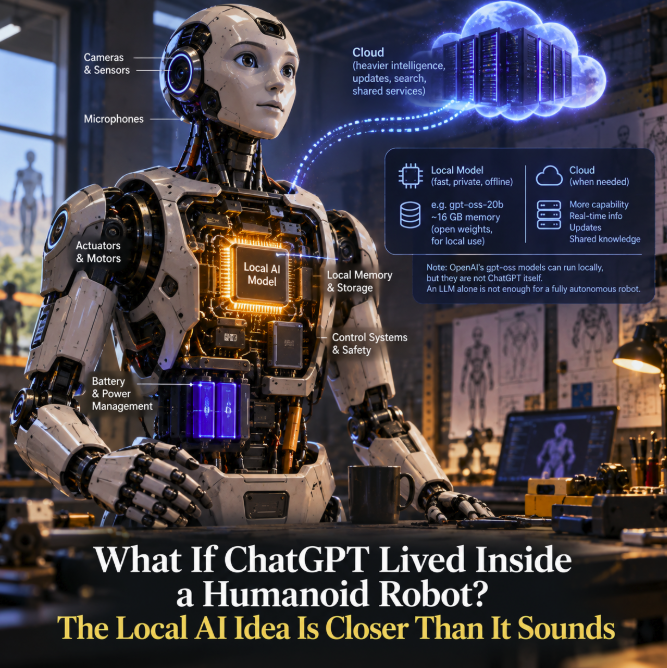
A Reddit concept posted to r/ChatGPT asks a deceptively simple question: what if ChatGPT were a local model installed inside millions of humanoid robots, with onboard intelligence for immediate tasks and a persistent connection to cloud data centers and to other robots?
The original Reddit post is explicitly a concept design rather than a product announcement. Its prompt imagines an industrial-looking humanoid carrying a local version of the model while remaining constantly connected to ChatGPT data centers and other units. But the architecture behind the image is becoming much less speculative than the robot itself.
OpenAI now distributes open-weight reasoning models that can run on hardware controlled by the user. Robotics companies are simultaneously pushing more intelligence into physical machines. Put those trends together and a plausible future architecture begins to emerge: a relatively compact model handles fast, private and latency-sensitive reasoning onboard, while cloud systems provide heavier computation, updated knowledge and services that do not need to live inside the robot.
The important distinction: a local OpenAI model is not local ChatGPT
The first technical correction is important. OpenAI's gpt-oss models can run locally, but OpenAI explicitly says they are not ChatGPT and are not served through the OpenAI API. They are separate open-weight reasoning models released under the Apache 2.0 license.
The smaller gpt-oss-20b has 21 billion total parameters with 3.6 billion active parameters per token. OpenAI says it can run with approximately 16 GB of memory and positions it for local, on-device and specialized use cases. The larger gpt-oss-120b has 117 billion parameters with 5.1 billion active per token and is designed to fit within roughly 80 GB of memory.
Those numbers do not mean that today's humanoid robots can simply install ChatGPT and become autonomous companions. They do show that capable reasoning models no longer have to exist exclusively inside hyperscale cloud infrastructure.
A robot needs much more than a language model
One early response to the Reddit concept makes the essential point: autonomy requires more than an LLM. A humanoid robot has to perceive the physical world, estimate its own position, understand objects, plan movements, maintain balance, control motors, manage power and respond safely when the environment changes unexpectedly.
A language or reasoning model can contribute to high-level planning and natural-language interaction, but it is only one component in a much larger control stack. Cameras, microphones, depth sensors and other inputs have to become usable representations. Motion planners and low-level controllers have to convert intentions into stable physical behavior. Safety systems need authority to prevent actions even when the higher-level model requests them.
This is the embodied-AI gap: producing a good textual answer and reliably manipulating a physical environment are fundamentally different engineering problems.
Local inference makes sense for a physical machine
Despite that complexity, running part of the intelligence locally is attractive for robotics for reasons that have little to do with novelty. A robot cannot always afford to wait for a round trip to a data center before reacting to the physical world.
Network connectivity can disappear. Latency can fluctuate. Uploading continuous camera and microphone streams raises privacy and bandwidth concerns. A robot working inside a home, hospital, warehouse or factory may also process information that should not leave the premises unless necessary.
Local inference can therefore handle immediate perception, basic language interaction, routine planning and safety-sensitive decisions. Cloud inference can be reserved for tasks that benefit from more compute, broader context, current information or specialized services.
The result is less like “ChatGPT trapped inside a robot” and more like a distributed computing architecture in which intelligence is split between edge and cloud.
OpenAI already has a model explicitly designed for local deployment
OpenAI's current documentation for gpt-oss says the models can run on infrastructure controlled by the user, including on-premises systems and private clouds. The company supports common inference stacks including vLLM, Ollama and llama.cpp, and describes the models as suitable for agentic workflows.
The models support capabilities such as function calling and structured outputs, while OpenAI's developer documentation also highlights agentic use cases involving tools. That matters for robotics because a useful onboard reasoning model needs to do more than generate conversational text. It has to issue structured requests to the surrounding software stack.
A robot might expose functions for navigation, object lookup, camera inspection or manipulation. The reasoning model could choose among those functions while dedicated robotics software retains control of how the physical action is actually executed.
The hybrid local-cloud model is more plausible than an entirely offline super-robot
The Reddit concept explicitly imagines robots that are both locally intelligent and connected to data centers. That hybrid design avoids forcing one computing environment to solve every problem.
Onboard models offer low latency and resilience when connectivity fails. The cloud offers far more compute, easier model upgrades, shared services and access to information that changes continuously. A robot could operate locally for ordinary interactions and escalate difficult tasks to a more capable remote model when connectivity and policy allow it.
This architecture also creates graceful degradation. Losing the network would reduce capability rather than necessarily turning the machine into inert hardware. For systems operating around people, that could be a significant practical advantage.
Persistent local memory would make the robot more useful—and more sensitive
A local robot would also create a different kind of memory problem. A useful machine operating in the same environment every day could gradually accumulate information about rooms, objects, routines, preferences and previous interactions.
Keeping some of that state locally could improve both privacy and responsiveness. The robot would not need to upload every observation simply to remember where an object is normally stored or how a user prefers a recurring task to be completed.
But physical embodiment makes the privacy stakes unusually high. A robot's sensors can observe spaces, conversations and behaviors that a conventional chatbot never sees. Local processing reduces one class of exposure, but the device still needs strong access controls, encryption, retention policies and clear boundaries governing what can be synchronized to the cloud.
Robotics is already moving toward more general intelligence
The broader robotics industry is trying to move beyond machines that execute narrowly programmed motions. Recent reporting from Reuters, for example, describes Chinese robotics startup Spirit AI's effort to build more general “robot brains” capable of understanding verbal instructions and performing increasingly complex physical tasks. Its founder expects major progress in embodied intelligence while acknowledging that household environments remain much harder than structured industrial settings.
That distinction is crucial. Factories constrain the environment. Homes do not. A domestic robot may encounter children, pets, clutter, transparent objects, unusual furniture, liquids and thousands of situations that were never represented exactly in training.
A powerful local language model can help interpret instructions, but the difficult robotics problem is converting those instructions into safe physical behavior across that long tail of real-world conditions.
Local intelligence also changes the security model
Putting an agentic model inside a machine with motors creates a different security boundary from running the same model on a laptop. The model's tool calls can eventually become physical actions.
The safest architecture therefore cannot rely on the reasoning model alone to decide what is permitted. Low-level controllers and independent policy layers need to constrain speed, force, reachable areas and dangerous actions. Network access should be scoped. Software updates need authentication. Cloud commands should not automatically override local safety controls.
This is the same principle emerging across agentic software: the model can propose an action, but the surrounding system must decide whether that action is authorized and safe to execute.
Millions of connected robots would create a second question: what should they share?
The Reddit concept also imagines robots connected to one another. Technically, fleet learning is attractive. If one robot learns a better way to recognize or handle a situation, improvements could eventually be distributed across the fleet.
But direct sharing between embodied agents raises difficult questions about provenance and trust. A robot should not blindly inherit observations, instructions or learned behavior from another unit. Shared knowledge would need validation, permissions and likely a controlled intermediary rather than unrestricted peer-to-peer learning.
The distinction between sharing a software update and sharing raw experience is especially important. The latter could contain private environmental data captured in homes and workplaces.
The hardware constraint is shrinking, not disappearing
OpenAI's ability to run gpt-oss-20b in approximately 16 GB of memory is significant, but memory is only one constraint. A mobile robot also has to manage power consumption, heat, weight, inference latency and competition for compute from vision and control workloads.
A workstation can draw hundreds of watts without needing to walk across a room. A humanoid robot has to spend much of its battery budget on motors while carrying its compute hardware with it. Efficient accelerators, quantization and specialized smaller models may therefore matter as much as raw model intelligence.
This makes a layered architecture likely: small specialized systems for continuous perception and control, a more capable onboard reasoning model for higher-level tasks, and cloud escalation when the problem justifies the cost and latency.
The Reddit image is speculative, but the architecture is no longer science fiction
There is no announced “ChatGPT humanoid robot” represented by the Reddit concept, and the post should not be confused with an OpenAI product leak or roadmap. The image is a community thought experiment.
What makes it interesting is that several of its assumptions now map onto real technology. OpenAI has open-weight models designed for local inference. Those models support agentic tool use. Robotics companies are building increasingly general humanoids. Edge accelerators continue to improve, while cloud systems can remain available for workloads too large or too dynamic to execute locally.
The future humanoid assistant may therefore not contain one giant model that does everything. It is more likely to combine local reasoning, specialized perception and control systems, persistent device memory, strict safety layers and optional cloud intelligence. The Reddit concept gets the broad direction right even if the label “ChatGPT installed in a robot” compresses a much more complicated engineering stack into one familiar name.
And that may be the most important shift. Local AI is moving from being primarily a privacy alternative for desktop users toward becoming a practical architectural component for machines that have to perceive, decide and act in the physical world—even when the internet is unavailable.