
OpenAI is about to put paid and organic ChatGPT visibility into the same marketing conversation.
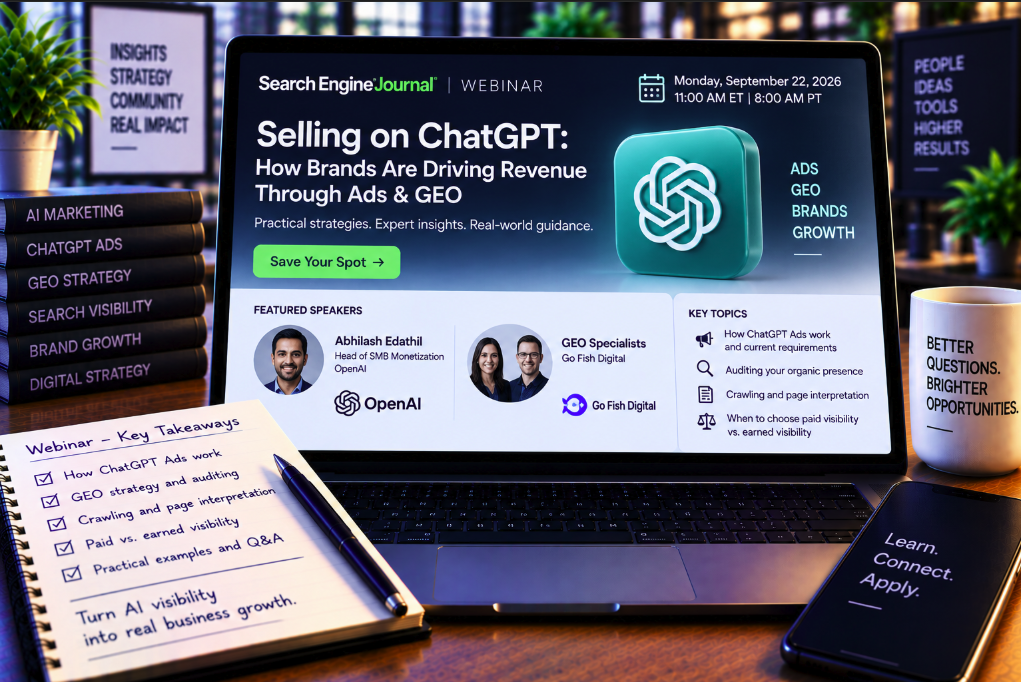
On September 22, Abhilash Edathil, Head of SMB Monetization at OpenAI, will join two generative engine optimization specialists from Go Fish Digital for a Search Engine Journal webinar focused on a question brands are increasingly being forced to answer: when should they buy visibility through ChatGPT Ads, and when should they invest in earning visibility inside ChatGPT’s organic answers instead?
The event is scheduled for Tuesday, September 22 at 2 p.m. ET. Patrick Algrim, VP of GEO at Go Fish Digital, and Ashish Jacob, the agency’s GEO Search Manager, will cover the organic side, while Edathil will provide the advertising perspective from OpenAI. Search Engine Journal founder Loren Baker will host the roundtable.
The important qualification is timing: this is currently an event announcement, not a technical release or research paper. The promotional page describes what the speakers intend to discuss, but it does not yet contain new benchmark data, previously undisclosed ranking signals or verified results from the session.
The webinar frames ChatGPT visibility as a paid-and-earned decision
The event’s premise is that brands now have two distinct ways to appear around commercial discovery in ChatGPT.
They can purchase advertising inventory through ChatGPT Ads, or they can work on the information and source environment that contributes to organic answers—the practice marketers increasingly call GEO.
Those mechanisms are not interchangeable.
Advertising buys a clearly labeled placement. Organic visibility depends on whether ChatGPT’s answer-generation process surfaces, cites or mentions a brand or its sources in response to a user’s need.
The September 22 discussion is designed to help marketers decide where each mechanism belongs in a broader AI marketing strategy.
OpenAI will represent the paid side of the discussion
Edathil’s participation is what makes the event more than a standard agency webinar.
Search Engine Journal identifies him as OpenAI’s Head of SMB Monetization, and the event page says attendees will hear directly about what it takes to run ChatGPT Ads today.
The agenda also promises discussion of where ads appear in the conversational experience, how they remain separate from ChatGPT’s answers and why the advertising product should not simply be treated as another paid-search channel.
Those topics align with OpenAI’s current public documentation, but the webinar could provide useful operational context about how the company wants advertisers to think about the product.
ChatGPT Ads already position themselves as different from keyword search
OpenAI’s official advertising site describes ChatGPT as an environment where people explore options, compare alternatives, weigh tradeoffs and make decisions.
The company explicitly tells advertisers they can go beyond keywords by using richer context signals.
That is a meaningful distinction from conventional paid search, where a query string and keyword architecture historically formed the center of campaign design.
In ChatGPT, commercial intent can emerge through a longer conversation. The ad system can consider that richer context while deciding whether an eligible advertisement is relevant.
Ads currently appear separately from the answer
OpenAI’s current ChatGPT Ads documentation says standard ads appear below ChatGPT responses.
The company has repeatedly emphasized that advertisements remain clearly labeled and separate from the organic answer.
This separation matters for the paid-versus-earned question.
A brand cannot assume that purchasing an ad will make ChatGPT recommend it organically. Likewise, appearing in an organic answer does not guarantee an advertiser will win a paid placement.
The two systems can produce visibility in the same user journey without becoming the same ranking mechanism.
OpenAI has expanded the ways advertisers can buy
The paid side has also become more accessible since the initial pilot.
In its May 2026 advertising update, OpenAI said advertisers could begin creating campaigns through partners or a beta self-serve Ads Manager. The company also introduced CPC bidding and expanded measurement while reiterating that advertisers do not receive users’ private conversations or personal details.
Current Ads Manager documentation now supports multiple campaign objectives and buying approaches, including CPM, CPC and conversion-optimized CPC.
That creates a more recognizable performance-media infrastructure even though the matching environment remains conversational rather than query-centric.
The GEO side will be led by Go Fish Digital
The organic portion of the webinar comes from Patrick Algrim and Ashish Jacob of Go Fish Digital.
The event promises to examine how brands should audit their existing organic presence in ChatGPT and how to approach visibility beginning with the way pages are crawled and interpreted for answers.
This wording needs careful treatment.
The announcement does not publish a new OpenAI crawling specification or reveal a hidden ranking formula. It says crawling and page interpretation will be discussed during the webinar.
Until the session occurs, marketers should not convert the agenda into technical claims that the speakers have not yet made.
GEO is not an OpenAI advertising product
The event puts ChatGPT Ads and GEO side by side, but the distinction between the speakers matters.
ChatGPT Ads is an OpenAI product. GEO is a marketing practice used by agencies, brands and software vendors to describe efforts to improve visibility in generative answers.
OpenAI has not turned “GEO” into a paid organic-ranking program.
The webinar’s organic recommendations will therefore need to be evaluated as practitioner guidance from Go Fish Digital, even when they are discussed in the same session as an OpenAI advertising executive.
This is especially important if the post-event discussion produces tactical recommendations about content, citations or crawling.
The central budget question is incremental visibility
The most useful way to interpret the event’s premise is through incrementality.
If a brand is already consistently present in relevant organic ChatGPT answers, what additional business value does paid placement create? If the brand is absent organically, can advertising provide useful reach while the company works on the underlying information environment? If an organic visibility opportunity is strategically important but unlikely to be solved through media spend, should the next dollar go to content and authority instead?
Those are more sophisticated questions than simply asking whether ChatGPT Ads have a lower CPC than another channel.
They require marketers to understand what paid and organic visibility each contribute.
Paid visibility can be bought; organic inclusion cannot be guaranteed
The two systems have different control surfaces.
An advertiser can configure a campaign, budget, targeting and creative in Ads Manager and compete for eligible ad delivery.
Organic visibility is less deterministic.
A brand can improve the clarity, authority and accessibility of its information, earn third-party coverage and ensure important pages are technically available, but it cannot purchase a guaranteed organic mention inside a ChatGPT answer.
That difference affects both planning and measurement.
GEO audits need to begin with actual answer visibility
The webinar says it will cover auditing organic presence.
A useful audit should start by asking where the brand appears across the conversational tasks that matter commercially: category research, comparisons, problem-solving, recommendations and branded follow-up questions.
It should then distinguish between a direct brand mention and a citation to the company’s own pages.
A brand can be mentioned while a third-party publisher receives the citation. Conversely, an owned page can be cited without the brand becoming the dominant recommendation.
Those are different forms of organic AI visibility and may require different interventions.
Crawling is only one layer of organic visibility
The event’s reference to crawling could be especially useful because marketers sometimes reduce GEO to a technical accessibility problem.
A page that cannot be retrieved has little chance of becoming a useful source. But crawlability alone does not create authority, relevance or selection.
Organic AI visibility can depend on the broader information environment surrounding a brand, including first-party pages, documentation, third-party coverage, reviews, community discussion and other sources the system can use.
The webinar will need to distinguish between making information accessible and making it sufficiently useful to influence an answer.
Page interpretation is likely to matter more than keyword repetition
Generative systems do not need a page to repeat one exact query phrase in order to understand its subject.
For brands, that shifts the content challenge toward explicit entities, products, relationships, specifications, use cases and evidence.
A page should make it easy to determine what the company offers, who the product is for, how it differs and which claims are supported.
That principle also aligns with the advertising side, where OpenAI encourages clear and specific creative rather than treating ChatGPT as a conventional exact-match keyword platform.
Paid and organic systems remain separate, but both reward semantic clarity.
The webinar could help marketers avoid false paid-versus-organic comparisons
One risk in the emerging AI marketing market is comparing metrics that represent different things.
A paid ad produces measurable impressions, clicks, spend and attributed conversions. An organic ChatGPT mention can influence a user without generating a referral click at all.
Cost per click therefore cannot be compared directly with an organic citation count as though they were two prices for the same unit.
A more useful framework would separate visibility, engagement and business outcomes, then ask how each channel contributes to the customer journey.
The September 22 discussion is well positioned to address that distinction if the speakers move beyond surface-level channel comparisons.
ChatGPT Ads can provide control that GEO cannot
Advertising has one obvious advantage: it gives marketers a defined mechanism for allocating spend and testing creative against a target audience.
A company launching a new product does not need to wait for its organic source ecosystem to mature before testing paid demand.
Campaign budgets can be increased, reduced or stopped. Landing pages can be changed. Creative can be tested. Conversion signals can be measured.
That controllability is valuable in commercial situations where speed matters.
The tradeoff is that the visibility disappears when the advertiser stops paying.
GEO can create visibility that persists beyond a campaign
Organic work has a different economic profile.
A useful product page, authoritative technical document or strong piece of third-party coverage can remain available to answer systems long after its initial production cost.
That does not guarantee persistent citations. Generative outputs change, source selection is dynamic and competitors can improve their own information environment.
But earned visibility is not tied directly to an impression budget.
The strategic question is therefore not simply which channel is cheaper. It is which form of visibility matches the objective, timeframe and level of control the brand needs.
Some commercial moments may justify both
Paid and earned visibility are not necessarily substitutes.
A brand can appear organically in a ChatGPT answer and still choose to advertise if the additional placement produces incremental customers at an acceptable cost.
Likewise, an advertiser may use paid campaigns while building the content and authority required for stronger organic presence.
The mistake would be assuming that one automatically makes the other redundant.
The right decision depends on incremental performance, not channel ideology.
The event announcement contains no new benchmarks yet
Search Engine Journal’s September 15 announcement is promotional material for the upcoming session.
It does not provide new CPC benchmarks, conversion rates, crawling statistics, citation rates or controlled comparisons between ChatGPT Ads and GEO.
It also does not disclose a new OpenAI algorithm or technical standard for organic inclusion.
Any article treating the webinar announcement itself as proof of those claims would be getting ahead of the evidence.
The news today is that OpenAI is participating directly in a public discussion about how marketers should coordinate paid and organic ChatGPT visibility.
The September 22 session may be more valuable for boundaries than secrets
The most useful outcome may not be a new tactic.
Marketers need clearer boundaries around what advertising can influence, what organic optimization can influence and what neither side can guarantee.
OpenAI can clarify the paid product’s current capabilities and constraints. Go Fish Digital can explain how it audits and improves organic visibility in practice.
Putting those perspectives in the same session could help brands avoid a common category error: treating every appearance in ChatGPT as if it came from one unified ranking system.
Brands should arrive with a paid-and-earned measurement model
Before reallocating budget, marketers should already know how they plan to evaluate both sides.
For ads, that can include impressions, clicks, CPC or CPM, conversion rate, qualified leads and incremental revenue.
For organic visibility, the metrics may include brand mentions, owned-page citations, third-party source citations, topic coverage, referral traffic and downstream business outcomes.
Neither measurement system is perfect.
But separating them makes it possible to ask whether the combination is producing more demand and revenue than either channel alone.
The bigger story is that ChatGPT now has two marketing economies
The webinar announcement reflects a broader structural change in AI discovery.
ChatGPT is becoming both a media environment where brands can purchase attention and an organic information environment where visibility must be earned through the sources and evidence that shape answers.
Those economies operate side by side while remaining separate.
That creates a familiar strategic problem in a new interface: how much should a brand spend to buy reach, and how much should it invest in the underlying content, reputation and technical accessibility that can earn reach without an ad?
OpenAI and Go Fish Digital are scheduled to address that question on September 22. Until then, marketers should treat the agenda as a preview, not as new technical evidence.
The most important takeaway is already clear enough: ChatGPT Ads and GEO are not two names for the same tactic. One buys a labeled placement. The other tries to earn a place in the answer. The brands that understand the distinction will be in a better position to decide where their next dollar—and their next hour—should go.