
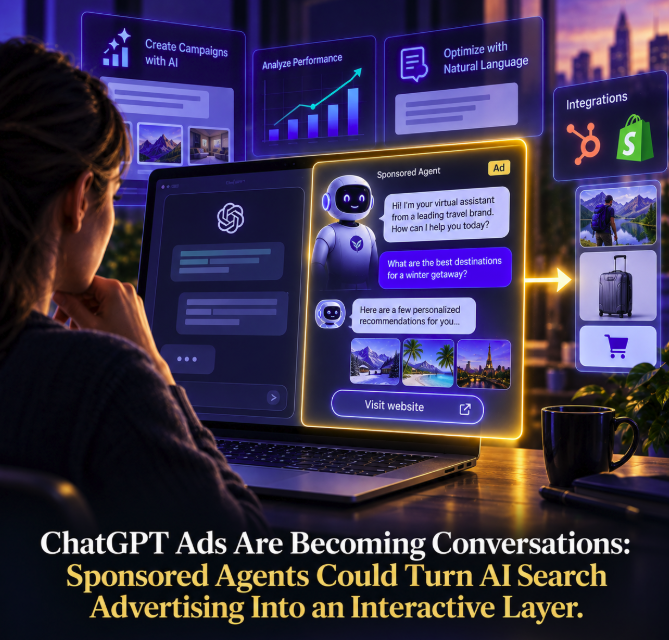
OpenAI is turning the advertisement inside ChatGPT into something users can talk to. The company said on September 16 that it has begun testing “Sponsored Agents,” conversational experiences funded by advertisers that let people ask a business follow-up questions after encountering an ad. Alongside the new format, OpenAI is adding AI-powered campaign management, dynamic text customization and integrations with HubSpot and Shopify as it expands ChatGPT into a more complete advertising platform.
The development was reported by Reuters and Search Engine Land. The important distinction is that Sponsored Agents do not replace ChatGPT's independent answer. OpenAI says the sponsored conversation is clearly labeled and remains separate both from the assistant's response and from the user's original ChatGPT conversation.
That separation is central to the product design, but the advertising format itself represents a significant change. Search advertising has historically optimized the path from query to impression to click. Sponsored Agents add an interactive layer between the impression and the advertiser's website, giving a prospective customer the ability to interrogate the commercial message before deciding whether to continue.
A sponsored ad can now become a separate conversation
The basic flow is straightforward. A user sees an eligible advertisement in ChatGPT and can choose to open a conversation with the advertiser-sponsored agent. Instead of receiving only a headline, image and link, the person can ask questions about the business, product or service and then visit the advertiser's website when ready to take the next step.
For a product advertiser, that could mean questions about sizing, features or compatibility. For a travel business, it could involve dates, destinations or package details. A software company could use the interaction to explain integrations, pricing tiers or which product configuration is appropriate for a particular use case.
OpenAI's current Ad Tools Terms formally define a Sponsored Agent as an advertiser-sponsored conversational experience through which users can interact with an AI-generated representative for a business, product or service. The company is initially testing the format with select advertisers in the United States.
The ad no longer has to compress everything into a few lines
This changes one of the oldest constraints in digital advertising. Conventional search ads have limited space to establish relevance and persuade the user to click. Advertisers therefore spend enormous effort refining headlines, descriptions and landing-page alignment so a very small amount of copy can carry the commercial message.
A conversational ad can unfold instead. The initial creative still needs to earn attention, but the advertiser no longer has to anticipate every objection or product question inside the ad itself. The Sponsored Agent can respond after the user reveals what they actually care about.
That creates a potentially richer middle layer between discovery and conversion. Someone researching a complex purchase may not be ready to click through immediately because key questions remain unanswered. A conversational agent can address those questions before the website visit, theoretically producing a more informed visitor when the handoff finally occurs.
It also creates new demands on advertisers. A sponsored conversation must represent products accurately, handle ambiguity and remain useful across a much wider range of user inputs than a static ad. Creative quality therefore expands from writing persuasive copy to defining the information, instructions and boundaries that shape an interactive commercial agent.
ChatGPT Ads Manager is getting its own AI assistant
OpenAI is simultaneously applying conversational AI to the advertiser side of the platform. Reuters reports that the ChatGPT Ads Manager plugin allows advertisers to create, update and analyze campaigns using natural-language prompts. It can turn a website or campaign brief into a campaign, review performance and provide recommendations.
The system can also suggest advertising copy and images based on a landing page and campaign objective. That pushes campaign creation closer to an agentic workflow: rather than navigating every configuration screen manually, an advertiser can describe the outcome it wants and use AI to assemble or modify the campaign.
This extends the direction OpenAI established earlier this year when it launched a beta self-service Ads Manager, CPC bidding and expanded measurement. In its May advertising update, OpenAI said advertisers could already set budgets, bids and pacing, upload creatives, launch campaigns and monitor performance directly. The new AI tools add a natural-language operating layer on top of those controls.
Ad copy can adapt to conversational context
OpenAI is also introducing an optional AI text-customization feature that can tailor existing headlines and descriptions to the context of a conversation and translate advertising copy into the user's preferred language. This is a particularly important development because conversational advertising has much richer context than keyword advertising.
A traditional search engine often starts with a query consisting of a handful of words. A ChatGPT conversation can reveal the task, constraints and decision criteria that led to the advertising opportunity. OpenAI has previously said its advertising system considers conversational intent when determining relevance, while maintaining restrictions on how advertiser data and user information can be handled.
Dynamic customization could therefore make one approved advertising concept useful across many different contexts. A product benefit relevant to a beginner may differ from the one that matters to an expert, while the language required for a price-sensitive comparison may differ from the language appropriate to someone prioritizing premium features.
The challenge will be maintaining a clear boundary between contextual relevance and the sense that advertising is intruding into a private conversation. OpenAI says advertisers do not receive users' conversations or personal details and instead receive aggregated performance information. The company also says ads remain separate from the assistant's independent responses.
HubSpot and Shopify extend the advertising stack
The September update also adds new third-party connections. Reuters reports that HubSpot is OpenAI's first CRM partner for the advertising platform, while Shopify is its first ecommerce partner. The Shopify app is scheduled to launch internationally on September 23 in markets where ChatGPT Ads is available.
These integrations matter because conversational advertising becomes more valuable when it connects to the systems marketers already use to manage customers, products and campaigns. A CRM connection can help advertisers work with campaign and customer workflows without rebuilding their marketing stack around a new advertising interface. Ecommerce integrations can make product information and campaign creation easier to coordinate with the merchant's existing catalog and operations.
OpenAI has already been expanding its broader partner ecosystem. Earlier in 2026 it named agency partners including Dentsu, Omnicom, Publicis and WPP, along with technology partners such as Adobe, Criteo, Kargo, Pacvue and StackAdapt. The HubSpot and Shopify additions move the platform deeper into the systems that sit around advertising rather than merely the ad-buying transaction itself.
ChatGPT advertising is scaling quickly
The Sponsored Agents test arrives only months after OpenAI began testing ads in ChatGPT in the United States. The company has since expanded the program internationally and introduced self-service buying, CPC pricing and conversion measurement. On August 31, OpenAI said ChatGPT Ads had reached a $1 billion annualized revenue run rate less than 200 days after launch and was being used by tens of thousands of advertisers.
OpenAI says ads can appear to eligible users on Free and Go plans, while paid tiers including Plus, Pro, Business and Enterprise remain ad-free. The company has repeatedly stated that advertising does not influence ChatGPT's answers and that sponsored content is visually separated from the organic assistant response.
Those commitments become even more important when the advertisement itself can speak. A static sponsored card is relatively easy to distinguish from an AI answer. A fluent sponsored agent can feel more like the surrounding conversational product, so labeling and separation need to remain obvious throughout the interaction rather than only at the entry point.
AI search advertising may develop its own funnel
Sponsored Agents suggest a new advertising funnel built for conversational interfaces. The first stage is relevance: the platform determines that an ad fits the user's current context. The second is engagement: the user elects to interact with the sponsored experience. The third is qualification: the agent answers questions and helps the user determine whether the product or service fits. The fourth is action, such as visiting the advertiser's website.
That differs from the familiar search-ad model in which the click is usually the first meaningful interaction with the advertiser. Here, substantial commercial engagement can happen before the referral. The website receives the user later in the decision process.
This could change campaign measurement as well. Click-through rate remains useful, but advertisers may also care about sponsored-conversation starts, question depth, successful product matching and the proportion of agent interactions that eventually produce a website visit or conversion. OpenAI has not established a universal measurement framework for those outcomes, and the Sponsored Agents format remains a test, but interactive ads naturally create more behavioral stages than a static impression.
Conversational ads also create new quality risks
The opportunity comes with obvious complications. A sponsored agent can answer many more questions than an advertisement can, which also means there are many more opportunities to provide an incorrect, outdated or overly broad answer. Advertisers will need reliable product data and clear guardrails around claims, availability, pricing and other commercial information.
There is also a fundamental trust issue. Users need to know when they are talking to the independent assistant and when they have deliberately entered a paid interaction. OpenAI's decision to place Sponsored Agents in separate, clearly labeled conversations addresses that problem at the product-design level, but the quality of implementation will matter as the format expands.
The company's advertising policies also restrict sensitive targeting and advertiser access to conversational data. Those protections are particularly important in a medium where the user may reveal more context through dialogue than they would through a conventional search query.
The ad is becoming an interface, not just a message
The larger significance of Sponsored Agents is that advertising inside AI systems may not remain a copy-and-link format. Conversational platforms can give the advertisement capabilities that were previously associated with the advertiser's website, chatbot or sales assistant. Product education, qualification and comparison can begin inside the paid placement itself.
That does not eliminate landing pages, websites or conventional performance marketing. Instead, it inserts a new interactive layer before them. For businesses, the challenge will be optimizing not only whether an advertisement appears, but whether the sponsored agent can hold a useful, accurate conversation that moves the customer closer to a decision.
ChatGPT Ads began as clearly separated sponsored placements alongside an AI conversation. With Sponsored Agents, OpenAI is testing what happens when the commercial layer becomes conversational too. If the format works, the defining unit of AI advertising may no longer be the impression or even the click. It may be the sponsored conversation that happens between them.