
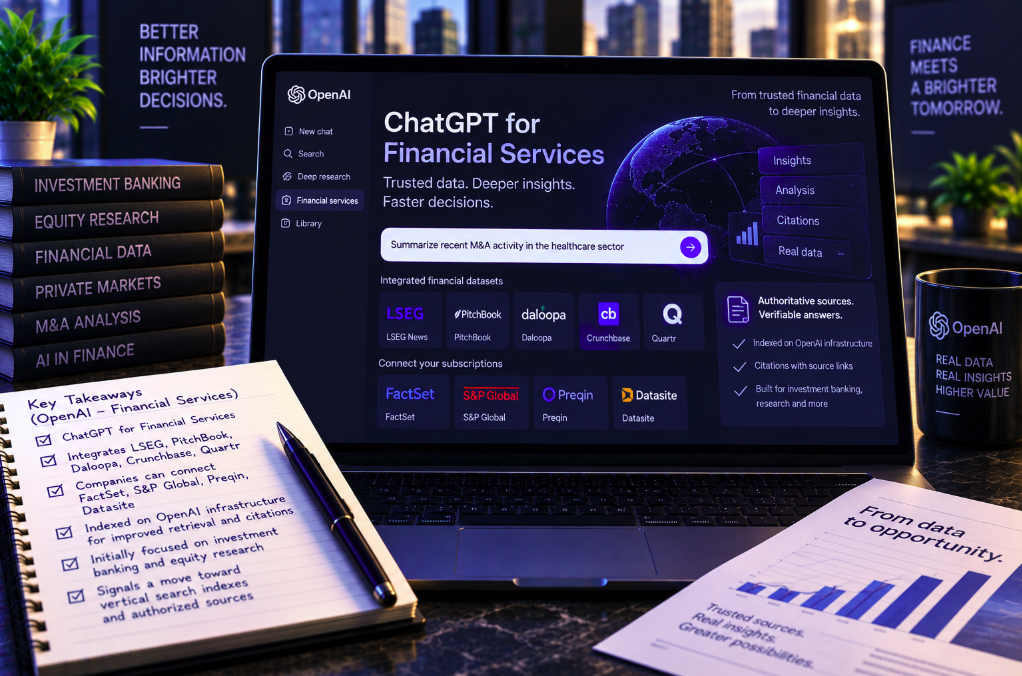
OpenAI is moving part of ChatGPT’s retrieval stack away from the open web and into a controlled, licensed data environment built for financial professionals. The company’s new ChatGPT for Financial Services does not merely connect to external databases on demand: selected premium datasets are indexed and hosted directly on OpenAI infrastructure so the system can retrieve financial information faster and attach more granular citations to the claims and figures it produces.
The architecture, announced on September 10 and detailed by both OpenAI and Reuters, points toward a significant evolution in AI search. Instead of treating every research task as a search across the public web, OpenAI can build a domain-specific retrieval layer around licensed, structured and permissioned information whose provenance is known in advance.
Calling that a “vertical search index” is an editorial description rather than OpenAI’s own product terminology. But the underlying design is explicit: OpenAI says it indexes and hosts premium financial data itself to improve retrieval, latency and citation quality.
ChatGPT for Financial Services starts with banking and equity research
The product is aimed initially at investment banking and equity research teams, with early development shaped through design partnerships with Morgan Stanley and Evercore.
OpenAI says those partnerships helped identify two recurring problems: reliable access to financial data and the creation of high-quality work products from that data.
The resulting system combines financial research with modeling and document creation. A banker can use it for earnings analysis, buyer screening, valuation work, LBO modeling and pitchbook preparation, then turn the analysis into editable spreadsheets, presentations or research materials using firm templates.
That workflow makes retrieval accuracy more consequential than it is in many consumer queries. A citation supporting an EBITDA adjustment, financing event or company metric needs to point back to the underlying evidence rather than merely provide a generic homepage link.
OpenAI is indexing and hosting premium datasets itself
The architectural detail is the most important part of the launch.
OpenAI says built-in premium financial datasets are indexed and hosted on its own infrastructure. The company says this allows it to improve retrieval, latency and the way information is surfaced inside the product.
It also enables what OpenAI calls granular citations. Users can trace figures and claims to specific tables and passages, with supporting information highlighted for review.
That is materially different from a conventional web-search workflow in which the model discovers a page, fetches it and then attempts to identify the relevant passage in real time.
With a pre-indexed vertical corpus, the system can know more about the structure, provenance and permitted use of the data before the user asks a question.
LSEG, PitchBook, Daloopa, Crunchbase and Quartr are among the data sources
Reuters highlighted integrations with LSEG News, PitchBook, Daloopa, Crunchbase and Quartr.
OpenAI’s current Financial Services documentation provides a broader list of included sources. It names public-company filings from the SEC, Quartr earnings-call transcripts and investor materials, Daloopa financial statements and selected company metrics, Fiscal.ai company fundamentals, PitchBook Essentials private-company information, Crunchbase funding data, LSEG News, Financial Modeling Prep and Nasdaq market data supplied through FMP.
Coverage differs by provider and entitlement. LSEG News, for example, is listed as included for U.S.-based financial professionals, while other datasets have their own restrictions and usage limits.
The product therefore should not be understood as one giant unrestricted copy of every partner database. OpenAI says included datasets provide selected coverage that may differ from the provider’s complete commercial product.
Financial citations can now point to specific evidence
For professional research, citation granularity is not a cosmetic feature.
If an analyst asks why adjusted EBITDA differs from reported EBITDA, the useful answer is not merely “according to Daloopa” or “according to a filing.” The analyst needs the reconciliation, the relevant notes and the specific costs that were excluded.
OpenAI says ChatGPT for Financial Services can expose that supporting information so users can inspect the evidence while developing their analysis.
This creates a different citation model from ordinary AI search. The destination is not necessarily a public webpage competing for a click. It can be a licensed table, transcript passage, filing section or structured datapoint available only through the financial-services workspace.
The open web is not disappearing
The vertical-index interpretation needs an important qualification.
OpenAI is not saying that financial research inside ChatGPT will use only licensed data or that web search has been removed. Its Help Center explicitly distinguishes native financial-data citations from web citations and notes that web sources can still appear as links.
A financial question may therefore draw on several retrieval layers: included premium datasets, connected enterprise subscriptions, public filings, firm-provided material and the web.
The change is that the open web is no longer the only external knowledge layer available to the model.
For high-value verticals, OpenAI can maintain a purpose-built corpus whose contents, permissions and citation structure are more controlled.
Companies can connect subscriptions they already pay for
The built-in data is only one layer of the product.
Reuters reports that financial institutions can also connect existing subscriptions to services including FactSet, S&P Global, Preqin and Datasite. Access depends on the organization’s entitlements and permissions.
OpenAI’s documentation similarly says additional sources may require the firm’s existing provider subscription and workspace authorization.
This creates a hybrid retrieval architecture. Some datasets are licensed into the product and hosted by OpenAI, while other information remains behind customer-specific connections.
For a large bank or research firm, the useful knowledge environment can therefore combine common premium data with proprietary subscriptions and internal information.
This is closer to enterprise search than consumer web search
Traditional web search assumes an open corpus. Pages are crawled, indexed and ranked largely because they are publicly accessible.
ChatGPT for Financial Services introduces a different access model. A source can be important precisely because it is not freely available on the public web.
PitchBook’s private-company data, Daloopa’s structured financial metrics and institutional market datasets derive commercial value from controlled access and specialized curation.
When those datasets become native retrieval sources, the AI assistant behaves more like an enterprise research terminal layered with generative reasoning than a chatbot summarizing public search results.
That distinction is strategically important for publishers and data businesses deciding how they want AI systems to access their content.
Licensed data changes the economics of AI citations
Open-web publishers typically expose content to crawlers and hope that visibility in search or AI answers produces traffic, subscriptions or brand value.
Licensed financial providers operate under a different economic model. Access is governed by contracts, entitlements and usage terms.
A citation to a premium dataset therefore does not need to function primarily as a referral mechanism. Its value can come from the licensing relationship and from being embedded inside a professional workflow.
That is a fundamentally different bargain from the open-web citation economy.
If similar architectures expand into law, medicine, scientific research or other specialist fields, more high-value AI retrieval could happen inside licensed corpora where attribution exists without a conventional publisher click.
OpenAI can optimize retrieval around a known corpus
A controlled index has technical advantages as well as licensing advantages.
The system can normalize metadata, understand table structures, map company identifiers, preserve document provenance and build retrieval methods around predictable document types.
OpenAI explicitly says hosting the financial data allows it to improve retrieval and latency.
The company also says it will deepen its models’ understanding of these datasets and post-train models to find, interpret and use the information more effectively.
That creates a tighter feedback loop between corpus design, retrieval and model behavior than is possible when the underlying web changes unpredictably.
Partner restrictions still define what OpenAI can do with the data
Hosting a dataset does not mean OpenAI receives unlimited rights over it.
The company’s Financial Services Terms contain provider-specific conditions. PitchBook data, for example, cannot be used to train, fine-tune, ground or otherwise develop model weights under the listed partner terms, and users face restrictions on bulk export and reconstitution.
Those contractual boundaries are important when interpreting OpenAI’s broader statement that it will post-train models to improve how they work with financial datasets.
Different datasets can carry different rights. It would be inaccurate to assume that every licensed source used for retrieval automatically becomes model-training material.
The architecture is permissioned at both the customer and provider level.
Structured financial data can reduce some retrieval ambiguity
Open-web financial research has a familiar problem: the same metric can appear in an earnings release, a regulatory filing, a news article, an investor deck and multiple aggregator pages, sometimes with different definitions or timestamps.
A specialized data provider often does substantial work to normalize those values and preserve source links.
Daloopa, for example, is presented by OpenAI as a source of verified financial fundamentals and KPIs with direct source links. PitchBook provides structured private-market fields with source metadata.
Giving the model native access to those representations can make retrieval more deterministic than searching the web for a phrase and hoping the best page is indexed.
It does not eliminate analytical errors, but it changes the quality of the retrieval substrate.
The data is not necessarily real-time
Professional branding should not be confused with perfect freshness.
OpenAI’s documentation says coverage and update schedules vary by dataset. Daloopa data has a 24-hour delay, while Nasdaq pricing supplied through Financial Modeling Prep is delayed by 15 minutes.
The company’s terms also warn that data and output may be inaccurate, incomplete, delayed or out of date.
For financial users, source timestamps therefore remain essential. A cited datapoint can be authoritative for its dataset and still be unsuitable for a decision requiring current market information.
OpenAI explicitly positions the product as an information and analysis tool, not financial or investment advice.
Granular citations are designed for verification, not just attribution
On the open web, SEO discussions often treat a citation as visibility: did the AI mention my domain?
In professional finance, the purpose is different. The analyst needs to verify whether a number or conclusion is supported.
OpenAI’s interface is designed to let users trace claims to specific tables and passages and inspect the supporting evidence.
This shifts the meaning of citation from a traffic opportunity toward an auditability mechanism.
For regulated or high-stakes workflows, that is likely to be a more important product requirement than whether the source receives a browser referral.
Vertical indexes could reduce dependence on arbitrary web authority signals
Open-web retrieval has to decide which of millions of pages deserve attention. Domain reputation, link structure, content relevance, freshness and many other signals help search systems navigate that uncertainty.
A licensed vertical corpus begins with a narrower set of approved sources.
That does not eliminate ranking. The system still needs to decide which document, table or passage best answers a question. But the source-selection problem is constrained before retrieval begins.
For financial analysis, OpenAI can know that a particular dataset represents company fundamentals, another covers private financing and another provides earnings transcripts.
The competition for citation therefore moves from “be discoverable anywhere on the web” toward “be part of the authorized corpus and provide the best evidence for the task.”
This creates a new visibility problem for financial publishers
For SEO teams, the architecture raises an uncomfortable possibility.
A high-quality financial page can rank well in Google and remain accessible to ChatGPT web search, yet still be irrelevant to a workflow that retrieves its core evidence from licensed databases already indexed inside the product.
That does not make open-web visibility worthless. News, analysis, commentary and niche expertise can still add context that structured datasets lack.
But some factual queries—funding history, historical financials, deal information, earnings transcripts—may increasingly be answered from controlled sources rather than from whichever public page wins the search ranking.
For publishers whose business depends on being the intermediary for commodity financial facts, that is a meaningful competitive shift.
Data providers gain a new distribution channel without becoming ordinary websites
The reverse is true for licensed data businesses.
They can become foundational sources inside AI workflows without exposing their full databases to public crawling or competing for every query in traditional search results.
Their distribution strategy becomes contractual and infrastructural.
If an investment banker can ask ChatGPT for a company comparison and receive PitchBook, Daloopa or Quartr evidence natively, the provider has gained AI distribution even if the user never opens the provider’s public website.
This is closer to API or terminal distribution than SEO.
The model is likely to matter beyond finance
Finance is a natural starting point because professional users already pay heavily for trusted data, provenance and workflow software.
But the architectural pattern is not finance-specific.
Legal research has licensed case-law databases. Healthcare has medical literature, clinical data and specialized reference systems. Scientific research has subscription journals and structured datasets. Industrial markets have proprietary catalogs and technical databases.
Where high-quality data is valuable enough to license and structured enough to index, AI providers have an incentive to build vertical retrieval layers rather than depend entirely on the open web.
ChatGPT for Financial Services provides a concrete example of that model in production.
The future of AI search may be a stack of different indexes
The common picture of AI search is a model querying one giant web index.
OpenAI’s financial product suggests a more modular future.
A user’s question can be routed across a stack of sources: the open web, public filings, licensed datasets hosted by OpenAI, customer-connected subscriptions and private enterprise documents. The model can then reason across those layers and cite the evidence appropriate to each claim.
Different industries may receive different stacks.
In that world, “ranking in ChatGPT” becomes an incomplete concept because there may be no single corpus in which every source competes equally.
OpenAI is turning source access into product architecture
The biggest shift in ChatGPT for Financial Services is not that ChatGPT can answer finance questions. It has been able to discuss financial topics for years.
The change is that OpenAI is formalizing where professional-grade answers should retrieve their evidence.
Selected premium datasets are indexed and hosted on OpenAI infrastructure. Other paid sources can be connected through customer entitlements. Web sources remain available. Citations can point to exact tables and passages rather than merely identifying a domain.
That architecture makes the financial assistant less dependent on opportunistic web retrieval and more like a controlled research environment.
For the wider search industry, the implication is substantial. The next phase of AI retrieval may not be one universal index replacing Google. It may be a network of vertical indexes, licensed corpora and private data layers, each optimized for a particular class of work.
And when that happens, the question for publishers changes. Visibility will no longer depend only on whether a page is crawlable, rankable and quotable on the open web. In high-value verticals, it may increasingly depend on whether the source is inside the authorized data layer at all.