
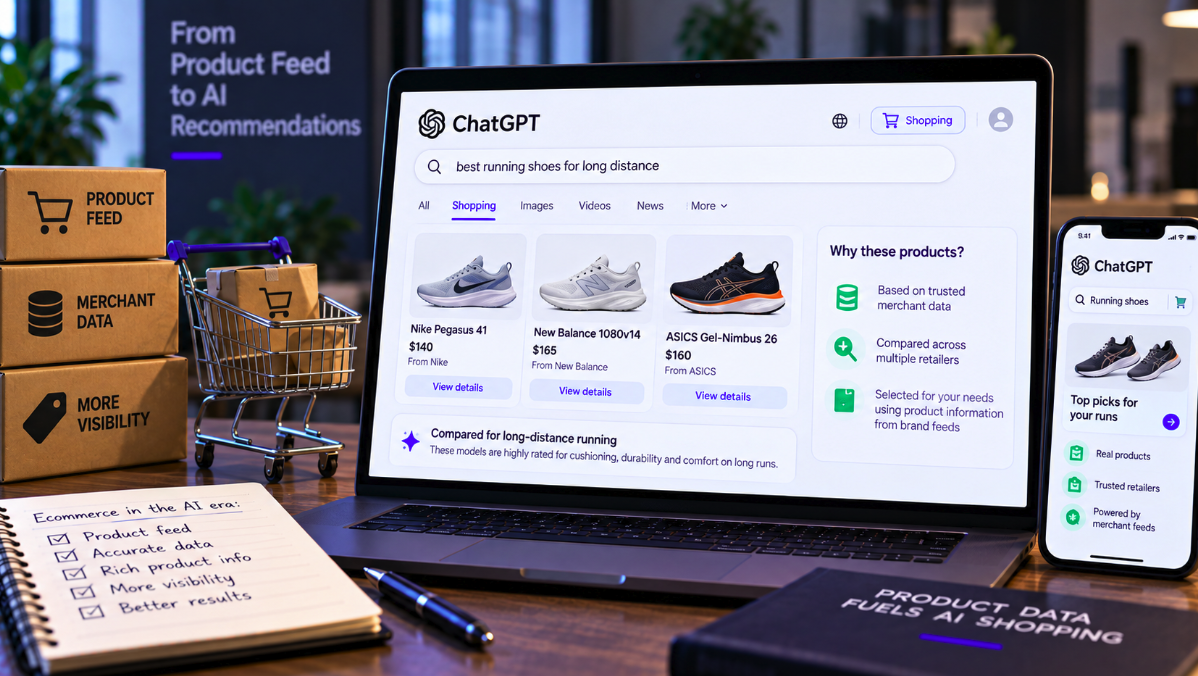
For years, ecommerce SEO has treated the product page as the center of organic visibility. ChatGPT Shopping may be pushing another asset much closer to the center: the product feed.
New data reported by Search Engine Journal shows a dramatic shift in the way Profound’s monitoring system classifies the sources behind ChatGPT Shopping recommendations. Within its tracked prompt runs, the share attributed to feed-integrated retrieval jumped from 8.26% to 61.54% on July 10. By September 3, Profound reported that feeds accounted for roughly 65% of the product recommendations it was tracking.
The numbers are large enough to matter: Profound’s July dataset covers 1,757,723 prompt runs. But they need a precise interpretation. These are prompts run by Profound for its customers, not a representative census of every real shopper using ChatGPT. “Feed-integrated” is also Profound’s classification based on network logs rather than a metric published by OpenAI. The study therefore provides strong evidence of a change inside this monitored dataset, not proof that 65% of all ChatGPT Shopping traffic worldwide now comes from product feeds.
A sharp July 10 break changed the retrieval mix
Profound runs its customers’ prompts through ChatGPT daily and analyzes network activity to classify the product sources behind Shopping results. It separates products retrieved through web search from those it identifies as coming through feed-integrated systems. For the daily July analysis, the company sampled 50% of prompt runs and counted each prompt once per day, producing the striking discontinuity on July 10: feed-integrated recommendations moved from 8.26% to 61.54%.
A separate, broader view points in the same direction. Profound analyzed 97,725 prompt runs between July 1 and August 24 using a 10% sample counted once per prompt per month. In that series, feed retrieval overtook web search during August, and by September 3 the company put the feed share at about 65% of the product recommendations it tracked.
The convergence of the two analyses makes the shift difficult to dismiss as a single-day anomaly. What remains uncertain is how far Profound’s customer prompts resemble the behavior of the overall ChatGPT Shopping population, something the dataset cannot establish.
Merchant visibility moved at the same time
The retrieval change coincided with substantial movement in store visibility. Profound examined 687 customers that actively tracked Shopping-triggering prompts every day and consistently had at least one product card pointing to their own products between July 7 and July 12. Comparing the three days before the break with the three days after it, 450 customers saw their Shopping visibility fall by at least one-third, while 67 gained at least one-third.
Among the 517 customers whose visibility changed by 33% or more in either direction, Profound modeled the relationship between lost web-search retrieval, gained feed retrieval and the visibility swing. The model explained 83% of the variation within that subset. That is a strong association in the vendor’s data, but it should not be converted into a claim that feed status alone causally determines ChatGPT rankings. Other variables could have changed simultaneously, and the analysis observes outcomes rather than experimentally assigning stores to retrieval systems.
Still, the timing gives ecommerce teams a concrete reason to investigate feed participation whenever ChatGPT Shopping visibility changes abruptly. A retailer can optimize its pages while the underlying route through which ChatGPT discovers products is changing beneath it.
Feed retrieval appears to draw from a narrower merchant pool
Profound also observed greater concentration after the July shift. The share of references going to the top 10 stores rose from 22.5% to 41.8%, while the number of unique merchants referenced fell from 13,524 to 10,607, a decline of more than 20%. In other words, the monitored recommendation system did not merely change retrieval method; it appeared to draw more heavily from a smaller group of merchants.
This may be the most consequential finding for retailers that are absent from integrated feeds. Web search can theoretically discover an enormous long tail of ecommerce pages. A feed ecosystem begins with the catalogs and providers available to it, potentially creating an eligibility layer before product-level ranking even begins.
The study does not reveal the exact boundaries of that pool or how ChatGPT chooses products once feed data is available. But it suggests that the route into the candidate set may matter almost as much as traditional page optimization.
Shopify appears to be a substantial part of the feed layer
Profound estimates that roughly 35% of feed retrieval during July was related to Shopify, based on the close movement of its Shopify and feed-retrieval series. This is an estimate rather than an OpenAI-published market-share figure, but it fits the broader product infrastructure described in OpenAI’s merchant documentation.
Search Engine Journal reports that Shopify stores already have catalog data integrated through Shopify Catalog without requiring merchants to take an additional feed-connection step. Etsy catalogs are also connected. Other retailers can request direct feed access, although OpenAI’s merchant page says existing applicants are currently on a waitlist, while supported providers can also supply product data.
That creates an uneven transition. Some merchants participate through their commerce platform by default, while others need a direct connection or intermediary. If feed retrieval is becoming more prominent, those infrastructure differences can turn into visibility differences even before two products compete on quality, price or relevance.
OpenAI says structured product data already powers Shopping
The basic importance of product data is not speculative. OpenAI’s Shopping documentation, as summarized by Search Engine Journal, says ChatGPT uses structured product information such as descriptions and prices from data providers and merchants when selecting products. OpenAI also states that Shopping product results are selected independently, are not ads and are not influenced by commercial partnerships.
The product-feed system operates through the Agentic Commerce Protocol, OpenAI’s standard for sharing commerce information with ChatGPT. The protocol was extended to product discovery in March, and supported data providers include companies such as Salesforce and Stripe. That makes product feeds part of the formal technical architecture of AI shopping rather than merely an SEO workaround.
What OpenAI has not published is the number marketers most want: how often Shopping uses feeds versus the open web. Profound’s measurements attempt to fill that gap, but they should not be presented as official platform-wide statistics.
A feed can determine eligibility without determining rank
The headline temptation is to conclude that feeds now “rank” products in ChatGPT. The available evidence does not support that formulation. Profound can observe whether retrieval appears feed-integrated, but the study does not reveal the algorithm that chooses one product over another after candidates have entered that retrieval path.
A feed may therefore operate as an eligibility and information layer. It can make a product available to the system with structured attributes, current pricing and merchant information. The recommendation layer can then evaluate those candidates using mechanisms OpenAI has not fully disclosed.
This distinction matters operationally. Connecting a feed may improve access to a growing retrieval channel without guaranteeing visibility for any particular prompt. Retailers still need accurate, competitive and complete product information if they want their eligible products to match what a shopper asks for.
The competitive unit is shifting from webpage to catalog record
Traditional ecommerce SEO focuses heavily on what a crawler sees on a product detail page: title, description, structured data, internal links, reviews, images and surrounding category context. Product feeds represent the same commercial entity in a more structured format, where fields such as price, availability, brand, variant, identifier, material or size can be consumed directly.
If AI shopping systems increasingly start their candidate selection from feeds, the quality of that structured record becomes a first-class visibility concern. A beautifully optimized landing page cannot compensate for a missing product if the relevant retrieval route never receives it. Likewise, a feed containing stale prices, weak descriptions or incomplete variants can give an AI system an inferior representation of an otherwise strong product.
This does not make the webpage obsolete. Product pages remain important for shoppers, verification, deeper research and other search channels. It does mean that ecommerce teams can no longer treat feed management as a back-office task belonging only to paid media.
Feed optimization is different from keyword stuffing
A rush toward feed-based visibility could easily produce the wrong tactic: stuffing every product field with query variants in the hope of manipulating AI recommendations. Structured commerce systems depend on accuracy, and polluted data can create mismatches between the catalog, landing page and actual offer.
The more durable approach is completeness and precision. Product titles should identify what is being sold clearly. Attributes should distinguish variants correctly. Prices and availability should stay synchronized. Descriptions should explain meaningful characteristics rather than repeat generic promotional language. Identifiers should be reliable enough to prevent different products from being conflated.
As conversational shopping becomes more specific, these attributes matter because users can ask for combinations of constraints that a generic category keyword does not capture. The richer and more accurate the catalog record, the easier it is for a recommendation system to determine whether the product actually fits.
The July shift coincided with GPT-5.6, but causation is unconfirmed
Profound associates much of the July change with the release of GPT-5.6. OpenAI announced GPT-5.6 on July 9 and said rollout would occur over the following 24 hours, putting the timing directly alongside Profound’s July 10 retrieval break.
That temporal match is interesting, but OpenAI has not publicly said GPT-5.6 caused Shopping to rely more heavily on feed-integrated retrieval. Search Engine Journal notes that OpenAI’s release notes did not announce a Shopping retrieval change on July 9 or July 10. The model rollout and feed shift should therefore be described as coincident events with a vendor-attributed connection, not a confirmed platform explanation.
This distinction is more than academic. If the change came from a Shopping backend update rather than the model itself, future model releases may have little bearing on feed usage. Ecommerce teams need to monitor the behavior rather than infer architecture from release dates.
The study measures recommendations, not shoppers or sales
Profound’s 1.76 million July prompt runs create statistical scale, but scale does not automatically make a dataset representative. The prompts are generated from Profound customer tracking rather than sampled from all ChatGPT users, and the analysis measures product recommendations rather than purchases.
It therefore cannot tell us what percentage of actual ChatGPT shoppers encounter feed-sourced products, how frequently those users click them, whether they purchase them or how much revenue the retrieval change generated. Nor does it show whether categories behave identically; feed availability and merchant coverage can differ substantially between product verticals.
For decision-making, the figures are best treated as a powerful early warning signal. Something changed dramatically in the vendor’s monitored Shopping environment, and that change aligned closely with merchant visibility. The exact platform-wide magnitude remains unknown.
GEO for ecommerce is becoming a data-engineering problem
The broader implication is that AI shopping visibility may depend increasingly on infrastructure that conventional content-led GEO frameworks barely address. If products are discovered through structured feeds, visibility work crosses into catalog architecture, data synchronization, merchant integrations and commerce protocols.
That means SEO, merchandising, paid media, ecommerce engineering and product-information teams may all own pieces of the same AI visibility problem. The SEO team can identify prompts where products disappear, but feed engineers may need to determine whether the catalog is eligible. Merchandising may need to improve attributes. Operations must ensure prices and inventory remain accurate.
The shift resembles what happened with Google Shopping years ago, except conversational AI can combine product retrieval with natural-language reasoning and comparison. The product record is not merely an ad input; it can become evidence used to decide which item answers a user’s request.
Retailers should monitor feed visibility and web visibility separately
Profound’s classification points toward a useful measurement model. Rather than treating “ChatGPT visibility” as one score, ecommerce teams should distinguish between products surfaced through web retrieval and those surfaced through feed-integrated systems whenever their tooling makes that possible.
A retailer could be strong on the open web but weak in feeds, or the reverse. An aggregate visibility metric might hide the transition until traffic or recommendations change substantially. Monitoring the two pathways separately can help explain whether a loss comes from content competitiveness, catalog eligibility or a platform-level change in retrieval mix.
The same principle applies to competitors. If a rival suddenly gains share, the first question may no longer be only which pages they improved. It may be whether their product data entered a retrieval system that yours did not.
Product feeds may be the new gatekeeper, but the gate is not the ranking
The strongest conclusion from Profound’s data is not that traditional ecommerce SEO has stopped mattering. It is that ChatGPT Shopping appears, within this large monitored dataset, to have shifted dramatically toward a structured feed pathway that can determine which merchants and products are available for recommendation.
That is a major change in where visibility work begins. Retailers accustomed to thinking of feeds as a Google Merchant Center or paid-shopping concern may need to treat catalog distribution as part of their AI search infrastructure. Shopify and Etsy sellers already benefit from connected catalog ecosystems, while other merchants face a more explicit integration path.
But the evidence stops short of proving that feeds decide every Shopping result or that feed inclusion guarantees ranking. Profound does not observe all ChatGPT Shopping traffic, OpenAI has not published its feed-versus-web share and the downstream recommendation algorithm remains opaque.
The strategic signal is nevertheless difficult to ignore. When feed-integrated retrieval rises from 8.26% to 61.54% in one day and remains around 65% weeks later in a large tracking dataset, product data stops looking like plumbing. It starts looking like the gate through which much of AI shopping visibility may now have to pass.