
For years, the safest answer to a commercial content question was often another listicle. “Best tools,” “top products” and ranked recommendation pages dominated traditional search strategies because they matched comparison intent and gave publishers a repeatable format for targeting high-value queries.
New proprietary citation data from Promptwatch suggests that generative search is complicating that playbook — and not in the same way on every platform.
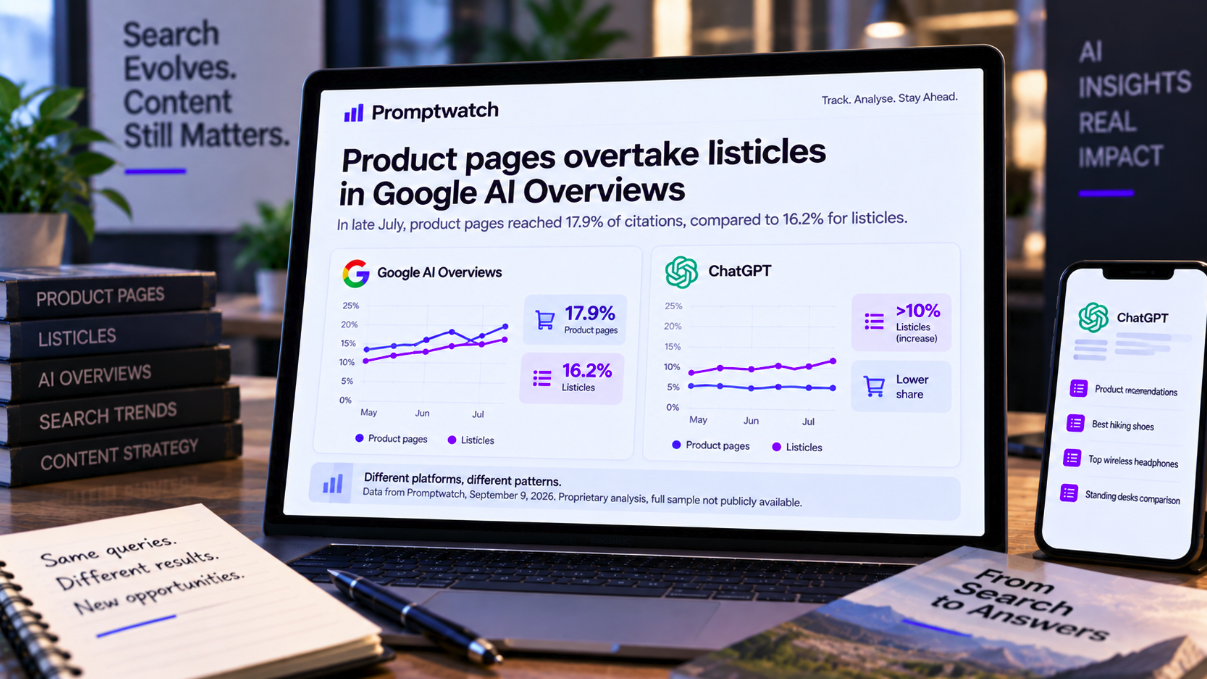
In an analysis published September 9, Promptwatch reports that product pages overtook listicles in Google AI Overview citations during the final days of July. Product pages reached 17.9% of classified citations, compared with 16.2% for listicles.
ChatGPT moved differently. Listicles increased from roughly 8% of Promptwatch’s classified ChatGPT citations at the beginning of July to just over 10% by the end of the month.
The result is not evidence that Google has introduced a preference for product pages or that ChatGPT has a ranking factor favoring listicles. It is a proprietary observational dataset whose complete sample and classification methodology are not published in the article. But it illustrates a strategically important point: content formats can gain citation share on one AI surface while moving in the opposite direction on another.
Listicles still led Google AI Overviews on the July average
The late-July crossover is more nuanced than the headline alone suggests.
Across July as a whole, listicles remained the largest content category in Promptwatch’s AI Overview dataset, accounting for 18.0% of classified citations. Product pages averaged 16.3%, followed by how-to content at 15.1% and news articles at 13.5%.
Video accounted for 5.9% and social posts for 5.1%.
The important signal is therefore the direction of travel rather than the monthly average.
Promptwatch says listicles had averaged around 26% of AI Overview citations during the first quarter of 2026. By July, their monthly share had fallen to 18%. During the final days of the month, product pages moved ahead for the first time in the company’s data, reaching 17.9% against 16.2% for listicles.
That does not mean product pages dominated AI Overviews throughout July. It means the two formats crossed at the end of a longer decline in Promptwatch’s measured listicle share.
ChatGPT showed almost the reverse trend
Promptwatch’s ChatGPT data looks structurally different.
Product pages were already the largest content type by a wide margin, accounting for 32.8% of classified citations in July. The company says their share increased from roughly 18% in March to around 33% by July.
Listicles were much smaller, averaging 9.7% of ChatGPT citations during July.
But unlike in Google AI Overviews, their share was increasing.
Promptwatch measured listicles at around 8% on July 1 and just over 10% by July 31, making them the fastest-growing content format in its ChatGPT dataset during the month.
News remained near 5%, while video was almost absent at 0.1%.
So the useful comparison is not “Google likes product pages while ChatGPT likes listicles.” Product pages had a much larger overall share in ChatGPT than listicles did. The contrast is that listicle share was declining in Google AI Overviews while increasing from a smaller base in ChatGPT.
There may be no universal “best format” for AI citations
The split matters because generative engine optimization is often discussed as if “AI search” were a single channel.
It is not.
Google AI Overviews operate inside Google Search. ChatGPT has its own search and retrieval architecture. Gemini, Claude, Perplexity and other products introduce still more variations in source selection, answer construction and citation behavior.
A content format that performs strongly on one surface cannot automatically be assumed to receive the same treatment elsewhere.
That is consistent with other recent citation research showing low source overlap between AI engines. Different systems can answer similar questions while retrieving different domains and pages.
Promptwatch’s July format data adds another dimension: the type of page being cited can also diverge.
Product pages becoming citation sources changes the commercial-content equation
The late-July AI Overview result is particularly interesting because product pages have traditionally been viewed as destinations for transactions rather than editorial evidence.
A conventional SEO strategy might create a product page to convert demand and a separate listicle, guide or comparison page to capture informational and commercial-discovery searches.
If AI Overviews increasingly cite product pages directly, that division becomes less rigid.
A sufficiently informative product page can potentially serve two functions: it can remain a conversion destination while also providing facts that an AI system can retrieve when answering a broader question.
This does not mean publishers should turn product pages into bloated articles.
It does suggest that thin product pages containing little beyond a title, image, price and purchase button may leave information opportunities unused. Specifications, compatibility information, dimensions, materials, availability, use cases, policies and other verifiable details can make a commercial page more useful to both customers and retrieval systems.
The data does not show that Google changed a ranking rule
A shift in citation share should not be mistaken for an algorithm announcement.
Promptwatch is measuring observed citations and classifying the pages behind them. Google has not announced a July update that gives product pages a 17.9% allocation or deliberately demotes listicles to 16.2%.
Many factors could change the measured mix.
The queries generating AI Overviews can change. Google can alter when AI Overviews appear, how retrieval works or how citations are displayed. Publishers can produce more or better product content. Shopping-related query demand can shift. Promptwatch’s own monitored corpus can also affect the resulting percentages.
The data describes what Promptwatch observed, not why Google produced it.
The missing methodology matters
Promptwatch provides useful headline numbers, but the September article does not publish enough information to independently reproduce the specific percentages.
The company’s public data hub says its broader research infrastructure has analyzed more than 26 billion citations, prompts and responses across AI platforms and describes its July AI Overview content-type dataset as involving millions of classified citations.
However, the article does not disclose the complete sample size behind each July percentage, the geographic distribution of queries, the prompt or keyword mix, the precise classification system used to distinguish page types, uncertainty ranges or the extent to which the monitored sample represents overall AI Overview usage.
Those details matter when differences are only a few percentage points.
A 17.9% versus 16.2% crossover is interesting, but without confidence intervals or full sampling information it should be interpreted as a directional trend inside Promptwatch’s dataset rather than proof of a population-wide change across every Google AI Overview.
Content classification is harder than it looks
Even defining a “product page” or “listicle” can become ambiguous at scale.
An ecommerce category page may contain a ranked product grid and substantial editorial copy. A software landing page may include a comparison table, FAQs and tutorial sections. A publisher’s “best products” article can contain direct commerce modules.
Automated classification systems need rules for these hybrids.
That does not make large-scale content-type analysis invalid. It means the classification methodology becomes part of the result.
Without the full taxonomy and validation data, the safest interpretation is relative: Promptwatch observed its classified product-page share rising above its classified listicle share at the end of July.
Listicles are declining in one dataset, not disappearing
The figures also provide little support for another tempting headline: “listicles are dead.”
They were still the largest AI Overview content type on Promptwatch’s July monthly average.
At 18%, they represented almost one in five classified citations in the dataset. And in ChatGPT, their share increased during the month.
The more plausible conclusion is that listicles face more competition from other page formats than they did earlier in the year.
Promptwatch reports that video also gained ground in AI Overviews, rising from roughly 2.7% in January to nearly 6.3% by late July. How-to content, meanwhile, remained comparatively stable near 15%.
Generative results appear capable of drawing evidence from a broader mixture of page types rather than relying on one dominant editorial template.
Why listicles remain useful to retrieval systems
Promptwatch argues that listicles have a structural advantage because they divide a topic into discrete, self-contained sections.
A ranked recommendation page might have one section per product, with a clear heading, description, evidence and conclusion. That organization makes individual passages relatively easy to extract without requiring the entire article for context.
The company connects this to query fan-out and passage-level retrieval.
That explanation is plausible, but it should not be confused with a documented Google or OpenAI rule saying numbered lists receive preferential citation treatment.
The underlying editorial principle is still useful: information that remains understandable when extracted from the surrounding page is easier to reuse accurately than vague prose dependent on distant context.
The same characteristic can exist in a product page, how-to guide, comparison or research article.
A product page can also be highly extractable
This may help explain why product pages can compete with editorial formats without becoming listicles themselves.
Well-designed product pages often contain unusually structured factual information.
Product names, specifications, prices, dimensions, variants, compatibility, ingredients, materials, technical requirements and shipping information can all be represented in predictable sections.
For an AI system answering a factual product question, that page can be a more direct primary source than a third-party article paraphrasing the same specifications.
That advantage depends on the query.
A manufacturer may be authoritative about what a product weighs. It is not necessarily the most credible source for an independent claim that its product is the “best” option on the market.
Different intents can therefore favor different source types even within the same commercial journey.
ChatGPT’s product-page share is the bigger number
The most striking figure in Promptwatch’s ChatGPT data is not actually the increase in listicles.
It is the 32.8% share attributed to product pages.
That is nearly double the share of any format in Promptwatch’s July AI Overview breakdown and more than three times ChatGPT’s 9.7% listicle average.
Promptwatch interprets the rise as consistent with ChatGPT’s growing role in shopping and product research.
That causal explanation remains the company’s interpretation, but the measured difference is large enough to reinforce a practical point: brands should not assume that editorial articles are the only assets worth monitoring for AI citations.
Commercial URLs may be part of the discovery layer too.
Format optimization should follow the question, not the trend chart
A marketer looking at the 17.9% crossover could make the wrong tactical decision: replace listicles with product pages because product pages are “winning AI Overviews.”
That would confuse an aggregate content-type trend with the needs of an individual query.
A question asking for the best project-management tools is naturally comparative. A list or comparison can be the most useful format. A question asking whether a specific camera supports 4K at a particular frame rate may be answered best by the manufacturer’s product specification page.
The correct format depends first on the information task.
AI citation data can then help reveal whether platforms are actually using that format for comparable questions.
This is a more durable approach than forcing every topic into whichever page type happened to gain share last month.
Platform-specific monitoring is becoming necessary
The Google-versus-ChatGPT split also creates a measurement challenge.
A publisher could see a listicle lose AI Overview citations and conclude that the page is becoming less valuable. At the same time, the same URL or content format could be gaining visibility in ChatGPT.
Traditional analytics may not make that trade-off obvious, particularly when AI-generated answers produce impressions or brand exposure without a click.
Teams investing seriously in generative visibility therefore need to separate platforms in their reporting.
Combining Google AI Overviews, ChatGPT, Gemini and Perplexity into one AI visibility score can conceal movements that run in opposite directions.
A portfolio view can still be useful, but the underlying engine-level data matters.
Crawler data is a separate signal from citation data
Promptwatch’s article also discusses changes in verified AI crawler traffic.
Its separate log analysis shows OpenAI accounting for 94.8% of verified AI crawler requests in its observed production traffic during the week of June 8–14, falling to 79.8% during August 31–September 6 as Anthropic, Perplexity, Google and Mistral collectively took a larger share.
Promptwatch correctly notes that this does not mean OpenAI’s absolute crawling necessarily declined.
More importantly, crawler share and citation share are different measurements.
A bot requesting a page does not mean the page will be cited, recommended or even used in a generated answer. Conversely, an AI product can obtain information through mechanisms that are not represented by one publisher’s server logs.
Crawler monitoring can help diagnose access and discovery, but it should not be treated as a substitute for citation measurement.
The strongest takeaway is divergence, not the death of a format
The July numbers are useful precisely because they resist a single content-marketing rule.
In Promptwatch’s Google AI Overview dataset, listicles lost substantial share from their first-quarter level and product pages finally moved ahead in the closing days of July.
In ChatGPT, product pages were already dominant, yet listicles were gaining rather than declining during the same month.
Both can be true because the systems are different.
For publishers, ecommerce teams and SaaS marketers, that means the next phase of AI content strategy is unlikely to be about discovering one universally favored format.
It will be about matching the page to the user’s information need, making the underlying facts easy to retrieve, and then measuring how each platform actually uses that content.
Product pages overtaking listicles in one dataset is a noteworthy signal.
The more important lesson is that there may no longer be one citation leaderboard that applies everywhere.