
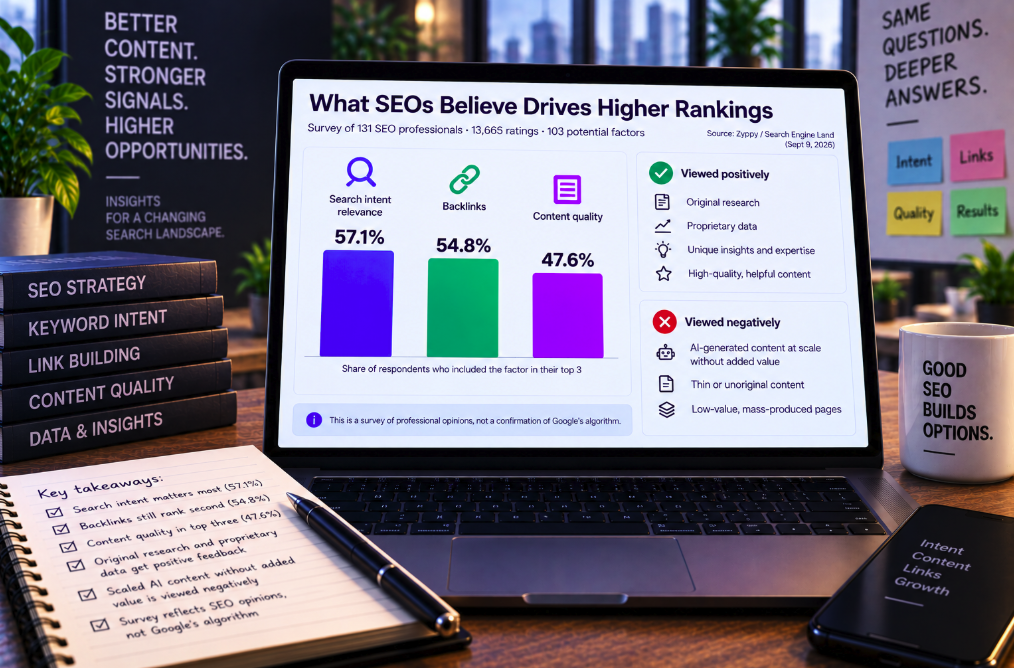
SEO has changed dramatically in the age of AI Overviews, algorithm leaks, antitrust testimony and generative search, but a new survey suggests practitioners have not abandoned the fundamentals. When 131 SEO professionals were asked to identify the factors they believe matter most for Google rankings in 2026, relevance came first, backlinks remained a close second and content quality placed third.
The findings come from Zyppy’s 2026 Google Ranking Factors Expert Survey, published by Cyrus Shepard and Dawn Shepard on September 9 and summarized by Search Engine Land. The project collected 13,665 ratings across 103 potential ranking factors, offering a detailed snapshot of what experienced practitioners currently believe influences organic Google performance.
The distinction between belief and evidence is essential. This is not a reverse-engineering study of Google’s ranking systems, an analysis of millions of search results or a disclosure from Google. It is a structured survey of professional judgment. Its value lies in showing where SEO practitioners agree, where they remain skeptical and how their priorities are evolving—not in proving what Google’s algorithm does.
Relevance narrowly beat backlinks for the top spot
When respondents were asked an open-ended question about Google’s three most important ranking factors, 57.1% included relevance. Zyppy defines relevance around matching and satisfying the user’s search intent rather than merely repeating the same words that appear in a query.
Backlinks followed closely at 54.8%, while content quality was selected by 47.6%. Authority and trust came next at 36.5%, followed by behavior or click signals at 29.4%, brand signals at 27%, user satisfaction at 19.8%, technical SEO health at 17.5%, topical authority at 14.3% and internal links at 11.1%.
The ranking is notable because it reflects a hierarchy rather than a rejection of established SEO concepts. Respondents did not choose between content and links as competing philosophies. Instead, they largely described a system in which a page first needs to satisfy the right intent, then benefits from credible external authority and high-quality information.
Search intent match was the strongest individual relevance factor
Beyond the open-ended top-three question, participants rated each of the 103 proposed factors on a seven-point scale ranging from +3 for a strongly positive ranking effect to -3 for a strongly negative effect. Within that exercise, Search Intent Match received the highest rating among the relevance factors.
The concept goes beyond semantic similarity. A page can contain all the expected keywords and entities while still failing if it solves the wrong task. Someone looking for a product comparison may not want a broad educational guide; a navigational query may be poorly served by a long article; a user seeking a quick answer may not benefit from a page optimized primarily to maximize time on site.
Several survey comments also pointed toward information gain as a differentiator once multiple pages satisfy the same intent. That idea becomes especially important in a web where publishing generic coverage has become inexpensive. Matching intent gets a page into the right conversation; adding evidence or insight that competing pages lack can make the content more distinctive.
Backlinks remain central in practitioner thinking
Claims that backlinks no longer matter have circulated for years, particularly as Google has emphasized machine learning, helpful content and user-focused optimization. The Zyppy respondents were not persuaded that links have become secondary. More than half still named backlinks among their three most important perceived ranking factors.
The details matter, however. Respondents rated links from highly trusted domains and topically relevant pages especially positively. Links from pages with real visitors were also viewed favorably. That is a different philosophy from accumulating the largest possible raw link count.
In this model, the value of a backlink is tied to the credibility, relevance and real-world visibility of the source. A link embedded in a respected page used by an actual audience is perceived as more meaningful than hundreds of artificial links created solely to manipulate rankings.
Spammy backlinks, meanwhile, were rated among the strongest negative factors by survey participants. That perception should not be confused with proof that every suspicious link harms a site—Google has repeatedly said its systems can ignore many forms of link spam—but it shows that practitioners still view an unhealthy link profile as a significant risk.
Original research and first-party data stood out on content quality
The content-quality section offers perhaps the clearest indication of how AI is changing SEO priorities. Original Research and First-Party Data received some of the strongest positive ratings in the category. Respondents also valued qualities such as originality, accuracy and freshness.
That makes strategic sense in a publishing environment flooded with inexpensive summaries. If dozens of sites can generate competent explanations of the same topic, simply producing another comprehensive article becomes less differentiating. Proprietary surveys, experiments, customer data, original interviews and firsthand analysis give a page information that cannot be reproduced merely by prompting a model to summarize existing sources.
Original evidence can also create a reinforcing advantage. Other publishers may cite the research, earning links and brand mentions, while AI systems and search engines have a distinctive primary source to retrieve. The same investment can therefore support relevance, authority and content quality rather than functioning as a narrow content tactic.
SEOs were negative on scaled AI content without added value
The survey did not produce a simplistic verdict that AI-generated content is inherently bad. Respondents differentiated between how AI is used and what the finished page contributes.
AI-generated content published at scale with little additional value received negative ratings. By contrast, Zyppy highlighted practitioner comments describing positive results from AI-assisted content that underwent intensive human editing and existed alongside substantial unique content and user-generated material.
The distinction is increasingly important. AI can reduce the cost of research, drafting, structuring and production, but lower production cost does not automatically create information value. If thousands of sites use similar models to rewrite the same existing material, the result is a larger supply of interchangeable pages.
Human review alone is not necessarily the differentiator either. The more defensible advantage is adding something that was not already present in the model’s source material: proprietary evidence, expert experience, original analysis, new examples, a useful tool or a genuinely better solution to the searcher’s task.
Brand and user signals also ranked highly
The survey’s second tier reflects a broader shift in how practitioners think about organic visibility. Authority and trust was selected as a top-three factor by 36.5% of respondents, behavior or click signals by 29.4% and brand signals by 27%.
Within those categories, branded search volume, online reputation and user satisfaction received strong ratings. Satisfaction and task completion were particularly important among user-related factors, while quickly returning to Google after visiting a result was viewed negatively.
These responses do not establish precisely which behavioral or brand signals Google uses, how they are weighted or whether the practitioners’ causal interpretation is correct. They do show that many experienced SEOs increasingly view rankings as connected to the wider reputation and usefulness of a business rather than to page-level optimization alone.
That has practical consequences. A technically optimized page cannot manufacture a trusted brand overnight. Reputation, repeat demand, customer satisfaction and recognition are built through product quality, marketing, public relations and customer experience as much as through traditional SEO.
Technical SEO remains foundational rather than glamorous
Technical SEO placed eighth in the open-ended top-three ranking list at 17.5%, but the individual technical factors generally received positive scores. Respondents characterized crawling, indexing and overall site health as foundations that allow other strengths to matter.
This helps resolve an apparent contradiction. A technically sound site does not necessarily outrank a more relevant, authoritative competitor simply because its implementation is cleaner. But serious crawling, rendering or indexing failures can prevent excellent content from competing at all.
Internal linking also remained positively regarded and was selected as a top-three factor by 11.1% of respondents. That reflects its dual role: helping search systems discover and understand relationships between pages while directing authority and users through a site’s architecture.
Meta descriptions were near the bottom as a direct ranking factor
Not every familiar SEO task received strong support. Meta descriptions ranked near the bottom of the survey, with most respondents assigning them little or no direct ranking impact.
That does not make them useless. A compelling description can influence how a search result is understood and potentially affect clicks when Google uses it in the snippet. The survey simply reflects the longstanding distinction between optimizing a search presentation and influencing the ranking calculation itself.
The result is a useful reminder that SEO teams should separate direct ranking hypotheses from broader optimization work. Some tasks improve crawling, some improve presentation, some help users convert and others may influence relevance or authority. Not everything valuable needs to be a ranking factor.
This survey measures consensus, not Google’s algorithm
The methodology places clear limits on how the findings should be interpreted. Zyppy contacted more than 200 practitioners and ultimately received responses from 131. Collectively, they spent 2,620 minutes—43.6 hours—completing the survey and generated 13,665 ranking-factor data points.
That is substantial for an expert-opinion survey, but the answers remain perceptions shaped by each respondent’s clients, industries, experiments and professional experience. The study did not independently manipulate backlinks, intent match or content quality and then measure resulting Google rankings under controlled conditions.
Nor does agreement among experts mean Google has confirmed the same hierarchy. Search Engine Land explicitly frames the results as what SEO professionals believe Google values in 2026. Google’s ranking systems are complex, query-dependent and continually changing, and the company does not publish a definitive weighted list of 103 ranking factors.
The percentages should therefore be read as measures of professional consensus. Saying that 54.8% of respondents put backlinks in their top three is supported by the survey. Saying backlinks are definitively Google’s second-most-powerful algorithmic signal would go beyond what the research establishes.
The strongest consensus is about usefulness and evidence
Despite that limitation, the survey paints a coherent picture of current SEO thinking. Practitioners still believe links matter enormously, but they put satisfying search intent slightly ahead of them. They value content quality, but increasingly define quality through originality, evidence and first-party information rather than word count or polished prose alone.
AI fits naturally into that framework. Using a model is not treated as an automatic penalty in the survey; publishing large volumes of low-value AI material is. The perceived problem is commoditization, not the tool used to produce the first draft.
For SEO teams, that suggests a more durable allocation of effort. Understand what the searcher is actually trying to accomplish. Earn references from credible, relevant sites with real audiences. Create information competitors cannot simply reproduce. Maintain the technical foundation that allows those strengths to be discovered. And use AI where it improves the process without confusing faster production with better evidence.
After 13,665 ratings, the practitioner consensus is less revolutionary than it is clarifying. SEO’s tools and interfaces are changing quickly, but the surveyed professionals still put relevance, authority and genuinely useful information at the center of organic search success.