
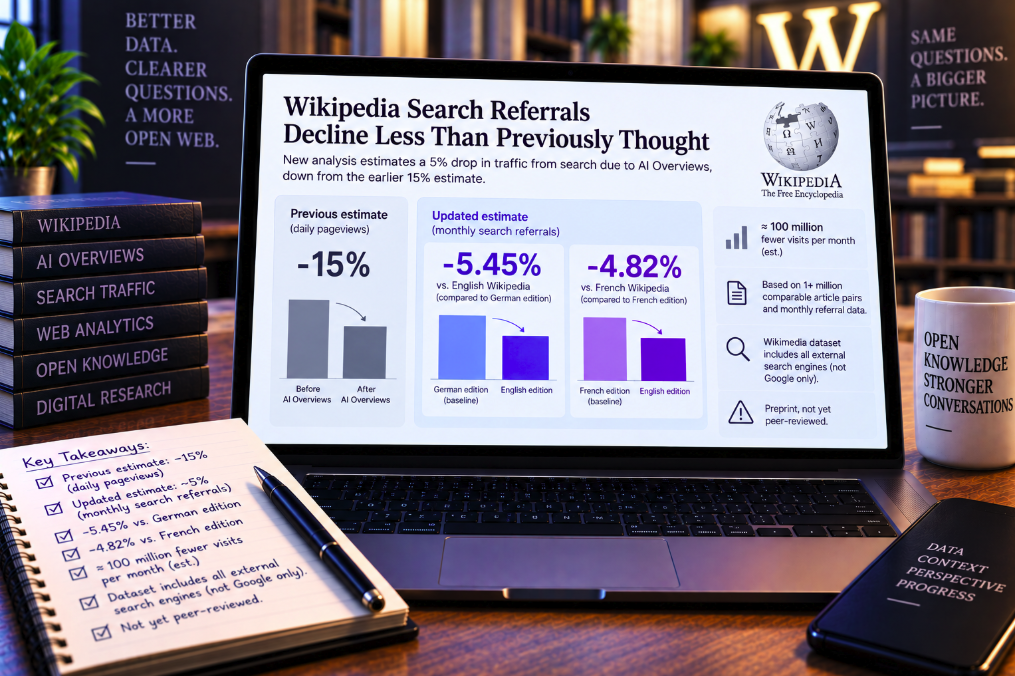
One of the most striking early estimates of AI Overviews’ effect on publisher traffic has been substantially revised. A University of Washington working paper that initially reported an approximately 15% decline in Wikipedia traffic now estimates that the rollout of Google AI Overviews reduced external-search referrals to English Wikipedia by roughly 5%.
The change is not a minor statistical adjustment. The researchers rebuilt the outcome they measure and changed the comparison design. The September 2 version of the paper now analyzes monthly search referrals rather than daily pageviews and compares English Wikipedia articles with corresponding German and French versions. The result is a 5.45% relative decline against German and a 4.82% decline against French after AI Overviews became part of the default U.S. Google Search experience in May 2024.
Search Engine Journal highlighted the revision on September 11, noting that the new estimate replaces the much larger figure widely discussed after the paper’s original release. The updated research still points toward traffic substitution from generative answers, but it also demonstrates why early AI-search statistics should not be treated as permanent facts when the measurement itself is evolving.
The estimate fell because the researchers changed what they measured
The original version of the study analyzed daily Wikipedia pageviews and used language editions that had not yet received AI Overviews as controls. That design produced an estimated decline of about 15% for English articles after the U.S. rollout.
The current version asks a narrower question. Instead of measuring all pageviews, it uses Wikimedia’s public clickstream data to isolate monthly referrals classified as coming from external search engines. That outcome is more directly connected to the mechanism the researchers are trying to study: whether answer-first search experiences reduce clicks from search engines to Wikipedia.
The control groups changed as well. The main analysis now compares English Wikipedia with German and French editions of the same underlying articles. Google had made AI Overviews part of the default U.S. search experience in May 2024, while the European markets associated with the German and French editions did not receive default AI Overviews during the study period.
Version 5, posted August 26, introduced the rebuilt referral-based analysis. Version 6, posted September 2, contains the current estimates.
The new study covers more than one million matched article pairs across two panels
Wikipedia’s multilingual structure gives the researchers an unusual natural comparison. The same underlying subject can exist as an English, German and French article, allowing traffic changes to be compared within topics rather than between unrelated websites.
The English-German sample contains 499,927 matched article pairs. The English-French sample contains 530,873. The researchers analyze monthly traffic from December 2023 through December 2024, giving them five months before the May 2024 U.S. AI Overview rollout and eight months afterward.
The English edition is treated as exposed because approximately 40% of its traffic comes from the United States. The German and French editions serve as controls because most of their readership was concentrated in European markets where AI Overviews were not yet part of the default search experience during the observation window.
The design is not equivalent to randomly assigning AI Overviews to individual users, but it allows the researchers to test whether search-referral traffic to English versions of the same articles diverged from comparable language editions after the U.S. rollout.
English search referrals fell 5.45% versus German and 4.82% versus French
The paper uses a Poisson pseudo-maximum likelihood difference-in-differences model, commonly abbreviated PPML DiD. The specification includes article-by-language fixed effects to absorb persistent differences in popularity between language editions and month fixed effects to account for shocks shared across the comparison groups.
The English-German coefficient translates into a 5.45% relative reduction in monthly English Wikipedia search referrals after May 2024. Against French, the estimated reduction is 4.82%. Both estimates are statistically significant at the 0.1% level in the paper’s main specification.
The similarity of the two estimates is useful because German and French are independently constructed comparison groups. A shock affecting only one control language is less likely to explain a roughly five-percent English decline against both.
The authors also perform parallel-trend diagnostics, timing placebos and tests using alternative treatments for low-volume observations suppressed by Wikimedia. They report that the central result remains negative across those checks.
The researchers estimate roughly 100 million fewer search visits per month
Translating the percentage effect into traffic volume, the authors calculate a back-of-the-envelope reduction of approximately 100.27 million direct search-originated visits to English Wikipedia per month.
Annualized mechanically, that would equal about 1.20 billion fewer referrals per year if the estimated effect remained constant. The paper treats this as an economic-magnitude calculation rather than a directly observed count of visits that Google withheld.
That distinction is important. The 100 million figure comes from applying the estimated relative effect to Wikipedia’s traffic levels. It is model-based, not a log file showing 100 million identifiable sessions that would otherwise have arrived from AI Overview searches.
The current analysis therefore supports saying that the authors estimate a traffic reduction of that magnitude, not that Wikimedia directly measured 100 million monthly visits disappearing specifically because of Google AI Overviews.
The Wikimedia dataset cannot isolate Google
The most important limitation is built into the traffic data. Wikimedia’s public clickstream dataset groups external search engines into an other-search category rather than providing article-level Google referrals separately.
The authors use this measure as a proxy because Google accounts for the large majority of global search activity, and their identification strategy relies on the timing of the U.S. AI Overview rollout. But the outcome still contains referrals from other search engines.
Google has challenged this aspect of the analysis. As Search Engine Journal reports, Google argues that a combined search-referral metric cannot isolate the effect of a Google-specific feature.
The researchers acknowledge the limitation. Their claim is not that every observed decline in the referral metric can be directly tagged to a Google AI Overview. Their difference-in-differences design estimates the relative change that occurred after English Wikipedia became substantially more exposed to the default-AIO environment than the German and French controls.
The new 5% figure is not the click loss when an AI Overview actually appears
This distinction is easy to miss. The paper does not measure the probability of a Wikipedia click on a Google results page with an AI Overview versus an otherwise identical page without one.
Instead, the authors describe the result as a reduced-form effect of moving part of the English Wikipedia audience into a search environment where AI Overviews were available by default. Actual exposure was incomplete.
Only about 40% of English Wikipedia traffic comes from the United States. AI Overviews appeared for only a subset of Google queries. The frequency and triggering rules also changed during the post-treatment period. And the Wikimedia referral metric includes non-Google engines that were not part of the treatment.
As a result, the 4.82% and 5.45% estimates average together users and searches with very different levels of actual AI Overview exposure. The paper explicitly says it cannot recover the effect conditional on an individual AI Overview being displayed.
Under the assumption that the effect runs in the same negative direction, the authors argue that incomplete exposure would tend to dilute the measured average relative to the effect among searches that actually showed an AI Overview.
Why the original 15% estimate should no longer be quoted as the current finding
The revision offers a broader lesson about research in a fast-changing search environment. The earlier 15% number was not simply updated because another month of data arrived. The underlying empirical design changed materially.
Daily pageviews answer a different question from monthly external-search referrals. Pageviews include behavior after a user reaches Wikipedia, while referral counts focus more directly on the incoming search channel. Changing the control languages also changes the counterfactual used to estimate what would have happened without default AI Overview exposure.
For that reason, the old and new percentages should not be averaged or treated as competing estimates from the same specification. The authors have effectively replaced the earlier measurement with a revised one they consider better aligned with the causal mechanism.
Anyone citing the paper today should use the current approximately 5% result and explain that earlier versions reported a substantially larger effect under a different design.
A Japanese comparison still produces a much larger decline
The current paper includes one result that shows how sensitive the magnitude can be to the comparison group. In a separate robustness analysis, the researchers match English articles to Japanese Wikipedia and stop the observation window before Google expanded AI Overviews to Japan.
That comparison produces an estimated 16.53% decline in English search traffic relative to Japanese.
The authors do not treat this as a third main estimate. They say the Japanese edition differs more substantially from the English audience and the analysis uses a shorter post-treatment window, so the result is presented as directional corroboration rather than pooled with the German and French findings.
The discrepancy reinforces why the control group matters. The central estimates are around 5% because the authors judge German and French to provide the more appropriate primary counterfactual for the current design.
The paper remains a preprint, not a peer-reviewed final result
The study is available on arXiv and has gone through six versions since February. It has not yet been peer reviewed.
That does not make the analysis invalid, but the revision history demonstrates the value of treating working-paper findings as provisional. Researchers often improve specifications, replace outcomes, discover limitations and respond to criticism before publication.
The current version is substantially more explicit about scope than a headline saying “AI Overviews cut Wikipedia traffic by 5%” might suggest. It describes the estimate as the effect of default AIO availability on the measured English search-referral environment, not a direct observation of individual AI Overview impressions.
Further revisions or peer-review feedback could still alter the methodology or conclusions.
Language editions are useful controls—but imperfect geographic proxies
The identification strategy depends on treating Wikipedia language editions as proxies for geographic exposure. English is heavily used in the United States, while German and French readership is concentrated in European countries.
But language and country are not the same thing. Roughly 60% of English Wikipedia traffic originates outside the United States, meaning much of the treated edition was not actually exposed to the U.S. rollout in May 2024. French Wikipedia also receives some traffic from Canada and other markets, while German is read outside Germany.
The researchers argue that these patterns mostly weaken the contrast rather than manufacture it, because treatment contamination makes English and control groups less cleanly separated.
Still, any event in 2024 that changed English-language search behavior differently from German and French could potentially contribute to the measured divergence. Difference-in-differences designs rely on the assumption that, without the treatment, the groups would have continued along sufficiently parallel trends.
Wikipedia may not represent other publishers
Even if the 5% estimate proves robust, it should not be generalized automatically to news publishers, ecommerce sites or other informational websites.
Wikipedia is unusually prominent in search, widely cited by AI systems and structured around concise factual answers. Those characteristics can cut in opposite directions. Its information is easy for a generative system to summarize, potentially reducing the need to click. At the same time, Wikipedia’s authority and frequent inclusion as a cited source can preserve visibility.
Other publishers have different query mixes, business models, ranking positions and reasons for users to visit. A news site may offer reporting that cannot be fully reproduced in a short summary. A retailer provides transactions. A forum provides community discussion. A specialized research site may contain data users need to inspect directly.
The paper therefore provides evidence about one unusually measurable publisher rather than a universal traffic-loss coefficient for the web.
The revised result still supports a substitution effect
Reducing the estimate from 15% to about 5% changes the magnitude, but not the direction. Under both German and French comparisons, English Wikipedia’s external-search referrals fell relative to the controls after default AI Overview availability arrived in the United States.
That is consistent with the idea that answer-producing search interfaces can satisfy some information needs without sending users to the underlying publisher.
The paper also sits alongside other research showing lower outbound click behavior when AI summaries appear, although those studies use different designs and measure different outcomes. They should not be treated as direct replications of the Wikipedia estimate.
The important contribution of the revised paper is publisher-side evidence across hundreds of thousands of matched articles over a real-world rollout, rather than a short experiment on individual search sessions.
The revision is as important as the result
For SEO and publishing teams, the most useful lesson may be methodological. AI-search impact statistics can look precise while depending heavily on what counts as traffic, how exposure is defined and which counterfactual is chosen.
The famous 15% Wikipedia figure became easy to repeat because it offered a simple answer to a complicated question. The updated paper gives a less dramatic number but a measurement more directly focused on search referrals and more than one primary control group.
The current evidence is therefore better summarized this way: after Google made AI Overviews part of the default U.S. search experience, the researchers estimate that monthly external-search referrals to English Wikipedia declined by about 5% relative to matched German and French articles.
That decline could represent roughly 100 million monthly search visits at Wikipedia’s scale. But it remains an estimate from an unreviewed working paper, using a Wikimedia metric that combines search engines and a language-based design that cannot observe individual Google AI Overview exposures.
The revised number is smaller. The underlying concern for publishers is not gone. What changed is the quality and meaning of the measurement—and that is exactly why the revision deserves as much attention as the headline statistic.