
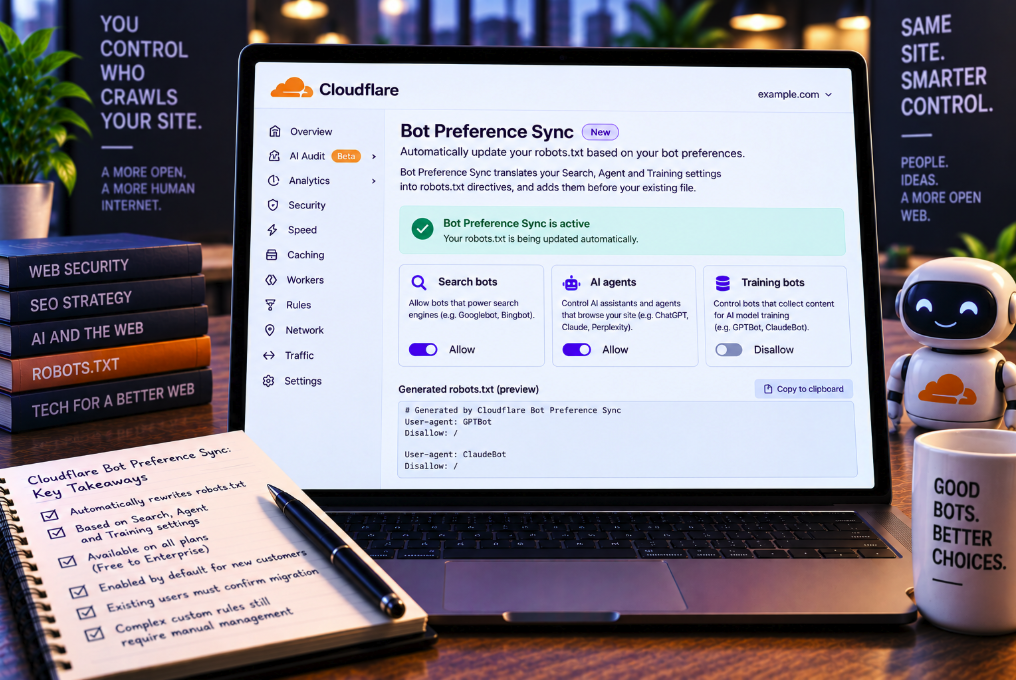
Cloudflare is turning one of the web’s oldest crawler-control files into a dashboard-driven policy layer. With Bot Preference Sync, a site owner’s choices about AI Search, Agent and Training bots can automatically be translated into robots.txt directives, removing the need to maintain a separate static list of AI user agents by hand.
The feature, announced by Cloudflare on August 21, is available across plans from Free to Enterprise. When enabled, it reads the AI bot preferences configured for a Cloudflare zone and updates the site’s robots.txt accordingly. If the site already has a file, Cloudflare says its generated section is prepended to the existing content so previously configured Disallow rules remain in place.
The convenience is obvious, but so is the operational significance. A change made in Cloudflare’s AI bot dashboard can now alter the crawler preferences publicly exposed by the website. For publishers and SEO teams, that means bot-policy settings are no longer merely an infrastructure configuration: they can directly change what the site tells AI crawlers they may or may not access.
Cloudflare is syncing three different AI use cases
Bot Preference Sync builds on the AI crawler controls Cloudflare introduced on July 1, which distinguish between three categories of automated activity: Search, Agent and Training. That separation reflects a growing problem for site owners. The same AI ecosystem can involve crawlers that discover pages for search-style answers, agents acting on behalf of users and systems collecting material for model training, yet publishers may want different policies for each use case.
A commerce site, for example, may actively want its product pages available to AI search and shopping agents because discoverability can generate sales. A publisher may want AI systems to find and cite its reporting while refusing permission for the same content to be incorporated into model training.
Cloudflare’s approach is to let the site owner express those preferences once in the dashboard and then synchronize the public robots.txt representation automatically.
For Search and Agent traffic, Cloudflare retains three dashboard choices: Allow, Block on pages that serve ads, or Block everywhere. Training uses a Disallow preference that can be written into robots.txt for the relevant crawlers.
The generated rules are added before the existing robots.txt
Cloudflare says Bot Preference Sync does not simply discard a site’s current robots.txt. When a file already exists, the service prepends a managed block reflecting the selected AI bot policies.
In Cloudflare’s example, a site configured to allow Search and Agents but disallow Training receives a managed section containing the relevant training and mixed-use user agents followed by Disallow: /. The original site-specific directives remain after that managed section.
This design is important because many production robots.txt files contain rules unrelated to AI: exclusions for search crawlers, staging paths, faceted navigation, internal search results or other crawl-management requirements. Bot Preference Sync is intended to add the AI policy layer rather than replace those instructions wholesale.
Cloudflare says the user-agent list will also be updated periodically using bots tracked in its BotBase directory. That reduces another maintenance burden: site owners do not have to continually identify every newly named AI crawler and manually add it to the file.
A dashboard toggle can now change the public crawler policy
The feature creates a tighter connection between Cloudflare’s administrative interface and a public web standard. If a site changes its policy for an AI category, Bot Preference Sync can update the corresponding robots.txt declarations to reflect the new choice.
For technical teams, that reduces the risk of configuration drift. Cloudflare specifically describes cases where a site’s robots.txt says one thing while edge-level bot controls do something else. A crawler might be publicly told it is disallowed even though the infrastructure permits it, or vice versa.
Synchronizing the two layers makes the site’s stated preference more consistent with the policy its owner believes it has configured.
But it also increases the importance of change management. A marketing, publishing or security team that adjusts an AI bot category in the dashboard may now be changing not only Cloudflare behavior but also the instructions exposed at /robots.txt. Organizations that previously treated those settings as separate responsibilities should review who has authority to modify them.
Robots.txt is still a preference, not a security boundary
The word “block” can create confusion here. robots.txt is fundamentally a crawler instruction mechanism. Cooperative bots read and honor it; a malicious or non-compliant crawler can ignore it.
Cloudflare explicitly distinguishes between mechanisms that state a preference and bot-management controls that enforce access at the network edge. Bot Preference Sync primarily addresses the first problem: making the site’s published crawler preferences match its configured AI policy.
This distinction matters for anyone assuming that adding Disallow: / guarantees a bot can no longer retrieve content. If actual access prevention is required, site owners need enforcement rather than relying exclusively on robots.txt.
Conversely, a crawler can respect a training opt-out while still accessing pages for an allowed search function if its operator provides sufficient separation and transparency. Cloudflare is explicitly trying to support that distinction instead of treating every AI-related request as the same activity.
Training opt-outs are becoming more granular
Cloudflare’s Training setting is particularly notable because the company is trying to accommodate mixed-use crawlers. These are bots whose operators may use retrieved material for more than one purpose, such as both search grounding and model training.
Under Bot Preference Sync, selecting Disallow for Training publishes a no-training preference in robots.txt. Cloudflare says cooperating mixed-use crawlers that meet additional transparency requirements can still retain access for search indexing while honoring the training restriction.
Those requirements include respecting a no-training preference, giving site owners a way to opt out of AI summaries, providing URL-level visibility into material made available for training and offering metrics that distinguish search use from training use. Cloudflare also asks operators to demonstrate that declining training does not damage traditional search visibility.
The broader goal is to move beyond the binary choice of “allow this company’s crawler” or “block it completely.” For publishers that want AI referral traffic without automatically consenting to model training, that separation could become increasingly important.
New customers get sync by default—but not automatic blocking
Cloudflare says Bot Preference Sync is enabled by default for new customers. That statement needs one qualification: having synchronization turned on does not mean Cloudflare automatically blocks every AI crawler.
For ordinary new domains, Cloudflare says the starting configuration adds no blocks or disallows on the customer’s behalf. The owner still chooses whether to restrict Search, Agent or Training activity. Sync simply ensures that once a preference is selected, the corresponding robots.txt policy can stay aligned.
Publishers and ad-supported sites can choose a different onboarding default. Cloudflare has added an option indicating that a domain monetizes pages with advertising. Selecting it sets Training to Disallow by default, reflecting the assumption that these publishers may want human visitors and search discovery while withholding content from model training.
Customers can change that choice later.
Legacy robots.txt users must confirm the transition
Existing customers using Cloudflare’s older managed robots.txt functionality are not simply migrated without review. Cloudflare says those accounts will be prompted to inspect and confirm their preferences before transitioning to Bot Preference Sync.
That matters because the old system was more narrowly focused on blocking major training crawlers. The new model expresses category-level policies for Search, Agent and Training, so an automatic migration without confirmation could translate an old configuration into a broader policy the site owner did not intend.
The review step gives existing customers an opportunity to decide how they want each newer category handled before Cloudflare begins synchronizing the file.
Complex exceptions still require manual management
Bot Preference Sync is designed around category-wide policy, not arbitrary per-bot logic. Cloudflare acknowledges that some organizations have special agreements or security requirements that cannot be expressed as a simple “allow Search, block Training” rule.
A publisher might permit one AI company to train on licensed content while denying another. A commerce site might allow a specific shopping agent but restrict other agent crawlers. Enterprise environments can also have custom firewall and bot-management logic that depends on paths, user agents or commercial arrangements.
Cloudflare says the sync feature does not directly read individual custom rules with complex logic. Customers that need finer control can disable synchronization and maintain a tailored robots.txt matching their custom policy.
That makes Bot Preference Sync a convenience layer rather than a replacement for deliberate crawler governance.
The SEO risk is accidental overblocking
For search and GEO teams, the most important operational risk is obvious: a broad bot-policy decision can affect discoverability if it is applied without understanding what a crawler actually does.
AI companies increasingly operate multiple user agents for different purposes, while some crawlers remain mixed-use. Blocking a training crawler may have little relevance to whether a page can be cited in a search answer, but blocking a search or agent crawler can remove a discovery path that the business actually wants.
The distinction is particularly important for sites measuring AI visibility. A team could spend months improving content for generative discovery and then unintentionally restrict the crawler responsible for retrieving that content.
Cloudflare’s category model is designed to make those decisions clearer, but the dashboard cannot decide the correct business strategy for the site. Publishers need to understand whether their objective is referral traffic, citations, agent access, training control or some combination of the four.
Bot lists can change without a developer editing the file
There is another subtle consequence of managed synchronization: the effective contents of robots.txt can evolve even when nobody on the site’s engineering team edits the source file.
Cloudflare says it will periodically update the bots included in managed categories using its BotBase tracking. If a new verified crawler is classified as Training and the site has disallowed Training, that user agent can be incorporated into the managed policy automatically.
Operationally, this is the point of the feature. Maintaining an accurate crawler list manually becomes increasingly difficult as AI companies introduce new agents and separate search, user-triggered and training functions.
From a governance perspective, however, teams should recognize that the public file is now partly managed by an external classification system. Monitoring robots.txt changes becomes useful even when the organization has not deployed new code.
Cloudflare is turning robots.txt into part of AI governance
The larger shift is that robots.txt is no longer merely a technical SEO file used to manage conventional search crawling. It is becoming a public policy surface for how websites want their content used by AI systems.
Training, search grounding and autonomous agents create different economic relationships between websites and crawlers. A publisher may benefit when an AI search engine cites an article and sends readers back, yet see little value when the same article is collected for training without referral. An online store may actively welcome shopping agents because they can surface products at the moment of purchase intent.
Bot Preference Sync attempts to convert those business choices into machine-readable crawler instructions without forcing every site owner to maintain an expanding list of user agents.
That simplification is useful, but it also means crawler governance can no longer be treated as an obscure infrastructure detail. A single policy change can affect which automated systems are invited to discover, retrieve or learn from a site.
One setting can now propagate much further than before
Cloudflare’s new system reduces the work required to keep AI bot preferences consistent. Search, Agent and Training choices can be expressed in the dashboard, translated into User-agent and Disallow directives and prepended to an existing robots.txt file. New customers get synchronization by default, legacy managed-file users are asked to confirm migration, and complex exceptions remain available through manual control.
The feature does not make robots.txt an enforcement mechanism, and it does not remove the need to understand individual crawler behavior. What it does is connect a high-level dashboard decision directly to the public instructions bots receive from a website.
For SEO, publishing and security teams, that makes AI crawler settings worthy of the same change-control discipline as any other configuration that can affect discoverability. The convenience is that one setting can update the policy everywhere. The risk is exactly the same thing.