
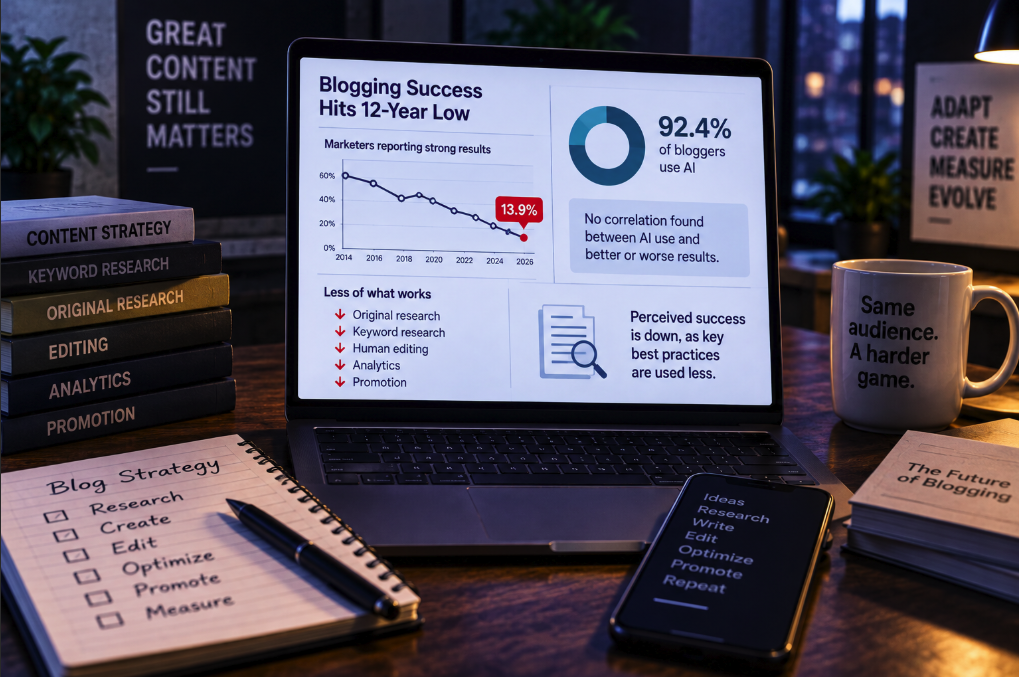
AI has become nearly universal in blogging, but content marketers have rarely felt less confident about the results they are getting. In Orbit Media’s latest annual survey, 92.4% of respondents said they use AI in their blogging process, while only 13.9% said their blogs deliver “strong results”—the lowest share recorded across the study’s 12-year history.
The contrast is striking, but it does not mean AI caused the decline. Orbit Media’s 2026 Blogging Statistics report, based on responses from 1,042 content marketers, found no relationship between the AI use cases it measured and a higher likelihood of reporting strong performance. Search Engine Land’s analysis of the survey similarly emphasizes a different pattern: marketers are doing less of several labor-intensive practices that have historically correlated with stronger content outcomes.
Reported blogging success has fallen to a 12-year low
For most of the survey’s history, the percentage of content marketers describing their blog results as strong remained between 20% and 30%. In 2026, that number dropped to 13.9%, roughly six percentage points below the previous low and far below the 26% recorded in 2022. At the same time, 18.9% of respondents said they did not know whether their blogs were delivering results, another unusually high figure in the historical data.
Those numbers require an important qualification. The survey measures marketers’ perceptions of performance rather than independently verified analytics, traffic, leads or revenue. A respondent saying that a blog delivers strong results is not the same thing as an audited measurement showing that the site gained or lost traffic. Changes in expectations, measurement practices and the growing difficulty of attributing discovery in an AI-driven search environment could all affect how marketers answer the question.
Orbit itself argues that traffic is becoming a less complete measure of content effectiveness as users increasingly receive recommendations from AI systems before visiting a brand directly or through a citation. In the survey, marketers focused on deeper business outcomes such as qualified leads, deals and revenue were more likely to report strong results than those focused primarily on volume metrics.
AI use is at 92.4%—but it does not predict stronger results
The adoption figure is difficult to ignore: more than nine in ten respondents now use AI for at least some part of blogging. Yet Orbit reports that none of the individual AI use cases measured in the survey correlated with overall performance. AI users and non-users had the same likelihood of saying they achieved strong results, although respondents who did not use AI were more likely to report disappointing results.
That makes the survey more nuanced than either “AI is destroying content” or “AI makes content perform better.” The data support neither claim. They show widespread adoption alongside declining perceived performance, but simultaneous trends do not establish that one caused the other. Orbit’s own analysis explicitly looks elsewhere for an explanation.
What AI does appear to be changing clearly is production efficiency. The average blog post now takes respondents about three hours and 20 minutes to create, down from more than four hours in 2022. Orbit estimates that, based on typical publishing frequency, the average content marketer is saving roughly 50 hours of writing time per year compared with 2022. Faster production, however, has not translated into a higher percentage of marketers reporting strong outcomes.
Marketers are doing less of the work associated with stronger performance
The more revealing part of the survey may be what content teams have stopped doing. Orbit identifies several practices that correlate with stronger reported results and says adoption of all of them declined: collaboration with influencers and experts, original research, keyword research, paid content promotion, formal human editing and consistent use of analytics.
Influencer and expert collaboration shows one of the strongest associations. Respondents who regularly collaborate with influencers were 2.6 times more likely than the benchmark to report strong results, according to Orbit, yet the share using that tactic has fallen sharply over the years. Original research also remains associated with stronger outcomes, but fewer marketers are investing in it.
Keyword research presents a similar contradiction. Despite recurring claims that traditional search optimization matters less in an AI-search environment, respondents who research keywords are still more likely to report strong results. Nevertheless, the practice declined again in the latest survey. Publishing frequency, visual content, formal editing and promotion show related patterns: several demanding practices associated with better outcomes are being used less often.
The risk may be optimizing away the valuable work
AI makes it possible to remove friction from content production, which can be genuinely useful. It can accelerate ideation, drafting, summarization, editing assistance and other repetitive tasks. The survey’s deeper warning is that efficiency becomes counterproductive when teams remove the activities that create differentiation, evidence, distribution and quality control.
A generic draft is relatively easy to produce. Original research requires collecting data. Expert collaboration requires relationships and coordination. Keyword research requires understanding demand. Human editing requires time and judgment. Analytics require measurement discipline, while promotion requires effort after the publish button is pressed. These are precisely the steps that are difficult to automate away completely—and, in Orbit’s data, several remain associated with better reported performance.
This distinction matters as organizations build AI-assisted publishing workflows. The relevant question is not simply how much content a team can produce per hour. It is which parts of the process benefit from automation and which parts constitute the reason the content deserves to exist in the first place.
More content is not the same as more effective content
The survey arrives at a moment when publishers face pressure from several directions. Search is more competitive, social reach is difficult, AI-generated answers can satisfy some informational queries without a click, and the cost of producing competent text has fallen dramatically. That combination increases the supply of content while making attention harder to earn.
In that environment, reducing production time is useful only if the saved time is reinvested intelligently. A content team might use AI to accelerate a first draft and then spend more time on proprietary data, interviews, fact-checking, visuals, distribution or conversion strategy. The alternative—using AI simply to publish more interchangeable articles—may improve output metrics without improving business outcomes.
Orbit’s survey cannot prove that declining use of best practices caused the fall in perceived success, just as it cannot prove that AI did not have indirect effects that the questionnaire failed to capture. The findings are observational and based on self-reported behavior and results. They are nevertheless useful because the strongest pattern is not a simple divide between AI users and non-users. It is a divide between teams that continue to invest in substantive content practices and an industry that, on average, appears to be doing less of them.
The 2026 numbers therefore offer a more useful lesson than an anti-AI headline. AI adoption has reached 92.4%, making the technology close to a baseline rather than a competitive advantage. If almost everyone has access to faster drafting, the differentiators move elsewhere: original evidence, expert input, search research, rigorous editing, measurement and promotion. The tools may have made content easier to produce, but the survey suggests that producing content was never the hardest part of producing results.