
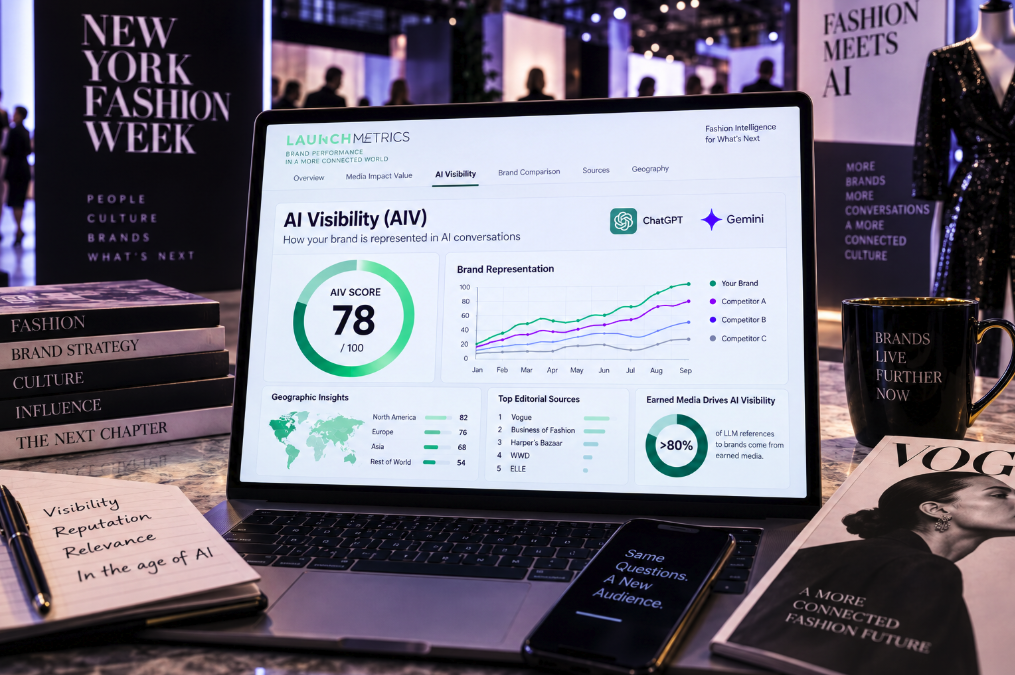
Fashion has spent years turning media exposure into measurable value. Now the industry is beginning to quantify something less visible but increasingly important: what AI assistants say about a brand. Launchmetrics has introduced an AI Visibility metric designed to show fashion, lifestyle and beauty companies how prominently—and in what context—they appear in generative AI responses.
The new measurement was highlighted during New York Fashion Week and reported by Vogue Business. Launchmetrics is positioning AI Visibility alongside its established Media Impact Value, or MIV, framework, giving communications and marketing teams a way to compare traditional media impact with representation inside AI-generated answers.
From media mentions to AI representation
Traditional brand measurement has largely focused on observable exposure: press coverage, influencer posts, social engagement and other forms of media visibility. Generative AI changes the problem because a consumer may now ask an assistant which brands matter in a category, what a company is known for or how competing products compare, receiving a synthesized answer instead of navigating a conventional list of links.
Launchmetrics’ AI Visibility system is intended to make that layer measurable. The company’s current product documentation describes continuous tracking of how brands appear across ChatGPT, Claude, Gemini and Perplexity, with an AI Visibility Score that can be benchmarked against competitors. The platform also analyzes the narratives and themes associated with a brand rather than treating visibility as a simple mention count.
That distinction matters. A fashion house could be frequently mentioned by an AI assistant while being associated with a narrative the company does not consider strategically important—or, worse, with outdated or inaccurate information. A useful AI visibility metric therefore has to answer more than whether a brand appeared. It needs to help explain how the model represents the brand, which sources are shaping that representation and how the picture changes over time.
Geography, competitors and sources become part of the dashboard
According to Vogue Business, Launchmetrics’ approach is designed to expose geographic differences in AI representation, show which editorial sources influence answers and compare brands against competitors. That makes the product closer to a monitoring and intelligence layer than a one-dimensional score.
Launchmetrics says its platform can identify the publications, journalists and topics driving a brand’s AI presence. Its official product page also describes weekly competitive benchmarking and event-based analysis, allowing brands to examine whether major moments such as fashion weeks, campaigns or cultural events change their AI Visibility before and after they occur.
For communications teams, this creates a new feedback loop. A campaign can generate conventional press coverage and measurable MIV, but marketers can also examine whether the same event changes how AI systems describe the brand. If it does, the impact of earned media may extend beyond immediate readership and social reach into the information layer that future AI answers draw upon.
Launchmetrics says earned media drives most AI brand references
One of the most consequential claims in the Vogue Business report is that more than 80% of LLM references to brands come from earned media. Launchmetrics uses that finding to argue that editorial coverage and other unpaid mentions are becoming increasingly important to AI visibility, strengthening the strategic connection between public relations and generative engine optimization.
The figure should be treated carefully. The Vogue Business article reports the company’s finding but does not provide a complete sample, query set and methodology that would allow readers to independently evaluate how the percentage was calculated. It is therefore better understood as a Launchmetrics result within its own measurement framework, not as a universal statistic establishing that more than 80% of every AI model’s brand knowledge originates in earned media.
Even with that limitation, the underlying idea is plausible enough to matter strategically: AI systems do not form brand narratives from corporate websites alone. Journalism, reviews, interviews, cultural coverage and other third-party material can shape the information available to retrieval systems and language models. For brands, reputation management in an AI environment may therefore depend heavily on what independent sources say rather than simply on what the brand publishes about itself.
GEO is moving from SEO teams into PR and communications
The rise of AI Visibility also reflects a broader shift in generative engine optimization. GEO is often discussed as an extension of SEO, with marketers testing ways to become cited in ChatGPT, Gemini, AI Overviews and other answer engines. Fashion brands are approaching the same problem from another direction: communications teams already manage narratives, media relationships and earned coverage, all of which may influence how a brand is represented in AI.
Vogue Business reports growing interest among fashion companies in GEO strategy, including pressure to understand which publications and narratives are most influential inside generative systems. If brands begin reallocating budget toward PR because third-party coverage improves AI representation, the boundary between search optimization, reputation management and media relations becomes much less clear.
This is especially relevant for luxury and fashion, where brand meaning is not reducible to product specifications. Heritage, creative direction, celebrity relationships, cultural positioning, sustainability claims and editorial perception all contribute to how a company is understood. An AI assistant asked to recommend or compare brands may compress those signals into a few sentences, making the upstream information environment unusually important.
The metric will need methodological transparency
AI visibility is harder to measure consistently than traditional media exposure. Generative responses can vary by model, prompt wording, geography, time and product version. Models are updated, retrieval systems change and two semantically similar questions can return different brands or sources. A single AI answer is therefore a weak basis for a stable brand-performance score.
Launchmetrics addresses some of that volatility by describing continuous tracking and weekly benchmarking, but the usefulness of AIV will ultimately depend on methodological details: which prompts are tested, how often they are repeated, how markets are represented, how visibility is weighted and how model-to-model differences are normalized. Those questions become particularly important if companies use the score to make budget decisions or compare performance against competitors.
The same caution applies across the emerging AI-monitoring industry. A dashboard can make generative visibility look as deterministic as a web analytics report, even though the underlying systems are probabilistic and constantly evolving. Brands should therefore treat AI Visibility as a new signal to investigate rather than an unquestionable equivalent of traffic, sales or independently verified consumer awareness.
Brand measurement is expanding beyond clicks and mentions
The launch is significant because it formalizes a change already happening in marketing. Consumers can increasingly discover brands without visiting a search result, publication or social profile first. They may instead ask an AI assistant for recommendations and receive a synthesized shortlist shaped by information collected elsewhere.
That creates a new competitive surface. Brands will still care about media value, organic search rankings, social reach and direct traffic, but they may also need to know whether AI systems mention them, how they describe them and which external sources are influencing those answers. Launchmetrics is betting that fashion companies will want that information in the same kind of dashboard they already use to evaluate traditional media performance.
The AIV score is unlikely to settle the question of how AI brand visibility should be measured; the field is too new, and the systems being measured change too quickly. But its arrival alongside Media Impact Value is itself revealing. AI representation is moving from an experimental marketing concern toward a metric that communications teams are expected to monitor, benchmark and eventually defend in budget meetings. For fashion brands, being visible is no longer only about appearing in the right magazine, feed or search result. It increasingly includes appearing in the answer itself.