
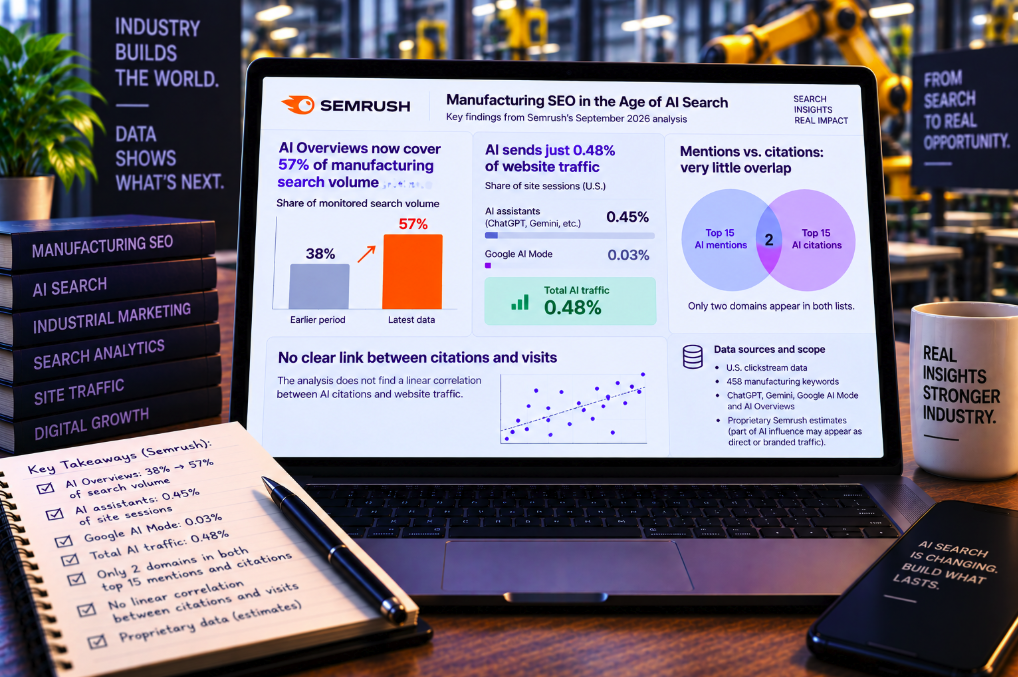
Generative search is rapidly occupying more of the manufacturing search experience, but it is still sending remarkably little identifiable traffic to industrial websites. A new Semrush analysis finds that Google AI Overviews appeared across 57% of the manufacturing search volume it tracked by July 2026, while AI assistants and Google AI Mode together accounted for only 0.48% of website sessions.
The September 8 Semrush study combines three different datasets: Google SERP observations across 458 manufacturing and industrial keywords, U.S. clickstream traffic across ten industry categories, and AI mention and citation data from ChatGPT, Gemini, Google AI Mode and AI Overviews. A separate analysis by PPC Land breaks the 0.48% traffic figure into approximately 0.45% from AI assistants and 0.03% from AI Mode.
The gap between visibility and traffic is the central finding. AI-generated answers are becoming difficult for industrial marketers to ignore, yet their measurable referral contribution remains tiny beside direct and traditional organic search. Even more importantly, Semrush finds that being mentioned by AI, being cited as a source and receiving a visit are three different outcomes that do not move together in a simple linear funnel.
AI Overviews expanded from 38% to 57% of tracked search volume
Semrush began with the top 20 manufacturing domains in its Trending Websites ranking, extracted the top 1,000 keywords for each and retained terms where at least two of those domains ranked prominently. That produced a panel of 458 manufacturing and industrial queries.
The company then examined monthly Google results from January through July 2026 and weighted the presence of AI Overviews by search volume rather than simply counting keywords. On that basis, AI Overviews expanded from 38% of the tracked search volume in January to 57% in July—a nineteen-point increase in six months.
The growth was not limited to broad informational questions. Semrush reports AI Overviews appearing for product-oriented terms such as “pneumatic cylinder,” specialized product identifiers and brand searches such as “National Instruments.”
That matters for manufacturers because AI-generated summaries are no longer confined to the top of an educational funnel. They increasingly sit inside searches where engineers, procurement teams and other B2B buyers may be evaluating products, suppliers and brands.
But identifiable AI traffic remained below half a percent
For the traffic portion of the study, Semrush used U.S. clickstream estimates covering websites across ten manufacturing-related categories from January through July. These included chemicals, machinery, equipment and supplies, plastics and polymers, renewable energy, transportation and logistics, warehousing, construction and maintenance, civil engineering and manufacturing itself.
Despite the expanding AI presence in search, AI referrals remained extremely small. AI assistants accounted for about 0.45% of sessions and Google AI Mode for approximately 0.03%, bringing their combined share to 0.48%.
Traditional channels still dominate. Semrush says direct and organic search together represented nearly 80% of all sessions to the manufacturing sites in its clickstream dataset.
This creates an important distinction between interface exposure and traffic acquisition. A buyer may encounter AI-generated material frequently during research without ever clicking an AI citation or producing a referral that analytics systems classify as AI traffic.
The 0.48% figure does not measure all AI influence
The temptation is to interpret 0.48% as evidence that AI barely matters to manufacturing marketing. The data does not support such a broad conclusion.
Semrush itself notes that buyers can use an AI assistant to identify or compare vendors and then continue their journey through a branded Google search or a direct visit to the company’s website. In that scenario, AI influenced the decision while the eventual session appears in analytics as organic search or direct traffic.
This is especially plausible in B2B purchasing, where transactions are rarely completed immediately after a single discovery interaction. A buyer may ask ChatGPT for supplier options, send a shortlist internally, research the manufacturers days later and finally reach a vendor through a bookmark, branded query, email or direct URL.
The referral percentage therefore measures observable traffic attributed to AI sources, not the full commercial influence of AI-assisted research.
Mentions and citations produce two very different leaderboards
Semrush’s AI Visibility database reveals another fracture in the traditional SEO model. The brands AI systems mention most often are largely not the websites they cite most often.
A mention means the company’s name appears in the generated answer. A citation means the system links to a source supporting that answer. Among the top 15 domains in each category, only two—Vevor and Grainger—appeared on both lists.
The most-mentioned group is dominated by familiar industrial brands such as 3M, John Deere and Boeing. These companies have decades of brand recognition, broad product portfolios and enormous information footprints, making them relevant to many prompts even when their own websites are not used as the source.
The citation leaderboard looks much more heterogeneous. Semrush’s top-cited domains include manufacturers, industrial distributors, directories, marketplaces, professional organizations and editorial reference sites such as Engineer Fix, Thermo Fisher, Sigma-Aldrich, Made-in-China, RS, The Blue Book, Grainger, Thomasnet, the Royal Society of Chemistry and GlobalSpec.
AI can know a brand without citing the brand’s website
This separation between mentions and citations changes what “AI visibility” means. A manufacturer can be strongly represented in generated answers because its brand is deeply embedded in the information ecosystem while receiving relatively few source links to its own domain.
Conversely, a specialist reference site can become a frequent citation source without being a widely recognized brand among buyers.
Semrush found more consistent Authority Scores among the most-mentioned brands than among the most-cited sources. Its Authority Score is a proprietary metric based on signals including organic traffic, backlinks and spam indicators. The top citation sources ranged much more widely, with Engineer Fix scoring only 17 while Made-in-China reached 77.
That suggests established web authority and brand reputation may align more consistently with being named than with being selected as a source. Citation retrieval appears capable of surfacing smaller or more specialized domains when their content fits the information need.
ChatGPT and Google can choose radically different sources
The study also reinforces that there is no single “AI ranking.” Source selection varied significantly by platform.
Engineerfix.com provides the clearest example. Semrush found that the site dominated ChatGPT citations in the manufacturing dataset, yet it did not appear among the leading cited sources on Gemini, AI Mode or AI Overviews.
Its Google search footprint also appears modest in Semrush’s organic ranking database, with roughly 3,700 ranking keywords and little estimated Google traffic. Yet Semrush Traffic Analytics estimates the site receives close to 300,000 monthly organic-search visits overall, with DuckDuckGo, Bing and Yahoo collectively responsible for more than 68% of its traffic and Google accounting for less than 2%.
The example does not reveal exactly why ChatGPT cites the domain so heavily. It does show why marketers should be cautious about treating Google rankings as a universal proxy for generative-search visibility. Different assistants have different retrieval systems, partnerships, indexes and source-selection behavior.
More citations did not produce a proportional increase in visits
Perhaps the most commercially important result is that Semrush could not find a clean relationship between AI citations and AI-referred traffic.
Engineer Fix again illustrates the disconnect. Despite leading heavily in ChatGPT citations, the site received only a fraction of the AI traffic going to some domains further down the citation leaderboard. Grainger, by contrast, performed strongly across mentions, citations and AI traffic, while Made-in-China and the Royal Society of Chemistry also attracted comparatively high AI traffic.
Semrush argues that the type of cited page matters. A generic informational answer can be summarized almost completely by an AI assistant, leaving the user little reason to follow the source link. A product page, marketplace listing or original research paper can offer something the generated summary cannot complete by itself.
In other words, citation visibility creates an opportunity for a click; it does not create the motivation.
Content value after the citation may determine whether anyone visits
This distinction is particularly relevant to industrial content strategies built around large libraries of educational articles. Manufacturers have long used definitions, FAQs and technical explainers to capture organic search demand.
Those pages can still become excellent grounding material for an AI answer. But if the assistant can extract the entire useful answer in a few sentences, the citation may generate visibility without meaningful referral traffic.
Semrush contrasts that with sources containing original scientific research or commerce functionality. The Royal Society of Chemistry receives citations to reference pages about chemical elements, while some of its strongest AI traffic goes to peer-reviewed research covering subjects such as PFAS chemistry, composite materials and biodegradable coatings. Those papers contain depth and evidence that a short AI summary cannot fully substitute for.
Grainger and Made-in-China offer a different reason to click: users can move from information into product discovery and purchasing. The website provides the next step the AI answer cannot complete on its own.
Industrial GEO may need three separate KPIs
The findings make a single AI visibility score increasingly difficult to interpret. Mentions, citations and traffic represent different stages of discovery and should be measured separately.
Brand mentions can indicate whether an assistant recognizes a manufacturer as relevant to a category or buying question. Citations show whether a domain is being selected as evidence. Referral traffic shows whether users find enough additional value in the source to leave the AI interface.
A company can perform well in one dimension and poorly in another. Boeing can be mentioned extensively without dominating citations. Engineer Fix can dominate a ChatGPT citation set without generating proportionate AI visits. Grainger can appear strongly across multiple dimensions because its brand, content and commercial utility align.
For reporting, collapsing those outcomes into one number risks hiding the actual business problem. A company with weak mentions may need brand authority. A company with weak citations may need stronger source content or broader third-party presence. A company with many citations but few visits may need to give users a better reason to click.
Traditional SEO still accounts for most measurable demand
For all the attention around GEO, the Semrush data does not support abandoning conventional search optimization in manufacturing. Direct and organic search still account for nearly four-fifths of sessions in the measured market.
AI Overviews can change how that organic demand is distributed, particularly as they expand into more commercial and product-oriented searches. But the underlying need for crawlable product information, technical expertise, brand authority and useful destination pages remains.
In fact, many of the assets that support strong industrial SEO also support generative visibility. Detailed product specifications, original research, credible technical explanations, third-party references and strong brand recognition give both search engines and AI systems more evidence to work with.
The strategic shift is therefore less about replacing SEO with GEO and more about understanding that the same information can now generate several different outcomes: a traditional ranking, an AI mention, an AI citation, an AI-influenced branded search or a direct referral.
The study is directional, not a census of manufacturing traffic
The numbers also require methodological restraint. Semrush is measuring the market through proprietary datasets rather than collecting first-party analytics from every manufacturing website.
The 458-keyword panel is constructed from keywords associated with prominent manufacturing domains and weighted by search volume. It is not a complete census of every industrial query. The traffic figures are U.S. clickstream estimates, while the AI mention and citation analysis comes from Semrush’s own AI Visibility database.
Those three datasets represent different stages of discovery and use different measurement systems. They are useful for comparing patterns at market level, but they should not be read as a controlled causal funnel in which an AI Overview exposure necessarily produces a citation and then a measurable session.
The study is best understood as a directional snapshot of how generative discovery and web traffic coexist in the manufacturing sector during the first seven months of 2026.
AI visibility is growing faster than AI referral traffic
The headline contrast captures the transition industrial marketers are facing. AI Overviews expanded from 38% to 57% of Semrush’s tracked manufacturing search volume in six months, yet identifiable sessions from AI assistants and AI Mode combined remained just 0.48% of website traffic.
That gap does not mean the visibility is worthless. It means visibility, citation and traffic have become less tightly coupled than marketers are accustomed to in traditional search.
A brand can influence an AI answer without receiving a citation. A site can receive a citation without earning a click. And an AI conversation can influence a buyer who later arrives through Google or types the brand’s URL directly.
For manufacturing marketers, the immediate challenge is therefore not simply to maximize AI citations. It is to understand which kind of visibility the business is earning, whether that visibility survives across platforms and prompts, and what unique value remains on the website after the AI has already summarized the obvious answer.
AI may currently account for less than half a percent of identifiable industrial website sessions. But with generative summaries already touching more than half of the monitored search volume, measuring only referral traffic risks missing where the buyer’s journey is increasingly beginning.