
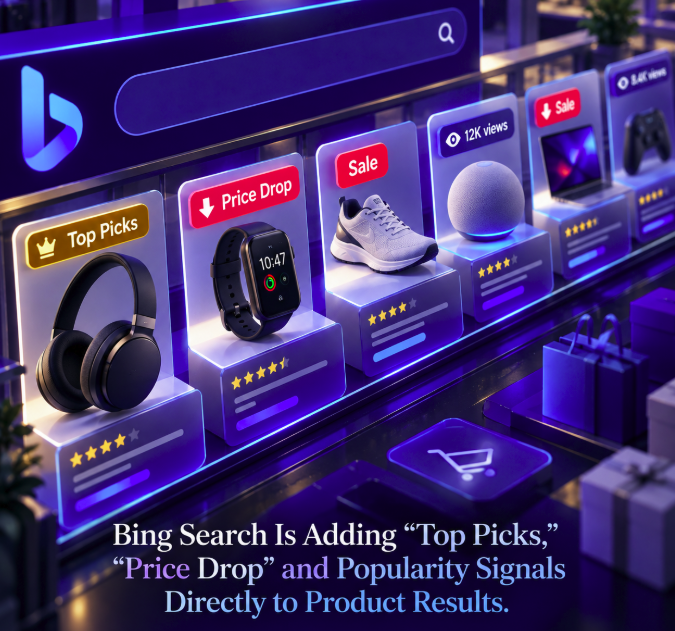
Microsoft is testing a new layer of merchandising signals directly inside Bing Search product carousels, with labels such as Top Picks, Price Drop, Sale and product view counts appearing alongside individual items. The changes are relatively small at the interface level, but they point toward a broader evolution of commercial search: Bing is making its results pages behave less like a list of links and more like a product discovery environment where shoppers can evaluate popularity, pricing and promotional context before leaving the SERP.
The experiment was documented on September 17 by Barry Schwartz at Search Engine Roundtable, after examples were spotted in Bing Search. Schwartz reported that Microsoft is testing several labels within product carousels, including Top Picks, Price Drop, Sale and the number of views associated with a product. He also cautioned that not every one of these treatments is necessarily new, an important distinction because Bing frequently experiments with shopping presentation and individual elements can appear for limited groups of users before changing or disappearing.
Product cards are becoming decision surfaces
A conventional product result answers basic questions: what the item is, how much it costs and where it can be purchased. The labels being tested by Bing add a second layer designed to help shoppers interpret those results. “Price Drop” gives the current price a sense of history, “Sale” adds promotional urgency, “Views” introduces a popularity signal, while “Top Picks” can visually distinguish selected products from neighboring alternatives.
That matters because product discovery is often driven by comparative cues rather than a single isolated piece of information. When several visually similar items appear in a horizontal carousel, a shopper may have little reason to prefer one card over another. A discount badge, popularity count or recommendation-style label can become the element that attracts attention and prompts the next action. In effect, Bing can influence the browsing sequence without requiring the user to open several merchant pages first.
Bing is pushing more shopping context into the SERP
The test also fits a wider pattern in Bing's commercial search interface. Microsoft has continued experimenting with ways to expose shopping controls and product information earlier in the search journey, including shopping-oriented filters and richer product presentations. The cumulative effect is a SERP capable of supporting more of the comparison process itself, rather than serving purely as an intermediary between a query and an ecommerce website.
This is especially relevant as search engines compete not only with one another but with marketplaces, retailer apps, social platforms and AI-assisted shopping experiences for product discovery. Users increasingly expect search interfaces to do more than retrieve pages. They expect them to narrow options, highlight meaningful differences and surface signals that help them decide what deserves attention. Labels such as Price Drop and Views are simple mechanisms for supplying that context at a glance.
What ecommerce SEOs and merchants should watch
For ecommerce teams, the immediate lesson is not that a new ranking factor has appeared. There is currently no evidence in the reported test that these visible labels represent new organic ranking signals, and it would be premature to treat them that way. Their importance is primarily presentational: they can change how a product is perceived within the same limited carousel space and potentially affect which result earns the shopper's attention.
The underlying product data therefore becomes increasingly important. Accurate prices, availability, promotional information, product identifiers and other structured commerce signals give search platforms more reliable material to work with when constructing rich shopping experiences. Merchants should also pay attention to how their products actually appear in Bing rather than evaluating visibility only through rankings. Two products occupying similar positions can have very different visual prominence if one receives an additional badge or popularity cue.
There is another measurement challenge. As more comparison activity takes place directly inside the search results, conventional click data captures only part of the user's journey. A shopper may inspect several products, notice a price reduction, compare popularity signals and reject alternatives before eventually clicking one merchant. The SERP itself is increasingly part of the conversion funnel, even when analytics on the merchant's site can only observe the final visit.
A small test with a larger product-discovery implication
Microsoft has not announced these labels as a universal Bing feature, and the observed treatments should be understood as tests rather than a confirmed global rollout. The exact labels, eligibility and presentation may change. Schwartz's observation that some elements may not be entirely new also reinforces the need to distinguish an interface experiment from a major product launch.
Still, the direction is worth watching. Search engines have spent years enriching commercial results with images, prices, ratings, availability and merchant information. Adding recommendation, discount and popularity cues pushes the interface another step toward active merchandising. Instead of merely finding products, Bing can increasingly help users browse and prioritize them within Search itself.
For ecommerce brands, that means visibility is becoming more multidimensional. Ranking remains important, but the way a product is packaged inside the result can influence whether that visibility turns into attention. “Top Picks,” “Price Drop,” “Sale” and view counts may look like minor badges, yet together they illustrate a larger shift: the commercial SERP is steadily becoming a product discovery surface in its own right.