
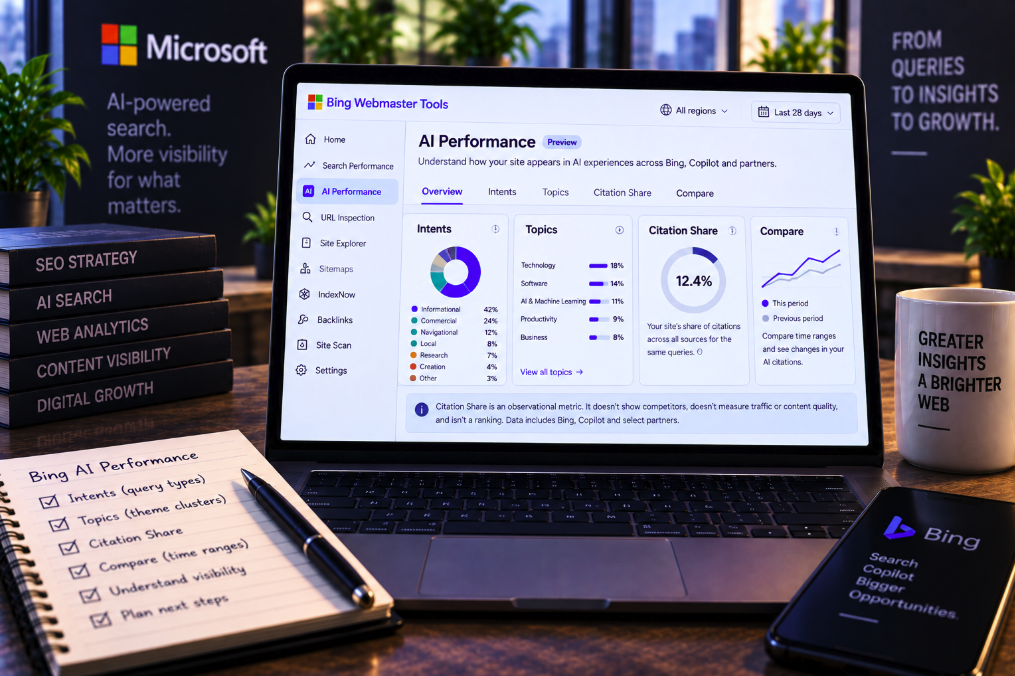
Microsoft is turning Bing Webmaster Tools into something search marketers have been asking for since generative answers began absorbing more of the discovery journey: a first-party dashboard for understanding how a website participates in AI-generated responses.
On June 16, Microsoft announced four new AI Performance capabilities rolling out globally in preview: Intents, Topics, Citation Share and Compare. Together, they move the reporting model beyond raw citation counts and toward the kinds of questions publishers actually need to answer—why a page is being cited, which subject areas generate visibility, how much of the available citation space a site receives and whether that presence is changing over time.
The release also sharpens a growing analytics gap between Microsoft and Google. Bing Webmaster Tools now exposes dedicated first-party reporting for AI citations across Microsoft’s ecosystem, while Google Search Console still does not offer an equivalent dashboard that separates AI citation share, thematic visibility and intent-level citation reporting.
AI Performance now classifies the intent behind citations
Microsoft first launched AI Performance in Bing Webmaster Tools in February 2026. The original preview showed total citations, average cited pages, grounding queries, page-level citation activity and visibility trends across Microsoft Copilot, AI-generated Bing experiences and select partner integrations.
The new Intents feature adds a classification layer to those grounding queries. Microsoft says queries can be grouped into categories including Informational, Commercial, Navigational, Learn and Solve, Research, Creation, Local and additional intent types.
That distinction matters because the same page can have very different strategic value depending on why it is being retrieved. A software company cited mostly for research queries has a different AI visibility profile from one appearing during commercial evaluation. A local publisher surfaced for location-oriented prompts is solving a different discovery problem from an educational site appearing in learning interactions.
Instead of merely seeing a phrase associated with a citation, publishers can begin examining the broader task Microsoft’s systems associate with that phrase. That makes AI citation reporting more comparable to the intent analysis SEO teams already use when deciding what kind of content should answer a conventional search query.
Topics shifts analysis from keywords to thematic clusters
The second feature, Topics, groups related grounding queries into larger subject areas. Microsoft gives the example of queries around solar panels, solar efficiency and residential installation being grouped into a broader Solar Energy topic.
This is a significant change in how AI visibility can be evaluated. Traditional SEO reporting often begins with individual keywords because rankings are attached to specific queries. Generative systems operate more fluidly across concepts, paraphrases and follow-up questions, making a keyword-by-keyword view less representative of how information is actually retrieved and synthesized.
Topic clustering gives content teams a way to ask whether they are consistently visible around a subject rather than whether they appeared for one wording of a question. A publisher could discover that dozens of different grounding queries all reinforce a strong thematic presence, or that an apparently successful page is being cited only for a narrow subset of the topic it was designed to cover.
Microsoft says Topics and Intents rely on evolving AI and machine-learning classification systems. During the preview, some labels may remain broad, especially in specialized niches. The company expects coverage and precision to improve as the systems mature, which means publishers should treat the classifications as useful analytical groupings rather than immutable taxonomies.
Citation Share measures how much of a query’s source space belongs to your site
Citation Share is the most novel metric in the release. Total citation counts tell a publisher how often its content appeared as a source. Citation Share attempts to provide context by calculating what percentage of all citations shown for the same grounding query were attributed to that publisher’s site.
If an AI experience cites multiple sources for a query and several come from the same domain, that site can capture a larger share of the observed citation space. Over time, the metric can reveal whether a publisher’s relative presence is growing, shrinking or being distributed among more sources.
That makes Citation Share directionally similar to concepts such as share of voice, but Microsoft is careful not to describe it as a competitive ranking. Bing Webmaster Tools does not reveal the domains receiving the rest of the citations. The metric therefore tells a site owner how much representation the site received without turning the report into a list of AI-search competitors.
Microsoft explicitly says Citation Share is not a ranking
The caveats around Citation Share are important because a percentage can easily acquire more meaning than the underlying data supports. Microsoft calls it an observational metric, not a ranking system or competitive scoreboard.
It does not measure traffic share. A site could receive a high percentage of citations for a grounding query without generating meaningful clicks from those appearances. It does not assign a quality score to the content, and a higher Citation Share should not be interpreted as Microsoft declaring one publisher more authoritative than another.
It also does not reveal citation placement or necessarily indicate how influential a particular source was in constructing an answer. AI responses can synthesize multiple pieces of evidence, and citation presentation can vary by product and interface. The metric is best understood as relative source presence within Microsoft’s observed citation set for a grounding query.
Microsoft also notes that citation ecosystems are dynamic. Model changes, freshness signals, user behavior, partner refresh cycles and changes across the web can all alter which sources appear. A rising or falling Citation Share is therefore a signal to investigate, not proof that a particular optimization caused the movement.
Compare gives GEO teams a before-and-after view
The fourth capability, Compare, lets publishers overlay a previous period onto the current AI Performance view. A team can compare the latest 30 days with the preceding 30 days or choose custom ranges to inspect changes in citation activity.
This gives generative engine optimization teams a practical way to evaluate trends around content updates, seasonal demand and broader ecosystem changes. If a publisher rewrites a major guide, expands a product page or improves supporting evidence, it can monitor whether citation activity changes afterward.
Again, correlation is not causation. Microsoft explicitly notes that AI citations can move for many reasons beyond a publisher’s own edits. A model update or shift in user demand can produce a visible change even when the site itself has not changed. Compare is therefore an investigative tool rather than a controlled attribution system.
The data spans Bing, Copilot and select partner experiences
The reporting is broader than Bing’s conventional search interface. Microsoft says AI Performance covers citations across Microsoft Copilot, AI-generated experiences in Bing and selected partner integrations. That makes the dashboard a view into Microsoft’s broader grounding ecosystem rather than a simple AI layer added to classic Bing rankings.
This distinction reflects Microsoft’s larger view of how search infrastructure is evolving. In a May 2026 explanation of grounding and indexing, the company argued that traditional search and AI grounding begin with similar web infrastructure but optimize for different outcomes. Search asks which pages a person should visit; grounding asks what information an AI system can responsibly use to construct an answer.
That difference helps explain why conventional rank tracking cannot fully measure AI visibility. A page can be useful as grounding evidence without occupying the equivalent of a familiar blue-link position, and an AI answer can combine evidence from multiple sources into a single response. Citation analytics therefore require different units of measurement.
Google Search Console still lacks an equivalent AI citation dashboard
The contrast with Google is increasingly difficult for publishers to ignore. Google Search Console remains the primary first-party source for understanding Google organic search performance, but it does not currently provide an equivalent report that exposes Citation Share, AI citation-specific intent categories or topic clusters across Google’s generative experiences.
That does not mean Search Console contains no data affected by AI-powered search. Search impressions and clicks can reflect user activity on Google surfaces that incorporate AI features, depending on Google’s reporting rules. The gap is one of granularity and attribution: publishers cannot open Search Console and inspect a dedicated first-party report showing which pages were cited in AI-generated answers, what grounding queries triggered those citations and what percentage of the citation set their site captured.
Microsoft’s approach makes those questions explicit. That could give Bing Webmaster Tools strategic importance beyond Bing’s share of traditional search traffic, particularly for publishers trying to understand generative discovery before industry measurement standards have stabilized.
AI visibility is becoming a separate analytics discipline
The four additions show how quickly GEO measurement is moving away from simply counting mentions. A useful AI analytics system needs several dimensions at once: citation frequency, page coverage, query context, thematic visibility, relative source presence and change over time.
Even those dimensions do not answer every business question. Bing Webmaster Tools cannot tell a publisher whether a citation produced a sale, whether a user read the source or whether a particular cited passage materially shaped an AI response. Citation data needs to be combined with referral analytics, conversions and broader brand measurement before it can demonstrate commercial value.
Still, first-party citation reporting solves an important part of the visibility problem. Third-party GEO tools must observe AI products externally and infer how often a brand appears. Microsoft can report signals from within its own ecosystem, giving publishers a direct view of the citations its supported AI experiences generate.
Publishers finally have more than a raw citation count
The biggest advance in the June update is not any single metric. It is the transition from asking “Was my site cited?” to asking more useful questions about the citation itself.
Intents explains the context in which content appears. Topics reveals broader areas of thematic visibility. Citation Share provides a directional measure of representation among all sources cited for a grounding query. Compare shows how those patterns change over time.
Microsoft is equally clear about what the tools do not provide. Citation Share is not a ranking, a traffic metric or a quality score, and it does not reveal competitors. Intent and Topic labels remain evolving classifications, while citation patterns can change for reasons outside a publisher’s control.
Those limitations are a feature of honest measurement rather than a reason to dismiss the data. AI search is dynamic enough that no single number can function as the new average position. Bing Webmaster Tools is instead building a set of observational signals that let publishers understand different dimensions of generative visibility.
For SEO teams accustomed to decades of keyword, ranking and click reports, that may be the more important shift. The next generation of search analytics will not simply tell publishers where a page ranks. It will increasingly need to show where their information participates in an answer—and Microsoft is now giving webmasters one of the clearest first-party views of that process.