
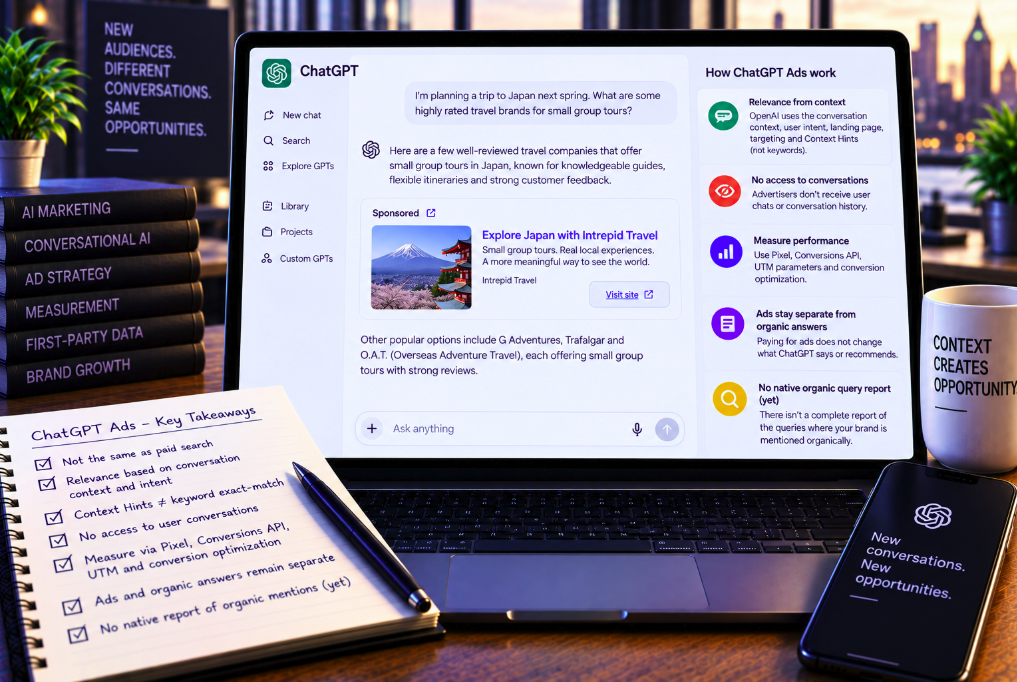
ChatGPT Ads create an unusual advertising asymmetry: OpenAI can use the meaning of a conversation to decide whether an ad is relevant, but the advertiser does not get to see the conversation that created the opportunity.
That difference is central to understanding why ChatGPT Ads should not be managed as a simple extension of paid search. A new Search Engine Journal analysis argues that PPC teams need to rethink targeting, measurement and reporting before shifting budget from conventional search campaigns into ChatGPT.
OpenAI’s own advertising documentation confirms the underlying mechanics. ChatGPT Ads can consider the context and intent of the current conversation, the advertiser’s landing page, ad title and copy, targeting selections and advertiser-provided Context Hints. But those hints are not exact-match keywords, and advertisers do not receive the user’s chats or chat history.
The result is a paid channel built around semantic conversational relevance without a traditional search-term report showing the prompts that triggered each ad.
ChatGPT Ads match against intent, not a single query string
Paid search begins with a relatively compact event: the user submits a query. The advertiser can build campaigns around keywords, match types and query reports, then analyze which search terms generated impressions, clicks and conversions.
ChatGPT interactions can be much longer.
A user might spend several turns explaining a business problem, narrowing requirements, comparing options and asking follow-up questions before an advertising opportunity appears. The commercial intent can emerge from the conversation as a whole rather than from one concise phrase.
OpenAI’s ChatGPT Ads documentation says its system selects ads based on expected relevance and outcomes using multiple signals, including the context and intent of the current conversation.
That makes the conversational state part of the matching system.
Landing pages and ad creative are also relevance signals
The conversation is not the only input.
OpenAI says ad delivery can consider the landing page, title, copy and advertiser-provided Context Hints. Targeting selections also contribute to eligibility and relevance.
This means the system is trying to understand both sides of the match: what the user is trying to accomplish and what the advertiser actually offers.
A vague landing page and generic ad creative can therefore make the advertiser’s intent harder to interpret even if the product is technically relevant.
ChatGPT Ads reward semantic clarity in a way that resembles modern automated advertising systems more than old-style keyword insertion.
Context Hints are the closest thing to keywords—but they are not keywords
At the ad-group level, advertisers can provide Context Hints describing the conversations, topics, needs or situations where a product may be useful.
OpenAI’s ad-group guidance recommends writing them as natural-language descriptions of real customer needs.
Instead of a disconnected phrase such as “running shoes,” OpenAI gives the example of a more descriptive concept such as cushioned everyday running shoes for beginners training for a first 5K.
The purpose is not to force an exact textual match. It is to help the system understand the use case.
A Context Hint does not guarantee delivery on a conversation
This is the most important difference for search advertisers.
OpenAI explicitly says Context Hints are not exact-match controls, audience-targeting rules or instructions to show an ad only for specific conversations.
Being specific does not mean the user has to type the same words contained in the hint.
The system can interpret broader needs, situations and natural variations in language.
Conversely, an advertiser cannot assume that writing a desired phrase into a Context Hint guarantees an impression whenever that phrase appears in a chat.
Context Hints guide relevance. They do not reserve conversational inventory.
“Context Hints replace keywords” is useful shorthand, not a literal product rule
For PPC teams, the easiest mental model is that Context Hints occupy some of the strategic role keywords once played: they tell the platform what kinds of demand the advertiser wants to address.
But the comparison should not be pushed too far.
OpenAI says hints can describe conversations, topics or even keywords. The difference is that the platform interprets them semantically rather than enforcing conventional match-type behavior.
ChatGPT Ads also support other controls, including geographic targeting and custom audiences.
The targeting system is therefore broader than a simple keyword replacement.
Advertisers do not see the conversation that triggered the ad
The matching system’s access to conversational context does not become advertiser access to that context.
OpenAI’s user-facing advertising privacy documentation states that advertisers do not receive users’ ChatGPT conversations, chat history, memory or personal data.
Advertisers receive aggregated, non-identifying information about ad performance instead.
This privacy boundary is fundamental to the product. The system can determine that a conversation is relevant to an advertiser without handing the underlying conversation to that advertiser.
There is no traditional search-term report of private prompts
That privacy model removes one of the most familiar feedback loops in paid search.
A Google Ads search-term report can show advertisers the queries associated with campaign activity. Current ChatGPT Ads reporting does not expose users’ private conversations as an equivalent prompt-level report.
OpenAI’s current Ads Manager documentation lists metrics such as impressions, clicks, spend, click-through rate, average CPC, average CPM and conversions.
Those metrics answer whether a campaign performed. They do not reveal the private chat that caused the platform to consider the ad relevant.
For search marketers accustomed to mining query reports for new keywords and negative terms, that is a substantial workflow change.
Privacy creates a new optimization constraint
In paid search, poor traffic quality can often be diagnosed by opening the search-term report and identifying irrelevant queries.
In ChatGPT Ads, the advertiser may see weak conversion performance without being able to inspect the exact conversational paths behind those impressions.
Optimization therefore has to rely more heavily on the signals the advertiser controls: Context Hints, ad-group structure, landing-page specificity, creative messaging, targeting, bids and conversion feedback.
The absence of raw prompt data does not make optimization impossible. It changes the diagnostic evidence available to the marketer.
Ad groups should be organized around use cases, not keyword buckets
OpenAI recommends keeping each ad group focused on a common product category, theme or customer need.
If Context Hints describe substantially different products or situations that require different creative or landing pages, the company recommends separating them into different ad groups.
This resembles a semantic architecture more than a conventional keyword list.
A SaaS company might separate a small-business workflow use case from an enterprise compliance use case even if both could historically have shared overlapping paid-search keywords.
The cleaner the use-case boundary, the easier it becomes for both the ad system and the marketer to understand performance.
Creative needs to explain when the product is useful
OpenAI’s creative guidance also reflects the conversational environment.
The company recommends clear, specific and benefit-focused ads that explain what the product offers, who it helps and when it is useful.
Generic slogans provide less information for a system trying to match a product to a nuanced conversation.
OpenAI also encourages advertisers to create multiple distinct title and copy variations so the system has enough coverage to identify different relevant opportunities.
This is less about inserting a keyword into a headline and more about expressing the product’s value across realistic user situations.
Measurement starts after the click
The fact that advertisers cannot inspect the triggering conversation does not mean ChatGPT Ads are unmeasurable.
OpenAI supports several familiar performance tools.
Ads Manager reports standard campaign metrics. Advertisers can add static tracking parameters such as UTMs to landing-page URLs. OpenAI also provides its own Pixel and Conversions API for conversion measurement.
The measurement layer is therefore much closer to mainstream performance advertising than the targeting layer may initially appear.
The OpenAI Pixel and Conversions API feed outcome data back to campaigns
OpenAI’s conversion documentation says advertisers can send standard or custom conversion events through the OpenAI Pixel, the Conversions API or both.
A conversion can be reported when OpenAI receives an eligible event, the event matches the campaign’s configured conversion action, it falls within the attribution window and the platform can connect it to an eligible ad click using available measurement signals.
OpenAI recommends using Pixel and Conversions API together where appropriate, including consistent event IDs for deduplication.
This gives the system outcome feedback without exposing the user’s private conversation to the advertiser.
Conversion optimization makes first-party outcome quality more important
ChatGPT Ads has moved beyond simple impression and click buying.
When OpenAI expanded ChatGPT Ads across Europe, the company said it had added conversion optimization alongside CPC and CPM buying, as well as geo-targeting, custom audiences and expanded measurement.
That makes the quality of conversion signals increasingly important.
If an advertiser optimizes toward weak events, the platform can learn to find more users likely to produce weak events. If the advertiser sends meaningful purchases, qualified leads or registrations, optimization has a stronger business objective.
The lesson is familiar from automated paid media even though the conversational targeting model is new.
UTMs remain useful because independent analytics still matter
OpenAI explicitly supports static tracking parameters on landing-page URLs.
UTMs allow advertisers to identify ChatGPT Ads traffic inside their own analytics stack, compare post-click behavior with other channels and maintain an independent record of campaign sessions.
This is particularly valuable because attribution systems can disagree.
OpenAI notes that Ads Manager and third-party analytics may report different conversion totals because of attribution windows, browser conditions, consent, time zones, deduplication and modeled conversion reporting.
No single reporting interface should therefore be treated as the only source of truth.
Advertisers see outcomes, not individual conversational histories
OpenAI’s measurement design is intentionally aggregated.
In its May expansion of ChatGPT ad buying and measurement, the company emphasized that advertisers can understand campaign performance without receiving individual conversations.
That separation persists even as the platform adds richer conversion signals.
The advertiser can know that an ad received impressions, clicks and attributed conversions. It cannot use the ad dashboard to reconstruct the user’s private conversation with ChatGPT.
That is an important distinction between measurement and surveillance.
Ads and ChatGPT answers remain separate systems
OpenAI has repeatedly stated that advertising does not influence ChatGPT’s answers.
The company says ads are clearly labeled and separate from the organic response. Paying OpenAI for advertising does not change what ChatGPT says, which products it recommends organically or which brands it mentions in its answer.
This is critical for marketers because paid visibility and organic AI visibility are different acquisition problems.
An advertiser can win an ad impression while remaining absent from the organic answer. A brand can dominate the organic recommendation without running an ad.
The two forms of visibility should not be combined into one metric.
There is still no complete native report for organic brand-query visibility
The Search Engine Journal analysis highlights another gap: advertisers do not currently receive a comprehensive native report showing the full set of conversations or queries in which ChatGPT organically mentioned their brand.
That means the paid platform can report campaign performance while organic conversational visibility requires a different measurement approach.
Brands may use external AI-visibility monitoring, controlled prompt panels, referral analysis and first-party research to estimate organic presence, but none of those is equivalent to a complete platform-level query log.
This is a current product limitation, not evidence that such reporting could never exist in the future.
Paid search and ChatGPT Ads answer different demand questions
Search advertising asks, in simplified form: what did the user search for, and can the advertiser win the click?
ChatGPT Ads can ask a broader question: given what this conversation appears to be trying to accomplish, which eligible advertisement is likely to be relevant and useful?
That creates opportunities that do not map neatly onto traditional keyword demand.
A user may never type the advertiser’s target phrase. The commercial need may emerge through several messages describing constraints, preferences and desired outcomes.
Contextual advertising inside a conversation can potentially recognize that need even without an exact keyword event.
That does not mean ChatGPT Ads are automatically better than search ads
Different matching logic is not the same as superior economics.
Paid search benefits from explicit intent, mature bidding systems, extensive query reporting and decades of advertiser optimization practice.
ChatGPT Ads offers richer conversational context but less transparency into the exact language behind individual ad opportunities.
Advertisers need to evaluate incrementality, conversion quality, cost and audience overlap rather than assuming conversational targeting should replace a profitable search program.
The Search Engine Journal framework is best read as a warning against copying paid-search campaign logic into a channel with different mechanics.
Context Hints need testing through outcomes rather than query mining
Without a raw prompt report, marketers need a different experimentation loop.
Create tightly defined ad groups around genuine use cases. Write distinct Context Hints. Match each group to landing pages and creative that express the same need. Measure conversion quality. Then expand or narrow the semantic territory based on outcomes.
This is slower than reading a search-term report and adding a negative keyword, but it is consistent with how the product is designed.
The advertiser describes the intended context; OpenAI decides whether a particular conversation is relevant; performance data tells the advertiser whether that strategy produces business value.
Landing pages become part of targeting strategy
Because OpenAI explicitly lists the landing page as a relevance signal, destination quality is not merely a post-click conversion issue.
A focused page can help communicate what the advertiser offers and which user problem it solves.
A broad corporate homepage may provide weaker semantic guidance than a product or use-case page aligned with the ad group.
This does not mean landing-page copy guarantees delivery for a conversation. It means the page contributes to the information the ad system can use when evaluating relevance.
For marketers, media structure and content architecture become more tightly connected.
Organic AI optimization remains independent from media spend
Brands interested in being recommended by ChatGPT still need to work on the information environment from which organic answers emerge.
That can include clear first-party content, authoritative third-party coverage, product information, reviews, documentation and other sources relevant to the user’s question.
Advertising cannot substitute for that work because OpenAI says paid campaigns do not influence the answer.
Conversely, strong organic presence does not automatically provide the targeting and conversion reporting available through Ads Manager.
The two programs can support the same commercial goal while remaining technically and editorially separate.
The absence of prompt-level reporting is both a privacy feature and a media limitation
From a user perspective, not giving advertisers private chat histories is a strong boundary.
From an advertiser perspective, the same boundary removes granular diagnostic information that paid-search teams are accustomed to using.
Both statements can be true at once.
The practical question is whether aggregated campaign reporting, Context Hint controls and conversion feedback provide enough information to allocate budget efficiently without exposing private conversations.
That will become clearer as advertisers accumulate longer performance histories across different industries and objectives.
ChatGPT Ads require a new campaign vocabulary
Keywords, match types and search terms remain useful concepts in conventional paid search. ChatGPT Ads introduces a different vocabulary: conversational intent, Context Hints, semantic relevance, use cases and outcome signals.
The transition is easy to underestimate because the buying metrics—CPC, CPM, clicks and conversions—look familiar.
The targeting logic underneath them is not.
A PPC team that imports a keyword list and expects exact conversational control will misunderstand the platform. A brand team that assumes contextual matching cannot be measured will misunderstand it in the opposite direction.
The platform combines semantic targeting with conventional performance measurement while deliberately withholding private conversation content from advertisers.
ChatGPT knows the conversation; the advertiser gets the business signal
That asymmetry may ultimately be the defining characteristic of ChatGPT advertising.
OpenAI can evaluate what a user appears to need using the current conversation and other permitted relevance signals. The advertiser can describe the situations where its product is useful through Context Hints, creative, landing pages and targeting.
But the advertiser does not receive the user’s chat as the price of participating in that matching system.
Instead, it receives campaign-level evidence: impressions, clicks, costs and conversions, supplemented by Pixel, Conversions API and UTM-based analytics.
And the paid relationship stops at the ad. OpenAI says advertising does not change the organic answer or recommendation.
For marketers, this means ChatGPT Ads should not be judged by how closely they recreate paid search. Their value will depend on whether contextual matching can find commercially useful moments without exact-match keywords—and whether outcome measurement can compensate for not seeing the prompts that created those moments.