
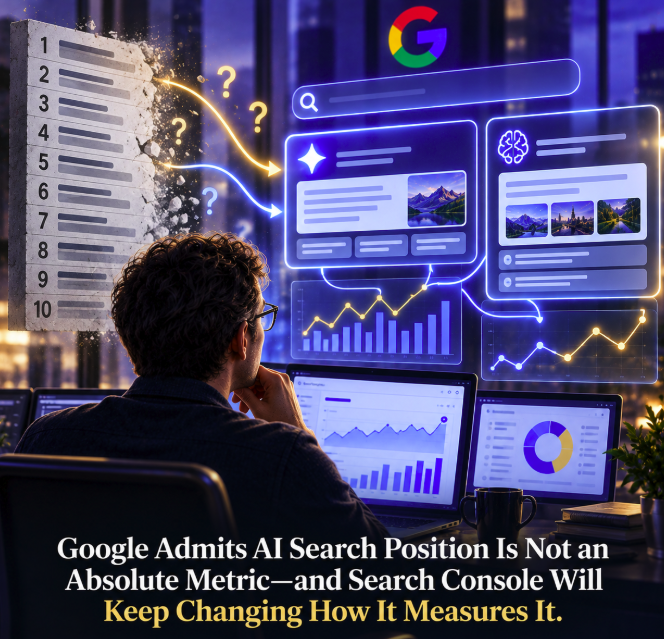
Google is warning SEOs not to treat “position” in AI search as a fixed physical measurement. John Mueller says the way Search Console records impressions and positions for Google Search, AI Mode and AI Overviews will evolve as the search interfaces themselves change, acknowledging edge cases and explicitly rejecting the idea that there can be a permanent, absolute truth for counting position across increasingly complex result layouts.
Mueller made the comments in a LinkedIn discussion reported by Barry Schwartz at Search Engine Roundtable on September 16. The discussion began with a deceptively simple question: when AI Mode shows several linked citations inside one generated response, should those links be counted sequentially as separate ranking positions, or should the entire AI response behave like one search-result block?
Google's answer is important because it reframes what Search Console position data actually represents. The metric is not a universal coordinate system for every link a user can see. It is a reporting convention designed to give site owners a useful approximation of how their content appears within interfaces that no longer behave like a simple ordered list.
Mueller says the methodology will evolve with Search
Mueller said he expects impression and position tracking to “evolve over time” as Google Search, AI Mode and AI Overviews evolve. He also acknowledged that there are edge cases in how these measurements work and said Google's objective is usefulness for site owners rather than a permanently fixed definition capable of describing every possible interface.
His most revealing point was that the goal is not a “written-in-stone absolute truth” for position counting, which he said is impossible. Google instead needs a methodology that helps publishers understand how their sites are being shown.
That distinction has practical consequences. Search Console data remains valuable, but a position number should be interpreted as the output of Google's current measurement rules rather than as an immutable fact about where a URL physically sat on every user's screen.
Mueller added that Google plans to update its documentation if and when significant changes occur. He also cautioned that changes in Search will require work from site owners when interpreting, understanding and comparing metrics over time.
AI Mode exposes the weakness of linear ranking numbers
The question raised by Kenichi Suzuki focused specifically on how links inside AI Mode are counted. Traditional web rankings invite a straightforward mental model: result one appears above result two, which appears above result three. Modern search interfaces break that assumption.
An AI Mode response can contain generated text, source links, cards and other interactive elements arranged within a larger answer. AI Overviews similarly combine generated information with multiple sources inside a single search feature. The question “What position did my link rank?” becomes difficult when several links are embedded inside one larger block rather than stacked as independent blue links.
Google has already signaled that this problem extends beyond generative AI. In a separate discussion earlier this month, Mueller said the old position-one-through-ten model is difficult to map onto modern results because users can interact with so many different search features. Search Engine Roundtable reported those comments on September 10, when Mueller said Google currently tracks position for these experiences similarly to other search features, as a block.
The September 16 comments go further by emphasizing that the measurement itself should be expected to change as the interface changes.
Search Console already counts AI Mode in its totals
Google has been progressively integrating generative search into Search Console rather than creating an entirely separate analytics universe. Its Search Central documentation updates show that AI Mode began counting toward totals in the Search Console Performance report in April 2026.
Google also documents how AI Overviews are counted in Search Console and previously clarified that clicks, impressions and position are recorded for AI Overviews using methodology comparable to other Search result features such as featured snippets and carousels. The company described that earlier update as a documentation clarification rather than a change to Search Console reports.
For AI Mode, follow-up questions create another measurement wrinkle. Google says a follow-up inside AI Mode is effectively a new query, so impressions, positions and clicks in the new response are counted against that new user query. This means a single conversational research session can produce multiple Search Console events even though the user experiences it as one continuous interaction.
“Average position” is becoming more abstract
Average position has always required careful interpretation. Search results can vary by device, location, query context and result type, and Search Console aggregates observations rather than reproducing a literal screenshot of every SERP. AI search makes the abstraction more obvious.
Imagine that a publisher is cited inside an AI answer that occupies a highly prominent part of the page. The citation itself might sit several lines or cards into that answer, but the broader feature may be treated as one block for reporting purposes. A numeric position can therefore describe Google's accounting model without precisely describing the visual prominence of the individual link.
The reverse can also happen conceptually. Two links that receive similar position reporting may have very different visibility depending on whether one appears immediately in view while another requires expansion, scrolling or interaction inside a complex feature.
That does not make the metric meaningless. It means position increasingly needs context. The number is useful for tracking patterns under a consistent methodology, but less suitable as a claim that a URL occupied an objectively defined pixel-level rank in an AI-generated interface.
Methodology changes can create breaks in historical comparisons
Mueller's warning that reporting will evolve creates an important analytics issue: time-series continuity. If Google changes how it defines an impression or assigns position within an AI feature, a trend line can shift even when the underlying visibility of a website has not changed by the same amount.
This is familiar territory in digital analytics. Measurement systems change as products change, and historical comparisons become harder when definitions move. AI search is likely to accelerate that problem because the interfaces themselves are evolving rapidly.
SEO teams should therefore preserve methodological context alongside their Search Console exports. When Google documents a meaningful change, that date should be annotated in dashboards and reporting systems. Otherwise a future analyst may interpret a reporting discontinuity as a ranking gain or loss.
This is especially important for year-over-year analysis. A position metric recorded under one AI Mode layout and counting methodology may not be directly comparable with the same field twelve months later if Google has substantially redesigned the experience.
Impressions can be ambiguous in interactive AI interfaces too
The same problem applies to impressions. In a traditional result list, it is relatively intuitive to ask whether a result was displayed to a user. Interactive AI interfaces can include expandable sections, dynamically generated responses, follow-up states and links that become visible at different points in the experience.
Google needs operational rules that determine when an appearance counts. Those rules can be consistent enough for reporting while still containing edge cases that resist a philosophically perfect definition.
Mueller's comments are therefore not an admission that Search Console data is arbitrary. They are an acknowledgment that measurement depends on product definitions. When the product evolves, those definitions sometimes have to evolve with it.
SEOs need to separate rank tracking from visibility measurement
The practical consequence is that AI search measurement should not be reduced to a single position KPI. Position remains one signal, but impressions, clicks, query patterns and actual business outcomes become more important when the visual relationship between “position 1” and user attention is unstable.
This is particularly relevant to GEO and AI visibility work. A publisher may care whether it is retrieved as a source, whether it appears in a generated answer, whether users can see the citation, whether they click it and whether the appearance influences downstream discovery. A single average-position number cannot describe that entire chain.
The challenge is similar to what happened as conventional SERPs accumulated featured snippets, knowledge panels, local packs, image carousels, video results and shopping modules. Ranking position became less synonymous with screen position. AI Mode and AI Overviews push that divergence further because the search result itself can be a composite answer containing many sources.
Search Console is measuring a moving interface
Google's own documentation history reinforces Mueller's point. The company's Search Central changelog records repeated adjustments and clarifications as AI features become integrated into Search reporting. AI Mode was added to Search Console totals in April 2026, while earlier documentation clarified the handling of AI Overviews. The reporting layer is adapting because the search product is adapting.
This is likely to continue. New layouts, conversational follow-ups, source treatments and interactive elements can create measurement cases that did not exist when the current rules were written. Google's position is effectively that documentation will describe the methodology, but the methodology should not be mistaken for an eternal law of ranking.
That is a useful distinction for anyone building automated SEO dashboards. A reporting system that treats position as a mathematically absolute variable risks creating false precision. A better system treats it as one platform-defined observation whose meaning is tied to Google's current interface and documentation.
The era of “I rank number three” is getting harder to defend
For years, SEO reporting often condensed performance into statements such as “we rank number three for this keyword.” Even conventional personalized search made that statement an approximation. AI search makes its limitations much more visible.
A site can appear as one of several sources inside a generated response, within a feature that Google counts as a block, after a conversational follow-up that Search Console records as a new query. The user may see the source prominently, barely notice it or interact with the AI answer without clicking any citation at all.
In that environment, the more defensible question is not simply “What rank are we?” but “How are we represented across this search experience, and what measurable outcomes follow?” That shifts analysis from rank as a destination toward visibility as a multidimensional phenomenon.
Google's message is to use the metric, but understand the convention
Mueller is not telling site owners to discard Search Console position reporting. His comments point toward a more careful interpretation. Google wants the metric to remain useful, and it will continue refining the methodology as Search changes. But usefulness does not require pretending that every complex AI interface has one objectively correct way to assign a linear position number.
For SEO teams, that means documenting measurement changes, avoiding false precision and combining position with impressions, clicks and broader AI visibility signals. It also means expecting historical comparisons to require more explanation as generative search evolves.
The larger lesson is that AI search is changing not only how results are generated but how search performance itself can be measured. When the result is a dynamic answer rather than a simple ordered list, “position” becomes a convention imposed on a multidimensional interface. Google is now saying explicitly that the convention will keep evolving — and that there is no absolute version waiting to be discovered.