
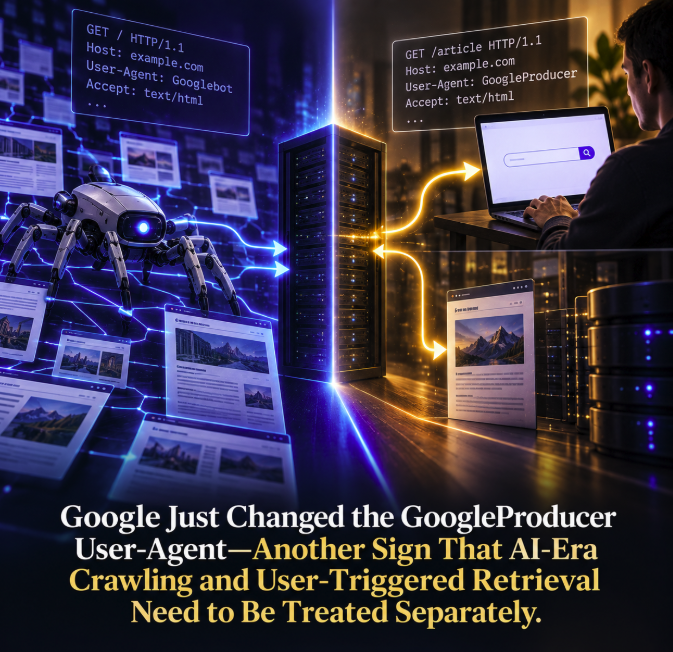
Google made a small but revealing change to its crawler documentation on September 16, 2026: the company updated the HTTP User-Agent string used by GoogleProducer, the fetcher associated with Google Publisher Center. On its own, changing a URL inside a User-Agent string is routine infrastructure maintenance. In the wider context of AI agents, retrieval systems and increasingly complex web access patterns, however, the update reinforces a distinction publishers should pay much more attention to: automated crawling and content retrieval initiated by a user are not the same thing.
Google documented the change in its Search Central updates log, saying it updated the URL in the GoogleProducer HTTP User-Agent string so the documentation matches the value used by the actual fetcher. Google added that the User-Agent string had recently changed and that future fetches would use the new value. The current string is documented as GoogleProducer; (+https://developers.google.com/search/docs/crawling-indexing/google-producer).
GoogleProducer is a fetcher, not a conventional search crawler
The important part of the update is not simply the new URL. It is where Google now places and explains GoogleProducer. In Google's current user-triggered fetcher documentation, GoogleProducer appears alongside systems whose requests occur because a person has initiated an action inside a Google product.
Google describes GoogleProducer specifically as the fetcher used by Google Publisher Center to retrieve and process feeds that publishers explicitly supplied for use on Google News landing pages. That behavior differs conceptually from Googlebot continuously discovering and crawling documents so they can participate in Google Search's indexing systems.
This distinction matters operationally. A server log containing a request from Google infrastructure does not automatically mean Google Search is crawling the URL for indexing. The request may instead be fulfilling a user or publisher action inside another Google product. Treating every Google-originating request as conventional search crawling can therefore produce misleading analytics, inaccurate bot classifications and poorly designed access controls.
Google has reorganized its documentation around this distinction
The User-Agent update arrived alongside a broader reorganization of Google's crawler documentation. Google said on September 16 that it had reorganized documentation for crawlers and user-triggered fetchers, added explicit notes about which products individual crawlers affect and included robots.txt examples for User-Agent tokens. Google said there were no otherwise meaningful changes to the content.
The company explained that the crawler documentation had become too long and difficult to extend. That may sound like ordinary documentation housekeeping, but the underlying ecosystem has become considerably more complicated. Google's infrastructure now serves Search, News, Shopping, Gemini and other products, while agentic and user-triggered systems create additional categories of web requests that do not map cleanly onto the traditional idea of a search-engine spider.
Google later moved much of its crawling documentation into a dedicated crawling-infrastructure area, explaining that the infrastructure is shared across products beyond Search. The architectural message is increasingly explicit: website operators should identify not just the company making a request, but the specific requester, product and purpose.
User-triggered retrieval can behave differently around robots.txt
One of the most consequential differences appears in Google's explanation of robots.txt. Google says user-triggered fetchers are initiated when a user asks a Google product to perform a fetching function. Because the request originates from a user's action, these fetchers generally ignore robots.txt rules.
That behavior makes sense when viewed from the user's perspective. If someone explicitly supplies a URL or feed to a product and asks it to retrieve that resource, the operation resembles a browser or application fetching content for the user rather than a crawler autonomously exploring the web for indexing purposes.
For publishers, however, this means robots.txt cannot be interpreted as a universal access-control layer. It remains a crawler directive, not an authentication system. If content genuinely must not be retrieved by unauthorized clients, publishers need server-side authorization and access controls rather than relying solely on crawler directives.
This distinction is becoming increasingly important as AI products blur the boundary between browsing and automation. A conventional bot might crawl millions of pages independently. An AI agent might fetch one specific page because a user asked a question or requested an action. Both requests are automated at the HTTP layer, but their intent and governance can be very different.
The AI era is producing more categories of web requester
Google's current documentation already illustrates how varied these categories have become. Its user-triggered fetcher list includes Google Site Verifier, Google Read Aloud, Google Messages, Gemini Notebook and Google-Agent, among others. Google-Agent is particularly notable because Google says it is used by agents hosted on Google infrastructure to navigate the web and perform actions upon user request.
That is a fundamentally different interaction model from classic search crawling. Instead of collecting documents in advance for a centralized index, an agent can retrieve information as part of a task being performed for a particular person. From the publisher's perspective, both systems may arrive as HTTP requests from machines, but the economic and technical meaning of those requests can differ substantially.
The distinction also complicates simplistic debates about whether publishers should “block AI bots.” A single company can operate crawlers for indexing, specialized fetchers for individual products and agents that access the web on behalf of users. Decisions about access increasingly need to consider which of those functions a publisher actually wants to permit.
User-Agent strings are useful identifiers, but not proof
The GoogleProducer change also provides a reminder that User-Agent strings are identifiers rather than reliable authentication. Google explicitly warns that User-Agent values can be spoofed. A malicious requester can send an HTTP header claiming to be GoogleProducer, Googlebot or another legitimate crawler without actually originating from Google.
Google therefore publishes network information that site operators can use to verify requests from its crawling infrastructure. For organizations making security or access decisions based on bot identity, verification is more robust than matching a text string in the HTTP header alone.
This matters for analytics as well. A logging system can classify requests by User-Agent for reporting purposes, but high-confidence decisions — especially those involving privileged access, rate limits or security exceptions — should not assume that a familiar crawler name proves who is on the other end of the connection.
What publishers should review after the GoogleProducer change
Sites that explicitly match the full GoogleProducer User-Agent string in web application firewalls, CDN rules, analytics filters or server-side bot classifications should make sure those rules recognize the current value. Google says future GoogleProducer fetches will use the updated string, so hard-coded logic built around an older complete string can become inaccurate.
More broadly, technical teams should avoid designing bot management around brittle full-string matches when a stable User-Agent token and verified network identity are more appropriate. They should also distinguish logs for automated crawlers from logs for user-triggered fetchers whenever possible. That separation can make it easier to understand whether traffic represents indexing activity, a product-specific retrieval operation or an agent responding to a user request.
For SEO teams, the key point is equally important: seeing GoogleProducer in a log is not evidence that Google Search is crawling or indexing the page. Google documents it as a Google Publisher Center fetcher. Conflating those categories can lead to false conclusions when diagnosing crawl behavior.
A small User-Agent change points to a larger infrastructure shift
The September 16 GoogleProducer update is not a new ranking signal, an indexing change or evidence of a new AI crawler. Google describes it narrowly as a User-Agent update that aligns the documented value with the actual fetcher. Its significance lies in the surrounding architecture.
The web is entering a period in which “bot traffic” is too broad a category to be useful on its own. Search crawlers discover content automatically. Product-specific fetchers retrieve resources for defined functions. AI agents can access pages because a person asked them to research, compare or perform an action. Those systems may share infrastructure while operating under different assumptions about discovery, retrieval and crawler directives.
Google's increasingly explicit separation of crawlers and user-triggered fetchers gives publishers a useful model for thinking about that future. The technical question is no longer simply whether Google — or any AI company — can access a page. It is which system is requesting it, what triggered the request, what the content will be used for and which controls actually apply. In the AI era, understanding those distinctions is becoming part of both technical SEO and web infrastructure management.