
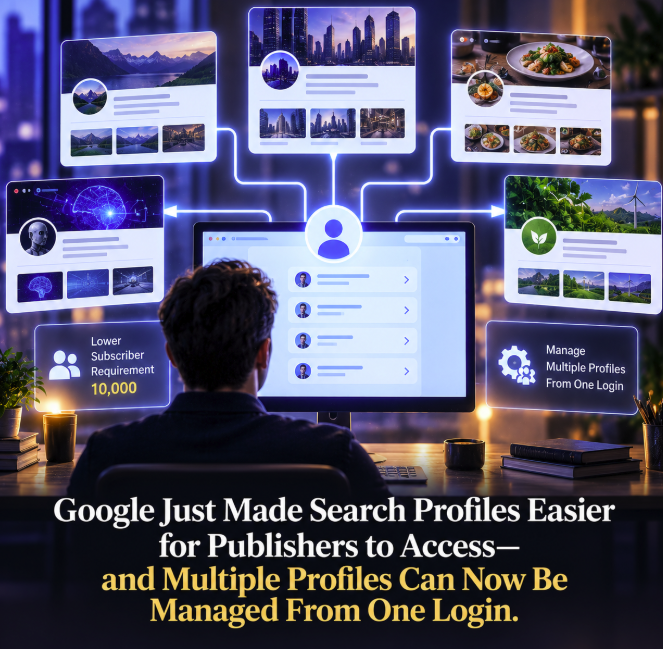
Google is making Search Profiles easier for publishers to access and considerably easier for multi-brand media companies to manage. In an update announced September 16, the company has lowered the social audience requirement for eligibility, redesigned how articles appear inside profiles and introduced the ability to administer multiple Search Profiles from a single Google login.
The changes were reported by Barry Schwartz at Search Engine Land, which said Google provided details of the publisher-focused update directly. None of the individual changes radically alters Google Search, but together they make Search Profiles a more accessible publishing surface at a time when Google is experimenting with new ways to expose sources and publishers inside increasingly AI-mediated search experiences.
One login can now manage multiple publisher profiles
The most operationally important change is account management. Publishers can now claim and manage Search Profiles for multiple sub-brands through a single login. Previously, organizations managing several publication brands could need separate Google accounts for the individual profiles, creating unnecessary administrative overhead.
The new arrangement is particularly relevant for publishing groups that operate several editorial properties under one organization. Centralizing access should simplify ownership, permissions and day-to-day profile management while reducing the number of credentials teams need to maintain.
That may sound like a small usability improvement, but publisher-facing tools often become difficult to scale when account structures assume one brand equals one login. Google is effectively acknowledging that the publishing ecosystem includes portfolios of titles and sub-brands, not only standalone sites.
The eligibility threshold drops to 10,000 followers
Google is also opening Search Profiles to a significantly larger group of publishers. Search Engine Land reports that the social and video audience requirement is now 10,000 followers across YouTube, Instagram, X or TikTok. When Search Profiles first launched, the threshold was 100,000. Google subsequently lowered it to 35,000 before reducing it again in this update.
Moving from 100,000 to 10,000 dramatically changes the type of publisher that can potentially qualify. The original requirement naturally favored large media brands and creators with established social audiences. The new threshold brings specialized publications, regional outlets, trade publishers and more mid-sized digital brands closer to eligibility.
The change is also revealing from a product perspective. Google appears to be expanding Search Profiles beyond an initial limited cohort rather than treating them as an experiment reserved for the largest publishers. Lowering the threshold twice within a relatively short period suggests Google wants more eligible publications participating in the feature.
Article presentation is getting a redesign
The third part of the update concerns how publisher content is displayed. Google is rolling out a redesigned article presentation inside Search Profiles, including optimized image thumbnails and longer headlines. Google told Search Engine Land the goal is to make it easier for people to discover and explore publisher content.
Presentation matters because Search Profiles function as a destination within Google's own interface. The more effectively those pages communicate a publication's identity and recent coverage, the more useful they become as an alternative discovery path to a standard search-result click.
For editorial teams, the redesign reinforces familiar publishing priorities. Strong images and informative headlines are not merely social-media assets; they increasingly travel through multiple Google surfaces where users may encounter a publication before deciding whether to visit it directly.
What exactly are Google Search Profiles?
Google introduced Search Profiles in June 2026 as enhanced publisher landing pages. As Search Engine Land reported at launch, the profiles can bring together a publisher's latest articles, videos and social posts while giving users a way to follow the publication.
The feature is closely connected to Google's broader effort to make source identity more visible across Search and Discover. Rather than presenting every article as an isolated result, Search Profiles give the publication itself a persistent presence that users can recognize and revisit.
This is especially relevant as search interfaces become more synthesized. AI Overviews and AI Mode can answer questions by combining information from multiple sources, potentially reducing the prominence of the conventional list of links. Publisher identity, source preference and follow mechanisms offer another route through which Google can preserve a relationship between users and the organizations producing the underlying information.
Search Profiles fit into Google's broader publisher strategy
The update should not be viewed in isolation. Google has been adding publisher-oriented features across Search, including Preferred Sources. According to Google's Search Central documentation, users can select publications as preferred sources, making content from those sites more likely to appear in Top Stories and potentially highlighting them with a preferred badge in AI Mode and AI Overviews where those experiences are available.
That creates an increasingly explicit source layer inside Google Search. Traditional SEO asks whether a page ranks for a query. Features such as Search Profiles and Preferred Sources introduce another question: whether users recognize, follow or deliberately prioritize the publisher behind the page.
For publishers, that distinction matters. Search traffic has historically been highly query-driven, with many visitors arriving on individual articles without developing a direct relationship with the publication. Google's newer features create mechanisms for publisher affinity to become part of the search experience itself.
The lowered threshold could matter most for specialist publishers
The 10,000-follower requirement is likely to be particularly meaningful for niche publications. A specialist site covering enterprise software, finance, science, local news or another focused topic may have considerable authority among its audience without accumulating the six-figure social following previously required.
Opening Search Profiles to more of those publishers could diversify the sources represented through the feature. It may also encourage smaller editorial brands to treat their social audiences as part of their Search presence rather than as an entirely separate distribution channel.
That does not mean publishers should chase followers solely to unlock a Google feature. Audience quality and direct reader relationships remain more important than an arbitrary threshold. But for organizations already near or above 10,000 followers on one of the supported platforms, the new eligibility level makes Search Profiles worth reviewing.
Multi-brand management removes a practical barrier
The single-login change may ultimately have the largest impact on established media organizations. A publisher with several titles can now manage those Search Profiles through a more centralized workflow instead of maintaining separate account arrangements for each brand.
This matters because publisher visibility features increasingly require active management. Organizations need to claim profiles, maintain correct brand information, monitor presentation and coordinate who has access. When those tasks multiply across a portfolio, administrative friction can become a genuine obstacle to adoption.
By simplifying account management, Google makes it more realistic for publishing groups to treat Search Profiles as part of their standard search operations rather than as a collection of isolated experiments.
Publisher visibility is becoming more than rankings
Google's September 16 update does not change the fundamentals of organic ranking, and Search Profiles should not be mistaken for a replacement for technical SEO, editorial quality or authority. What it does illustrate is how publisher presence inside Google is becoming more multidimensional.
A publication can rank individual URLs, appear as a preferred source, surface inside AI-generated experiences and maintain a Search Profile that brings together its content and brand identity. Those surfaces create opportunities that are related to SEO but not captured by a conventional position-tracking report.
That shift is particularly important as generative search reduces the certainty that every information query will result in a website click. If Google increasingly mediates discovery inside its own interface, publishers have an incentive to strengthen the parts of that interface where their identity remains visible and where users can express an explicit preference for their content.
A small product update with a clear direction
Google's latest Search Profiles changes are practical rather than dramatic: a lower eligibility threshold, better article presentation and simpler multi-profile administration. But all three changes point in the same direction. Google wants more publishers using the feature, wants their content to look better within it and wants larger organizations to be able to manage participation at scale.
For publishers with at least 10,000 followers on a supported social or video platform, Search Profiles are now accessible to a much broader tier than at launch. For multi-brand organizations, the one-login model removes an unnecessary operational barrier. And for the wider search industry, the update is another reminder that publisher visibility in Google is no longer defined solely by where an individual URL ranks. The publisher itself is increasingly becoming an entity users can discover, follow and prioritize inside Search.