
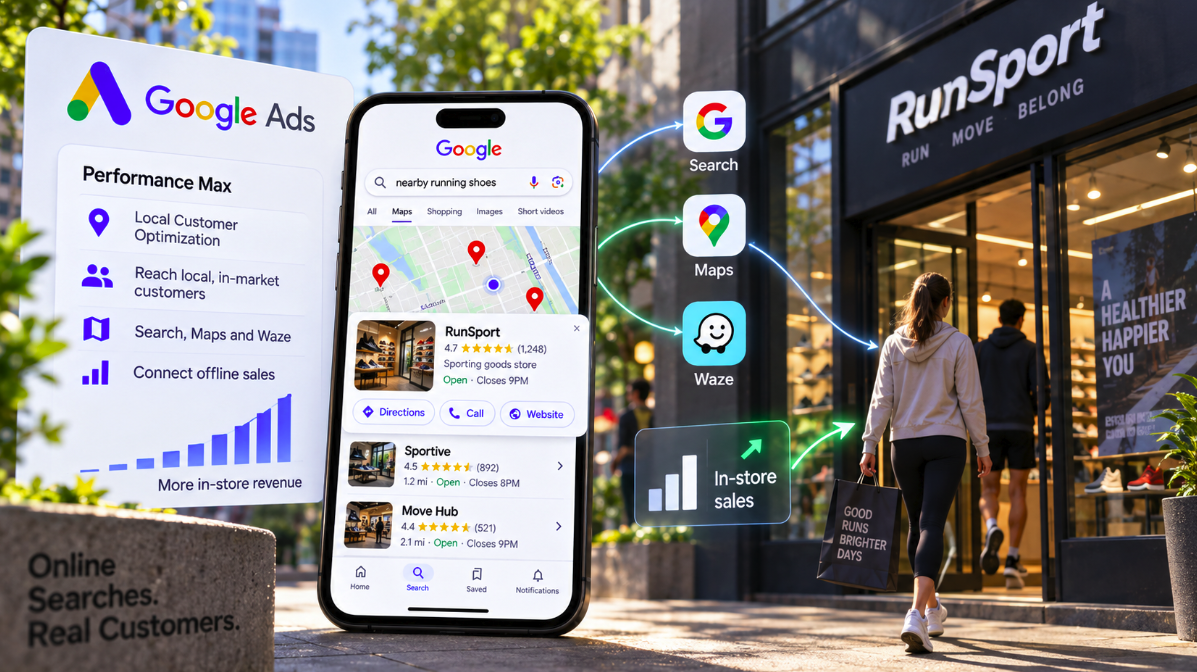
Google Ads is closing one of the most important gaps in local advertising: the distance between a person searching for a nearby business and the revenue that person eventually generates inside a physical store.
Google is rolling out Local Customer Optimization for Performance Max store-goal campaigns while also simplifying how eligible advertisers can feed in-store transaction data back into Google Ads. Together, the two changes create a tighter loop between local intent, ad delivery and offline sales measurement.
The first part of that loop is location and intent. Google’s official Local Customer Optimization documentation says the feature prioritizes potential customers who are close to or interested in a business area and ready to take immediate action, such as visiting or contacting a location. Google specifically describes moments when users are navigating, planning a trip or searching for places and services through Google Maps, Waze or Google Search.
The second part is revenue. Search Engine Land reported on September 8 that Google Ads is also introducing a simpler Store Sales workflow in Data Manager, allowing businesses to connect offline transaction sources such as CRM systems or Google Sheets and use that data for measurement and optimization.
The strategic change is larger than either feature alone. Google Ads increasingly wants to optimize the complete path from “I need something nearby” to “I bought it in the store.”
Local Customer Optimization focuses Performance Max on people ready to act nearby
Performance Max already has access to a broad set of Google inventory, but Local Customer Optimization narrows the campaign’s objective around immediate local opportunity.
Google describes the feature as a way to prioritize customers who are close to or interested in the advertiser’s business area and who appear ready to visit or make contact.
That is meaningfully different from conventional geographic targeting.
A person does not necessarily need to live near the store to have high local intent. Someone driving through a city, planning a trip, looking for a pharmacy near a destination or searching for a restaurant around an upcoming meeting can all have strong commercial intent tied to a place.
Google can encounter those users while they are searching, navigating and planning across several of its products.
Search, Maps and Waze capture different stages of the same local decision
The combination of Search, Maps and Waze is particularly important because each surface can represent a different moment in a local customer journey.
Google Search can capture explicit demand: “running shoes near me,” “oil change open now” or “Italian restaurant downtown.” Google Maps can capture discovery and comparison as users inspect nearby businesses, routes and locations. Waze can reach drivers while they are already moving through the physical environment.
Google’s broader Performance Max for store goals documentation says campaigns can serve across Search, Maps, Waze, YouTube, the Display Network, Business Profiles and Gmail. Local Customer Optimization specifically directs budget toward locally relevant formats where nearby, high-intent users can be reached.
On Maps, Performance Max can use formats such as promoted pins, map search ads, map suggestions and place-sheet ads. On Waze, promoted locations can appear along a driver’s route in supported markets.
Instead of treating those placements as separate channels, Performance Max can optimize them around the same physical-store objective.
The campaign is built around offline goals
Local Customer Optimization has a strict boundary: it is designed for store-goal campaigns.
Google says advertisers can enable the setting when Performance Max is optimizing only toward offline goals such as store visits, store sales, hosted contacts or directions.
The feature is not compatible with online campaign goals. It is also not compatible with Performance Max campaigns advertising products from a Merchant Center account.
That restriction has practical consequences for account architecture.
A retailer that currently combines ecommerce and store objectives inside one feed-based Performance Max campaign cannot simply activate Local Customer Optimization on top of that setup. It may need a separate Performance Max campaign dedicated to physical-store outcomes.
Google is effectively asking advertisers to isolate the local optimization problem so its bidding system can focus on people most likely to generate offline actions.
Google is also simplifying the other side of the loop: store sales data
Reaching a nearby customer is only useful to an advertiser if the resulting business outcome can be measured.
That is why the Store Sales update matters alongside Local Customer Optimization.
Search Engine Land reports that Google is bringing a simpler Store Sales workflow into Data Manager, with direct connections intended to make it easier for advertisers to bring CRM or Google Sheets data into Google Ads. The feature is expected to begin rolling out in the coming weeks.
Google already supports several methods for supplying in-store transaction data. Its official store-sales upload documentation says eligible advertisers can use Google Ads, Data Manager, the Google Ads API or approved store-sales partners.
The strategic objective is to make offline revenue a usable optimization signal rather than a number that lives separately in a retailer’s point-of-sale system.
The system can optimize toward actual store-sales value
Performance Max for store goals is not limited to counting visits.
Google says its AI can optimize bids, placements and asset combinations to maximize in-store conversions and value using goals including store visits, store sales, calls and directions.
When advertisers have eligible store-sales measurement and dynamic transaction values, those values can feed into Smart Bidding.
Google’s omnichannel bidding documentation confirms that Performance Max supports store-sales goals and value-based bidding strategies such as Target ROAS and Maximize Conversion Value.
This changes the quality of the optimization target.
A store visit is useful, but not every visitor has the same economic value. A customer who enters a store and spends $500 is different from a visitor who leaves without purchasing. Store-sales data gives the bidding system a closer approximation of the outcome the business actually cares about: revenue.
Local intent can become a revenue feedback loop
Viewed together, the new tools create a clear feedback structure.
Google identifies people displaying strong local intent. Performance Max allocates budget across relevant local surfaces. Some of those people visit or buy from the physical location. Eligible in-store transaction data is then brought back into Google Ads. Smart Bidding can use those conversion values to optimize future auctions.
The system therefore learns not only which users appear likely to visit but which kinds of ad interactions are associated with valuable offline sales.
That is the bridge local advertising has historically struggled to build.
Digital marketers have abundant click data. Retailers have abundant point-of-sale data. Connecting the two allows bidding to move closer to business outcomes rather than proxy actions.
“Directly” does not mean every sale can be causally traced to one ad
The promise needs an important qualification.
Connecting local intent to store revenue does not mean Google can deterministically prove that every individual ad impression caused every individual transaction.
Offline measurement can rely on matching, eligibility thresholds and modeled data. Attribution assigns credit according to a measurement framework; it is not automatically the same thing as incrementality.
A shopper may already have intended to visit the store before seeing an ad. A brand campaign, email, organic search result or offline promotion may also influence the purchase.
Advertisers should therefore distinguish attributed store sales from incremental store sales.
Google’s optimization loop can become much more revenue-aware without making causal measurement trivial.
First-party data quality becomes a bidding input
The Store Sales side of the system also increases the importance of data operations.
Google recommends uploading store transaction data regularly and consistently. Its documentation says recent transactions are important for dynamic conversion-value reporting and recommends daily or weekly uploads to keep reporting current.
Businesses need clean transaction timestamps, customer information where permitted, transaction values and consistent data pipelines.
If the offline revenue feed is incomplete or delayed, the bidding system is learning from an incomplete representation of store performance.
That makes CRM, point-of-sale and marketing-data infrastructure part of paid-media performance.
For sophisticated multi-location advertisers, campaign optimization is no longer isolated inside the Google Ads interface.
Privacy and consent requirements remain part of the setup
Store-sales measurement involves sensitive first-party transaction information, so advertisers cannot treat data uploads as a casual integration.
Google’s documentation requires applicable customer identifiers such as names, email addresses and phone numbers to be hashed using SHA-256 when required. Advertisers must also comply with Google’s policies and applicable privacy and consent requirements.
Google Ads Data Manager includes controls for consent status and the Google services permitted to receive consented user data.
The business case for better offline optimization therefore needs to be paired with a disciplined privacy implementation.
More connected data can improve measurement, but only data that the advertiser is entitled to collect and use should enter the system.
Waze turns navigation itself into an advertising moment
Waze is an especially interesting component because it places advertising close to physical movement.
Google says Performance Max for store goals can display Promoted Places on Waze, showing a branded location along a user’s route. Tapping the location can reveal business information and directions.
That is different from advertising to someone browsing at home.
The user may already be in a vehicle, traveling through the relevant area and capable of visiting the business within minutes.
Google currently limits Waze store-goal advertising to supported markets, so availability is not universal. But where available, it gives Performance Max a surface where digital intent and physical proximity converge unusually tightly.
Multi-location brands are the clearest beneficiaries
The feature set is particularly well suited to retailers, restaurant groups, automotive businesses and service brands operating many physical locations.
Those advertisers often face a difficult allocation problem. Demand differs by store, geography, time of day and local conditions, while central marketing teams need a scalable way to distribute budget.
Local Customer Optimization gives Google more freedom to prioritize customers near relevant locations when intent is strongest.
Store-sales data can then provide a stronger feedback signal about which locations and interactions generate economic value.
The more accurately a business maps locations, conversion goals and offline revenue, the more meaningful that optimization loop can become.
Business Profile data becomes part of paid-media infrastructure
Performance Max store-goal campaigns require advertisers to define the locations they want to promote, often through linked Google Business Profiles or affiliate location assets.
That makes location-data accuracy more than a local SEO concern.
Incorrect addresses, outdated opening hours or poorly maintained location groups can affect the advertising system that is trying to send nearby customers to physical stores.
Local search management, paid media and store operations therefore become more interconnected.
A Business Profile is no longer simply a free listing. For an omnichannel advertiser, it can be part of the infrastructure Google Ads uses to understand where customers can take action.
Retailers may need separate ecommerce and store-focused Performance Max campaigns
The Merchant Center incompatibility is one of the most important operational details.
Local Customer Optimization cannot be used in a Performance Max campaign that advertises Merchant Center products. Online conversion goals are also incompatible while the setting is active.
For omnichannel retailers, that can encourage a deliberate campaign split.
One campaign can focus on ecommerce and product-feed outcomes. Another can focus specifically on physical locations and offline actions using Local Customer Optimization.
That separation may reduce the convenience of consolidating every objective into one campaign, but it also gives each campaign a clearer optimization target.
The correct architecture will depend on the advertiser’s economics and measurement maturity rather than a universal rule that every account should be consolidated.
Directions and calls remain useful when store sales are unavailable
Not every advertiser will qualify for sophisticated store-sales measurement.
Google’s store-sales upload documentation is explicitly intended for eligible or allowlisted advertisers, and measurement capabilities can vary by account and market.
Local Customer Optimization can still use other offline-oriented goals, including directions and hosted contacts, where appropriate.
Those actions are weaker proxies for revenue than a verified store transaction, but they can still represent meaningful local intent.
A request for directions is especially valuable because it occurs close to the physical visit stage of the customer journey.
Advertisers should choose the strongest measurable store goal available rather than treating every local action as economically equivalent.
The bigger shift is from local targeting to local outcome optimization
Location targeting is an old advertising capability. What is changing is the objective.
The question used to be whether an advertiser could show an ad to somebody inside a particular radius.
Local Customer Optimization asks a more valuable question: can Google prioritize people whose location, navigation and search behavior suggest they are ready to take a physical action now?
Store-sales measurement adds the next question: which of those interactions are associated with actual revenue?
Once those answers feed Smart Bidding, local advertising becomes less about buying geographic reach and more about optimizing toward measurable offline business outcomes.
Google wants the physical store inside the digital advertising loop
Google Ads has spent years making online conversions easier to measure and optimize. Physical retail has always been harder because the final transaction happens outside the browser.
Local Customer Optimization and simpler Store Sales connections attack the problem from opposite ends.
One identifies high-intent local opportunities across Search, Maps and Waze. The other brings offline transaction outcomes back into Google Ads so those opportunities can be evaluated and, where eligible, used for bidding.
The result is not perfect causal attribution, and it does not eliminate the need for incrementality testing or independent business measurement.
But it does make the distance between a local search and a store sale considerably shorter inside Google’s advertising system.
For businesses with physical locations, that may be the most important evolution of Performance Max: Google is no longer optimizing only for what customers do online. It increasingly wants to learn from what they buy after they walk through the door.