
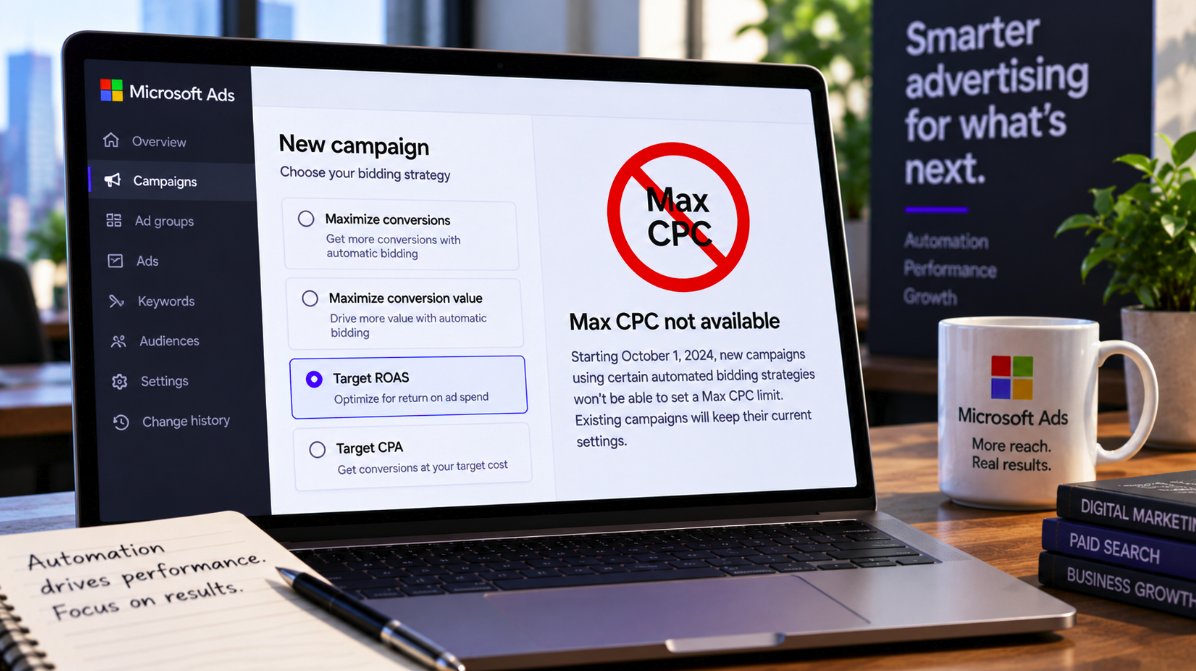
Microsoft Advertising is removing another manual guardrail from automated bidding, but the change is narrower than a full shutdown of CPC controls.
Starting October 1, 2026, advertisers creating certain new non-portfolio campaigns will no longer be able to set a maximum cost-per-click limit alongside Microsoft’s automated bidding. The affected configurations are Maximize Conversions with a Target CPA, Maximize Conversion Value with a Target ROAS, and Maximize Clicks.
The change was confirmed in Microsoft Advertising’s official August product update. Existing campaigns created before October 1 that already use Max CPC will keep the setting, while portfolio bid strategies will continue to support Max CPC for both new and existing campaigns.
That distinction matters. Microsoft is not deleting every advertiser’s CPC ceiling overnight. It is changing the rules for how new standalone automated campaigns can be built.
For advertisers that have used Max CPC as an emergency brake against unexpectedly expensive auctions, however, the direction is clear: Microsoft increasingly wants performance goals and conversion data to steer bidding instead of hard click-level limits.
What changes on October 1
The new restriction applies when an advertiser creates a new non-portfolio campaign using one of the affected automated strategies.
Maximize Conversions with Target CPA will lose the option to add a Max CPC. Maximize Conversion Value with Target ROAS will lose it as well. Maximize Clicks is also included.
Campaigns created before the deadline that already have a Max CPC are grandfathered for now. Microsoft has not announced a date on which those existing ceilings will be forcibly removed.
Portfolio bid strategies are the major exception. Microsoft explicitly says Max CPC will remain available for new and existing campaigns using portfolio bidding.
Search Engine Land’s reporting on the change also notes that Target Impression Share and Enhanced CPC continue to support Max CPC controls.
A Max CPC is a different kind of control from a CPA or ROAS target
The practical importance of the change comes from what Max CPC actually does.
A maximum CPC is a hard per-click boundary. If an advertiser sets a $5 ceiling, the automated system is not supposed to pay more than that specified amount for an individual click under the supported configuration.
A Target CPA works differently. It tells the system the average cost per conversion the advertiser would like to achieve. Individual clicks can cost very different amounts as the algorithm attempts to hit that broader performance objective.
Target ROAS is similarly outcome-based. It expresses the relationship the advertiser wants between conversion value and advertising spend rather than specifying the maximum acceptable price of one auction.
A daily budget is different again. It limits aggregate spending behavior; it does not reproduce a click-level ceiling.
That means Microsoft’s recommended alternatives are useful controls, but they are not mechanical replacements for Max CPC.
Microsoft says bid caps can conflict with the goal advertisers give its algorithm
Microsoft’s rationale is that a hard CPC ceiling can interfere with automated optimization.
The company says advertisers leaning on conversion-based bidding and targets such as tCPA and tROAS have an easier time meeting their goals than advertisers relying on legacy controls such as Max CPC. According to Microsoft, CPC caps can override the stated campaign objective and create spend-pacing irregularities.
From the algorithm’s perspective, the argument is straightforward.
If the system predicts that a particular auction has an unusually high probability of generating a valuable conversion, a rigid bid ceiling can prevent it from competing aggressively enough. The advertiser has simultaneously told Microsoft to maximize an outcome and prohibited the system from taking an action it believes is necessary to achieve that outcome.
Removing the cap resolves that conflict in favor of the automated objective.
Advertisers lose a simple protection against expensive individual clicks
From the advertiser’s perspective, the trade-off is equally clear.
Automated bidding can optimize around averages and expected value, but an account manager may still have a business reason to say that no single click is worth more than a particular amount.
That can matter in industries where auction prices are volatile, conversion volume is thin or one anomalously expensive click can consume a meaningful portion of a small campaign’s daily budget.
A Target CPA can eventually pull average economics toward a goal without preventing an individual click from becoming expensive. A budget can constrain total expenditure without controlling the price paid in one auction.
The removal therefore shifts risk management from a direct auction-level restriction toward broader performance signals.
Conversion tracking becomes even more important
The less direct control advertisers have over individual bids, the more consequential the signals feeding automated bidding become.
Maximize Conversions can only optimize intelligently if the conversion actions represent outcomes the business genuinely values. If an account counts low-quality form submissions, duplicate events or superficial engagement as primary conversions, the algorithm can become very efficient at generating the wrong result.
The same problem applies to value-based bidding.
Target ROAS becomes useful when conversion values meaningfully distinguish a $50 outcome from a $5,000 outcome. If values are arbitrary or disconnected from actual economics, greater bidding freedom does not automatically create better business performance.
Removing a manual safeguard therefore makes measurement quality part of bid-control strategy.
Microsoft wants advertisers to use targets, budgets and value rules instead
Microsoft recommends managing automated campaigns through controls more directly tied to outcomes.
Those include campaign budgets, Target CPA, Target ROAS, conversion value rules and seasonality adjustments where appropriate.
Conversion value rules are especially relevant because they allow advertisers to communicate that some conversions, audiences, locations or other qualifying dimensions are economically more valuable than others. Instead of telling the system not to bid above a particular click price, the advertiser gives it more information about which outcomes justify higher bids.
This represents a broader philosophy of automated advertising: describe the business objective accurately, provide high-quality data and allow the auction algorithm more freedom to decide the bid.
Microsoft is making that philosophy less optional for new campaigns.
Portfolio bidding becomes the escape hatch for advertisers who still require a cap
Advertisers that consider a hard CPC ceiling non-negotiable still have a documented route after October 1: portfolio bid strategies.
Microsoft says Max CPC remains available for both new and existing campaigns using portfolio strategies.
That makes portfolio bidding more than a campaign-management convenience. It becomes a structural way to retain a control Microsoft is removing from affected non-portfolio campaign creation.
Advertisers should not assume, however, that moving a campaign into a portfolio is operationally identical to leaving it as a standalone strategy. Shared bidding structures can change governance, organization and optimization behavior across campaigns.
Teams that plan to use portfolios primarily to preserve Max CPC should test the setup rather than treating it as a cosmetic workaround.
Existing campaigns gain a temporary strategic distinction
The grandfathering rule creates an unusual difference between an old campaign and an otherwise identical new one.
A campaign created before October 1 with Max CPC can keep the safeguard. A new qualifying non-portfolio campaign created after the deadline cannot add it.
That may influence how agencies approach Q4 restructuring.
Rebuilding a mature campaign from scratch, replacing an old campaign with a cleaner architecture or launching a seasonal duplicate can have a control consequence that did not exist previously. The newly created campaign may not expose the same bid ceiling.
Advertisers should therefore document which existing campaigns currently use Max CPC before making structural changes after the cutoff.
Microsoft is not promising that CPA and ROAS targets behave like rigid caps
Another subtle point in Microsoft’s announcement is how the company describes targets.
Microsoft says its bidding can over-achieve on Target CPA or Target ROAS efficiency regardless of whether the campaign is budget constrained. It describes targets as directional levers that help the system balance volume and efficiency rather than rigid values that must be met at the expense of better available ROI.
That is useful context for advertisers accustomed to thinking of a target as a hard boundary.
A Target CPA of $50 is not a promise that every conversion will cost $50 or less. A Target ROAS is not a guarantee that every auction or conversion will satisfy that ratio independently.
The algorithm operates across a portfolio of auctions and outcomes.
That flexibility is exactly why a Max CPC ceiling has served a different purpose.
Microsoft has already been simplifying automated bid strategies
The October change is part of a longer transition rather than an isolated product decision.
Earlier in 2026, Microsoft completed a global simplification of its bidding interface in which Target CPA became an optional target within Maximize Conversions and Target ROAS became an optional target within Maximize Conversion Value for newly created campaigns.
The underlying optimization goals remained, but the number of distinct strategy choices became smaller.
Now Microsoft is simplifying the controls inside those automated strategies as well.
The trajectory is toward fewer overlapping instructions: choose the outcome, set an optional performance target, supply good conversion data and give the bidding system room to operate.
Small and low-volume accounts may feel the loss differently
The strongest case for unconstrained automated bidding usually exists where the system has enough conversion data to distinguish high-value auctions reliably.
Low-volume advertisers can face a different problem.
If a campaign generates only a handful of meaningful conversions, the algorithm has less recent outcome data from which to learn. Expensive clicks can also represent a larger percentage of the total budget.
Microsoft’s own technical documentation has historically acknowledged conversion-volume requirements for some conversion-based strategies, while Microsoft representatives have pointed advertisers with insufficient data toward retained controls such as portfolio bidding, Enhanced CPC and Target Impression Share where appropriate.
The October policy therefore does not mean every advertiser should remove every bid safeguard immediately. It means the available safeguard depends increasingly on campaign architecture.
Microsoft recommends experiments before the deadline
Advertisers do not have to wait until October to discover what uncapped automated bidding does to their accounts.
Microsoft recommends using optimization experiments to test the removal of Max CPC from existing campaigns.
That is one of the more sensible ways to prepare because it converts a platform policy change into an account-specific question.
Does removing the cap increase conversion volume? Do average CPCs rise? Does CPA improve or deteriorate? Does the campaign gain access to valuable auctions that the ceiling previously blocked? Does spend become more volatile?
Those answers will vary by advertiser.
A controlled test is more useful than assuming either that automation will necessarily improve performance or that the absence of a CPC cap will necessarily create runaway costs.
Agencies should audit automation templates before October 1
For agencies, the operational impact may appear in campaign templates and standard operating procedures.
If a launch checklist currently says to apply a Max CPC to every new Maximize Clicks campaign, that instruction will stop working for affected standalone campaigns after the deadline.
Bulk creation tools, API integrations and internal campaign generators also deserve review. Microsoft is simultaneously modernizing its advertising API platform, and teams should not assume that old field expectations will remain valid indefinitely as bidding controls evolve.
At minimum, agencies should identify which workflows depend on Max CPC and decide whether the replacement is a portfolio strategy, a different bidding approach or a revised risk-control framework based on budgets and targets.
This is another step away from auction-level micromanagement
Paid search once gave advertisers direct keyword bids and encouraged granular manual control. Modern advertising platforms increasingly treat those controls as constraints on machine-learning systems that evaluate auctions in real time.
Microsoft’s Max CPC change captures that philosophical shift.
The platform is not eliminating advertiser input. It wants the input expressed at a higher level: how much a conversion should cost, what revenue is worth, how much budget is available and which outcomes deserve greater value.
The algorithm then determines the auction price.
For advertisers comfortable with outcome-based automation, the change may remove a control they rarely used. For teams that deliberately combine Smart Bidding with hard bid ceilings, it removes a meaningful safety mechanism from new standalone campaign creation.
The October deadline is about new campaigns, not an immediate forced migration
The most important practical takeaway is precision.
On October 1, Microsoft Advertising is not removing Max CPC from every account. Existing qualifying campaigns that already use the setting retain it. Portfolio bid strategies retain it. Other unaffected bidding configurations retain their documented controls.
What changes is the creation of new non-portfolio campaigns using Maximize Conversions with Target CPA, Maximize Conversion Value with Target ROAS or Maximize Clicks.
Those campaigns will have to rely more heavily on automation without a hard per-click ceiling.
Advertisers have a few weeks to determine whether that matters to their economics. The best preparation is not simply to preserve old campaigns out of fear of automation, nor to remove every cap because Microsoft recommends it. It is to test the bidding system with clean conversion data and understand which control is actually protecting the business.
Microsoft is taking away one manual safeguard. The responsibility for defining the right automated objective becomes more important in its place.