
For years, international SEO strategy could treat Google Search as broadly the same product expressed through different languages, locations and ranking signals. Google’s newest technical documentation makes that assumption increasingly difficult to defend.
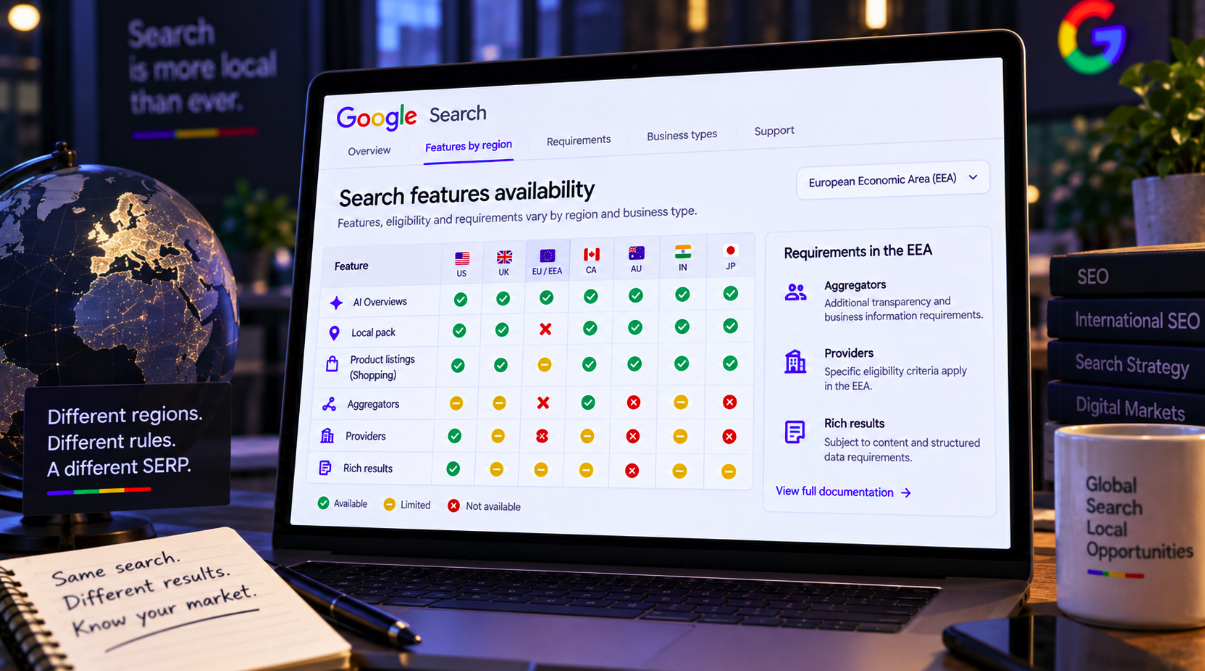
Google has published a new Regional differences in Search experience guide that functions as an official matrix of Search features by market and query type. The documentation shows that eligibility for some of Google’s most prominent result formats now depends not only on what a page contains, but where users are searching, what they are searching for and what role the website plays in the commercial ecosystem.
In the European Economic Area, an online travel agency can be eligible for one Search unit while the hotel it lists is eligible for another. A weather provider can qualify for an ecosystem carousel. A jobs aggregator can appear in a dedicated Job sites experience. A local-business page may qualify for a structured-data carousel under regional rules that do not apply identically elsewhere.
The practical result is a Search landscape in which there is no longer one universal feature set that SEOs can assume every market shares.
Google now has an official regional Search feature matrix
The new Search Central page asks site owners to identify where their company is based and which query types matter to their business. Google then surfaces the Search features relevant to those conditions.
The matrix documents several region-specific experiences.
In the EEA, Google lists Aggregator units and Supplier units for hotel, flight, ground-transportation and product queries. It also lists an Ecosystem carousel for weather, sports, finance and translation, plus Job sites features for employment queries.
Türkiye receives a separate Places sites experience for hotel and local-business searches. South Africa has its own badge and refinement-chip treatment for selected commercial categories. Google also documents structured-data carousels across the EEA, Türkiye and South Africa, but the supported verticals differ by region.
This is more than localization in the conventional sense. Google is documenting different Search interfaces and participation rules for different markets.
In the EEA, Google separates aggregators from direct suppliers
The clearest example is the new distinction between Aggregator and Supplier units.
Google’s Aggregator unit documentation describes a multi-provider feature designed for Vertical Search Services, or VSSs. These can include online travel agencies, Comparison Shopping Services, metasearch engines and directories.
The feature is available to users in EEA countries for queries involving hotels, flights, long-distance trains or buses, and products.
Eligible aggregators compete to populate the unit. Google says the top-ranked provider’s results are expanded by default, while users can select another participating aggregator where alternatives are available. Clicks inside the unit lead directly to the selected aggregator’s website.
That creates a Search surface whose eligibility begins with business model. A direct hotel and an OTA selling hotel inventory are not simply two domains competing for the same identical presentation.
Direct providers get a separate Supplier unit
Google’s Supplier unit is designed for direct providers rather than aggregators.
Google gives examples including individual hotels and airlines, brick-and-mortar businesses and service providers. In the documented EEA implementation, the Supplier unit appears alongside the Aggregator unit and only appears when the Aggregator unit itself is shown.
That creates a deliberate dual structure: one Search feature gives visibility to intermediary services, while another provides visibility to businesses supplying the product or service directly.
The technical requirements differ as well. Google says direct suppliers do not need to submit additional data beyond information accessible through normal web crawling to be eligible for the Supplier unit, although feeds can enhance results where available.
Aggregators can face a substantially different onboarding path.
Aggregator eligibility can require approval, feeds and APIs
For an aggregator, ordinary crawlability is not necessarily enough.
Google says businesses must be approved as Vertical Search Services, provide the necessary data and meet established quality standards. Depending on the vertical, participation can require direct feed integrations or real-time APIs.
Flight and long-distance transport data can be supplied through real-time APIs. Lodging and local-business experiences can use direct data-feed integrations. Product participation has its own Shopping-related mechanisms.
This means technical SEO is no longer the complete eligibility layer for these surfaces.
A site can be perfectly crawlable, indexable and well optimized yet still need a specific commercial classification, approval process or data integration to participate in a particular Search feature.
The same query can produce structurally different opportunities by geography
This is where the new matrix becomes strategically important.
An SEO team monitoring a hotel query from the United States and another monitoring it from an EEA country may not merely see different rankings. They can be observing different result architectures.
The EEA searcher can encounter units specifically created for aggregators and direct suppliers. The available pathways from query to website can therefore differ before conventional organic listings are even considered.
A global rank-tracking system that reduces both environments to “position one through ten” risks losing the most important part of the page.
The question is no longer only where the domain ranks. It is which Search surfaces exist in that region and whether the business is eligible to enter them.
Structured-data eligibility is regional too
Google’s structured-data carousel provides another example.
The carousel rich result remains in beta and uses ItemList markup combined with supported structured-data types to create a horizontally scrollable list of entities from one site.
But availability is not global.
In the EEA, Google documents the experience for queries involving hotels, vacation rentals, ground transportation, flights, local businesses, things to do and products. In Türkiye, the supported set is narrower: hotels, vacation rentals and local businesses. South Africa has another combination that includes hotels, vacation rentals, things to do, flights, products, food delivery, car hire and ground transportation.
The same valid structured data can therefore have different feature opportunities depending on the user’s market and query.
Schema implementation creates eligibility; geography helps determine whether the corresponding Search experience exists.
Valid markup still does not guarantee a rich result
The regional matrix should not be interpreted as a promise that eligible pages will receive the listed treatment.
Google’s long-standing structured-data principle still applies: satisfying technical requirements makes a page eligible for a rich result but does not guarantee that Google will display one.
The new documentation adds another layer before that familiar uncertainty.
A publisher must first determine whether the feature exists for the relevant region and vertical. It must then satisfy the feature-specific eligibility requirements. Google still decides whether and how to display the result for an individual query.
International SEO teams therefore need to distinguish availability, eligibility and actual visibility as three separate measurements.
Weather, finance and sports publishers get another EEA-specific surface
Commercial search is not the only area receiving specialized regional treatment.
Google’s Ecosystem carousel is available in EEA countries for queries involving weather, sports, finance and translation. It is designed for queries where data visualization or interactive information can be useful, such as weather data, stock charts or sports scores.
Tiles send users directly to participating websites. Google says their order is determined by Search ranking algorithms using non-discriminatory ranking principles intended to surface the most relevant results for the user’s location and language.
Eligibility depends on the site serving EEA users and being an authoritative source or specialized provider in the relevant domain. Google says no new structured-data markup or special feed is required for this specific feature, although eligible providers can express interest.
Again, the route into the SERP depends on what kind of publisher the site is.
Jobs receive a dedicated EEA aggregator experience
Employment search has another rule set.
Google’s Job sites features include an aggregator carousel and refinement chip for job-related searches in EEA countries. Google says publishers do not need to add special markup to become eligible for these particular features.
The carousel surfaces aggregator sites, while the refinement chip lets users focus the results page on aggregator text results.
This matters because “job site” is not simply a content category in this context. It can determine eligibility for a dedicated interface available to users in a particular regulatory and geographic market.
Türkiye and South Africa have their own Search experiences
The matrix also makes clear that regional divergence is not exclusively an EEA story.
In Türkiye, Google documents Places sites features for hotel and local-business queries. The experience includes an aggregator carousel and refinement chip that can direct users toward aggregator websites.
South Africa receives a different set of features, including a badge and refinement chip for businesses in selected travel, commerce, car-hire, food-delivery and transportation categories.
The exact product logic differs, but the strategic lesson is the same: a global SEO team cannot infer every market’s SERP capabilities from screenshots taken in one country.
Business classification is becoming an SEO input
SEO has always involved understanding what a site is about. The new regional framework increasingly requires understanding what the business is.
Is it an aggregator or a direct supplier? Is it an OTA, Comparison Shopping Service, specialized weather provider, jobs platform or local business? Does it operate in the EEA? Does it provide the data integration required for its vertical?
Those questions can determine access to specific Search experiences before page-level optimization enters the discussion.
For agencies, this means onboarding an international SEO client increasingly requires commercial and operational information, not only keyword data and technical crawl access.
Rank tracking needs to become feature-aware and market-aware
The documentation creates an obvious measurement challenge.
A report that says a domain ranks third for “hotels in Paris” does not fully describe its visibility if the EEA SERP also contains an Aggregator unit and Supplier unit above or around conventional results.
The business may be visible inside one of those units, absent from another and third in organic results. A competitor may dominate the expanded aggregator provider while ranking below it organically.
Those are materially different search positions even if a traditional rank tracker records only the blue-link order.
International reporting should therefore capture region, device, query class and Search feature where possible.
A global average ranking can hide the architecture that actually determines user attention.
International SEO testing needs local SERPs, not VPN assumptions alone
The matrix also raises the standard for SERP testing.
Teams need to verify what users in the target market actually receive, rather than assuming a Search screenshot from headquarters represents the customer experience elsewhere.
That includes checking whether specialized units appear, which providers populate them, how direct suppliers are represented and whether structured-data features are available for the relevant query class.
Location emulation and rank-tracking tools can help, but the feature definitions should be mapped against Google’s official regional documentation.
The goal is to understand not only ranking differences but product differences.
The EEA is becoming a distinct Search product environment
The EEA stands out in Google’s current matrix because multiple specialized Search features are explicitly documented there.
That fits the broader transformation of Google Search in Europe, where regulatory requirements under the Digital Markets Act have pushed the company to change how it gives visibility to competing vertical services and direct businesses.
But SEO teams do not need to settle the policy debate to understand the operational consequence.
European Search is increasingly its own product environment.
Aggregators, suppliers and specialized publishers can face feature opportunities and participation requirements that do not map neatly onto the experience seen by users elsewhere.
This does not mean ordinary organic Search has disappeared
The phrase “Google no longer has one SERP” should not be misunderstood as saying that conventional organic ranking has been replaced by a collection of regional programs.
Google still crawls, indexes and ranks web pages through its core Search systems. The new matrix documents specific Search experiences layered into that broader system.
Nor does it imply that every query in an eligible category always triggers every listed feature.
Google repeatedly conditions Search features on relevance, availability and individual query context.
The change is subtler but strategically important: the set of features a site can compete for is increasingly conditional on geography, vertical and business role.
SEO roadmaps should now begin with an eligibility map
For international businesses, a useful planning exercise is to build an eligibility map before building the optimization roadmap.
For each target market, identify the relevant query verticals, the Search features Google documents there, the organization’s business classification and the technical or data requirements for participation.
An EEA travel aggregator may need VSS approval and data feeds. A direct hotel may need to focus on crawlable supplier information and available feed enhancements. A local-business directory may face different opportunities in Türkiye. A commerce site may find structured-data carousel eligibility varies between markets.
Only after that map exists does it make sense to ask how to optimize each available surface.
This reverses a common SEO habit. Instead of starting with keywords and assuming the SERP is given, teams first need to understand which SERP they are actually competing in.
Google Search is becoming a matrix, not a template
Google’s new documentation gives SEOs something unusually valuable: an official acknowledgment that Search experiences differ systematically by region and participant type.
The matrix does not replace ranking systems, structured data or traditional technical SEO. It adds context that determines where those disciplines can produce a visible result.
For global organizations, that changes the unit of analysis.
There is no longer enough information in the question, “Do we rank on Google?” The useful questions are: in which country, for which query type, as what kind of business, and inside which Search feature?
That is a more complicated Search landscape, but it is also a more accurate one. Google’s own documentation now makes the fragmentation explicit.