
When people say they want to "train an AI," they often imagine feeding information into a model until it becomes smarter, almost like teaching a person new skills.
While the idea isn't completely wrong, the reality is much more interesting. Modern AI systems rarely learn in the way most people expect, especially when they're running remotely in the cloud.
If you've installed a remote AI assistant or you're experimenting with a hosted language model, the first thing to understand is that the model itself is usually already trained. Companies like OpenAI, Anthropic, Google, Meta and many open-source communities spend months training large language models using enormous datasets and thousands of powerful GPUs. That process is called pre-training, and it's something most developers will never need to perform themselves.
Instead, what people call "training" today is usually a combination of customization techniques that allow an existing model to become more useful for a specific task.
Imagine opening a brand-new notebook. The notebook already exists, but it's empty. Every time you add notes, bookmarks and references, it becomes more useful for your own work without changing the paper it was made from. Modern AI works in a surprisingly similar way. The model provides the reasoning capabilities, while the surrounding system provides the information and context it needs to answer accurately.
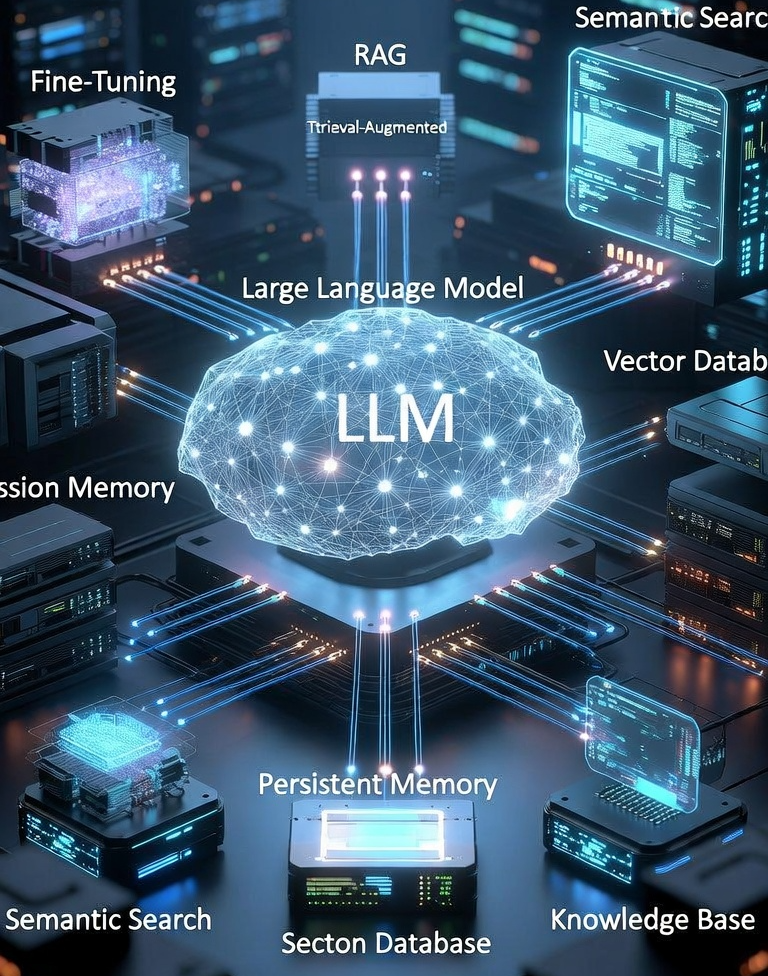
One of the most common ways to improve a remote AI is through fine-tuning. Rather than teaching the model everything from the beginning, developers start with a pre-trained model and continue training it using a much smaller dataset focused on a particular domain. A medical assistant, for example, might be fine-tuned using healthcare terminology, while a legal assistant could be optimized using legal documents and case law. The underlying model stays the same, but its behavior becomes more specialized.
However, many modern AI applications don't even require fine-tuning. Instead, they rely on Retrieval-Augmented Generation (RAG). Before generating a response, the AI searches an external knowledge base, retrieves the most relevant documents and includes them as context. The model doesn't permanently learn those documents; it simply uses them at the right moment. This approach keeps information current without retraining the model every time new content is added.
Another important component is persistent memory. Unlike RAG, which retrieves external knowledge, persistent memory stores selected information about the user. It might remember preferred languages, active projects, writing style or long-term preferences, making future conversations more personalized without changing the model itself.
Many remote AI systems also include vector databases. Instead of searching documents using exact keywords, they convert information into mathematical representations called embeddings. This allows the AI to perform semantic search, finding documents based on meaning rather than identical words. It's one of the reasons modern AI assistants can often retrieve the right information even when users phrase questions differently.
When all these components work together, the result feels like an AI that continuously learns. In reality, the language model isn't rewriting its neural network after every conversation. The surrounding architecture is responsible for deciding what should be remembered, what should be retrieved and what should remain temporary.
This distinction is becoming increasingly important as businesses build AI copilots, customer support assistants and autonomous agents. Simply choosing a larger language model is no longer enough. The quality of the memory architecture, the knowledge base and the retrieval system often has a greater impact on the final user experience than the model alone.
Building a remote AI today is therefore less about creating intelligence from scratch and more about designing an ecosystem around an already capable model. Fine-tuning, RAG, persistent memory, semantic search and vector databases all solve different problems, and understanding when to use each one is what separates a basic chatbot from a truly useful AI assistant.
As artificial intelligence continues to evolve, this modular approach is likely to become the standard. Instead of asking how to train an AI, a better question might be: how should your AI learn, remember and retrieve information? The answer depends on what you want your assistant to do, but one thing is already clear: the future of AI won't rely on a single learning technique. It will rely on multiple systems working together.