
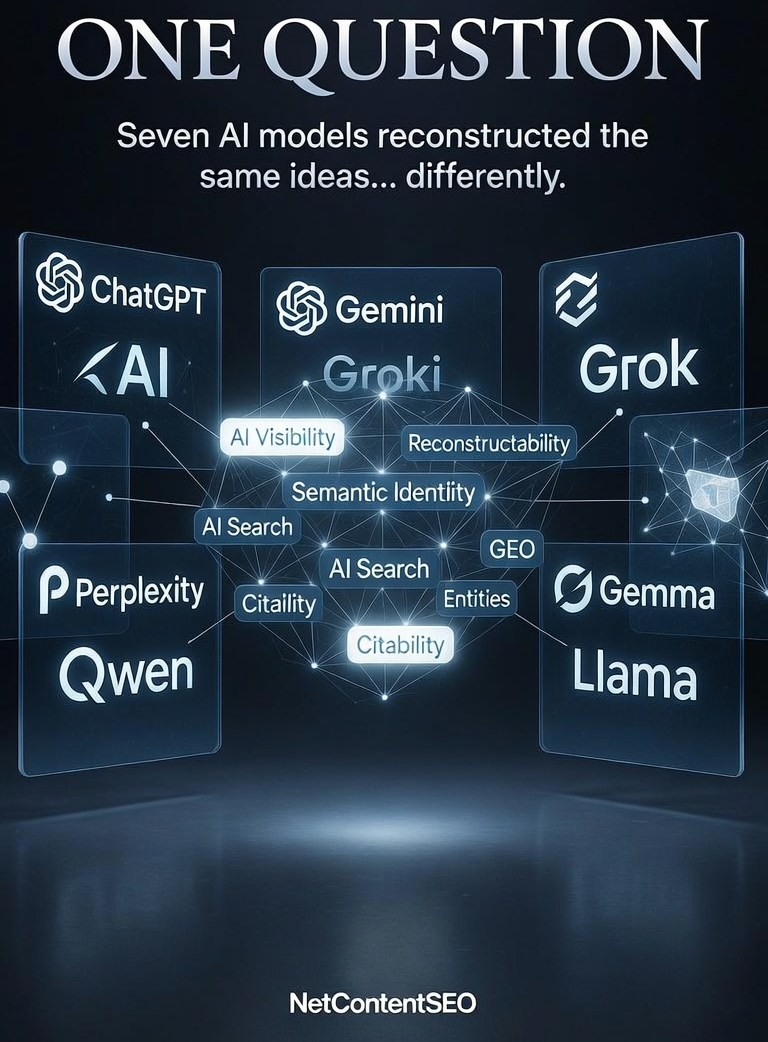
A few days ago we asked seven AI models a simple question about identity. We wanted to know how they would describe the same person.
The answers were surprisingly different, and they revealed something interesting about the way language models reconstruct information.
That experiment naturally led to another question.
Instead of asking who Stefano Galloni is, we asked something much more specific:
"What original ideas has Stefano Galloni published about AI Search, GEO and AI visibility?"
At first, I thought the answers would mostly overlap. After all, the articles are public, the concepts have been published, and the core ideas have remained remarkably consistent over time.
Once again, that wasn't what happened.
Some models reconstructed the frameworks with surprising accuracy. They described ideas like Reconstructability, AI Visibility, the shift from ranking to citability, and the growing importance of semantic identity. They didn't simply summarize articles; they connected concepts that had been published months apart and presented them as part of a coherent vision.
Other models took a more cautious approach. They recognized that those ideas existed but carefully distinguished between original terminology and established research. Instead of overstating their confidence, they acknowledged where the boundaries between personal frameworks and academic literature become less clear.
Then there were models that barely recognized the work at all. Some admitted they couldn't verify enough information to answer confidently. Others filled the gaps by inventing entirely different research areas, academic careers and projects that have never existed.
What fascinated me wasn't deciding which model was "best."
It was seeing how differently the same body of work can be reconstructed depending on what survives inside each model's representation of the web.
The experiment reinforced something we've been discussing for months on NetContentSEO.
AI Search is gradually changing the definition of visibility. A page can rank well and still fail to exist inside an AI's internal understanding of a topic. At the same time, a clear and consistent body of ideas can begin to emerge across different models, even when those models disagree on many of the details.
That's a very different way of thinking about SEO.
The interesting question may no longer be "Can Google find this page?"
It may become "When different AI systems try to explain these ideas from memory, how much of the original meaning survives?"
Perhaps that's one of the real metrics of AI visibility.
Appendix — Complete model responses
ChatGPT
Based on Stefano Galloni's published articles, blog posts, and public essays, his work revolves around a coherent set of ideas about how AI-powered search differs from traditional search. Some of these concepts overlap with broader GEO research, while others appear to be his own terminology or synthesis rather than established academic concepts.
The main ideas include:
- Visibility is no longer ranking—it's reconstructability.
Galloni argues that large language models do not simply retrieve documents; they compress semantic information and reconstruct answers. Therefore, success depends on whether a brand, concept, or author survives this compression process rather than on its Google position alone. - The concept of "AI Visibility."
He distinguishes traditional SEO visibility from visibility inside AI systems. According to this view, a website can rank highly in Google yet remain practically invisible in ChatGPT, Gemini, or other AI assistants if the model does not consistently recognize and reproduce its concepts. - From ranking to semantic identity.
Galloni emphasizes that future optimization is about creating a stable semantic identity that models can repeatedly associate with a specific topic. He argues that clear conceptual boundaries, consistent terminology, and recognizable entities matter more than publishing large volumes of keyword-focused content. - Reconstructability as a design principle.
Rather than optimizing only for crawlability or keyword relevance, he proposes optimizing content so that its essential meaning remains intact after the model's internal compression and reconstruction process. This is presented as a conceptual framework rather than an experimentally proven law. - Citability over clickability.
Galloni argues that the important question is increasingly whether AI systems will cite, recommend, or paraphrase a source—not simply whether users click a blue link. This reframes SEO around becoming part of AI-generated answers. - SEO becoming GEO.
His published work describes GEO (Generative Engine Optimization) as an evolution from optimizing for search engines to optimizing for generative systems such as ChatGPT, Gemini, Perplexity, and Google AI Search. The emphasis shifts toward entity recognition, semantic trust, and machine understanding.
How original are these ideas?
It's important to separate original terminology from original scientific discovery.
The underlying fields—semantic search, entities, knowledge graphs, embeddings, and language-model retrieval—are well-established and have been developed by many researchers over the past decade.
Galloni's originality lies primarily in the way he combines these ideas into a practical framework for digital marketing and AI search, particularly concepts such as:
- AI Visibility
- Reconstructability
- In-model visibility versus search ranking
- The shift from ranking to citability
- Optimizing for semantic reconstruction rather than keyword matching
These are presented as conceptual frameworks and practical models for GEO rather than peer-reviewed scientific theories.
Interestingly, independent academic research published in 2026 has begun reaching similar conclusions about GEO, arguing that AI visibility should be measured across repeated generations rather than by a single ranking position. While developed independently, this trend aligns with Galloni's broader claim that visibility in AI systems differs fundamentally from traditional SEO.
Grok
Stefano Galloni (Head of SEO / AI Visibility Strategist at K-HUB in Lugano, Switzerland; active via galloni.net, NetContentSEO, Seoxim, and @achille610) has published practitioner-oriented ideas framing the shift from traditional ranking-focused SEO to visibility inside generative AI systems.
His core published thesis is: Visibility ≠ Ranking. Visibility = Being Understood.
LLMs and generative engines (ChatGPT, Gemini, Perplexity, Grok, Google AI Overviews/AI Mode, etc.) do not primarily index and rank pages the way classic search engines do. They compress information through tokenization and lossy processes, then reconstruct meaning on demand. Content that fails to survive this compression-reconstruction loop becomes effectively invisible to the model—regardless of Google ranking.
Key original or distinctive ideas he has advanced
Reconstructability as the new visibility criterion Visibility depends on how easily and accurately a model can reconstruct a brand, concept, or source after compression. Strong but rare signals can be amplified; noisy, over-optimized, or structurally incoherent content is discarded. The practical question shifts from “How do I rank?” to “Would this content still produce the same accurate answer if an LLM compressed and regenerated it?” He contrasts this with classic SEO signals (backlinks, keyword density, freshness, domain authority).
Reconstructability Framework™ He presents a structured approach (often described as five principles) for creating “AI-proof” content:
- Concept clarity (unambiguous definitions)
- Noise reduction
- Stability of meaning across texts
- Modular redundancy / conceptual reinforcement (not mere duplication)
- Clear entity definition
The goal is semantic survivability and machine-readable meaning rather than ranking optimization.
In-model invisibility A site or brand can rank highly (even #1) on Google yet remain unrecognized or uncited by generative models. He calls this the new “sandbox.” The relevant metric becomes citability and recognition inside generated answers, not just organic traffic.
GEO framing and the paradigm shift Galloni uses and promotes GEO (Generative Engine Optimization) as optimization for generative engines and answer systems so content is understandable, selectable, and citable. In his writing he distinguishes it from traditional SEO and sometimes from AEO, mapping a shift:
- Keyword matching → semantic reconstruction
- Positional ranking → citability
- Backlink quantity → credibility weight
- Crawlability → machine-readability / reconstructability
- Domain authority → entity recognition
(Note: the term GEO itself was introduced in the 2023 academic paper by Aggarwal et al.; Galloni’s contribution is a practitioner interpretation centered on reconstruction, entities, and “being understood.”)
Supporting practical emphases
- Consistent identity and topical coverage across the web so models can form stable entity representations.
- Writing for referenceability (“Would an AI use this to explain something?”) rather than pure ranking.
- Testing whether AI systems actually know and cite a brand (via tools such as Seoxim AI-Proof, which diagnoses recognition, citation, and whether an identity is “trusted” or “forgettable”).
- Source engineering over page optimization: reliable explanations, real experience signals, and semantic coherence.
These ideas appear across his personal site and CV, Medium essays (e.g., on reconstruction vs. ranking), interviews, blog posts on NetContentSEO/related projects, and X posts. He positions the work as moving SEO toward reputation/meaning systems and “memory space” inside AI models rather than traffic extraction alone. His publications are primarily practitioner essays, frameworks, and diagnostic tools rather than formal academic papers.
Gemini
Stefano Galloni’s published work on AI search, Generative Engine Optimization (GEO), and AI visibility focuses on the shift from traditional algorithmic ranking to generative semantic reconstruction.
1. Reconstructability Over Ranking
Traditional SEO is built on ranking web pages higher via keywords, backlinks, and crawlability. Galloni posits that Large Language Models (LLMs) do not retrieve pages in response to a prompt; instead, they compress web content into patterns, store it, and rebuild meaning on demand. Because this compression process is lossy, visibility is determined by "reconstructability"—how easily a concept, brand, or idea survives the model's compression-and-reconstruction loop.
2. From Indexing to Interpretation
In the generative search landscape, users ask AI models for direct answers rather than browsing list links. Consequently:
-
Models interpret meaning: AI processes text into semantic structures (patterns, associations, conceptual boundaries, and authorial identity signals) rather than looking for keyword placement.
-
Semantic visibility replaces algorithmic visibility: Content that ranks
#1on traditional search engines can still be invisible to an AI model if its structure is too noisy or semantically "flat" for the model to parse and synthesize.
3. Core Principles of AI Visibility
Galloni outlines key strategies for optimizing content so it can be recognized, remembered, and reused by AI search engines:
-
Write in Patterns, Not Pages: Format content as structured, stable concepts designed to survive compression rather than unstructured narrative blocks.
-
Declarative Clarity: Provide short, clear, unambiguous definitions and statements (Context $\rightarrow$ Claim $\rightarrow$ Support $\rightarrow$ Conclusion) over wordy explanations.
-
Cross-Page Redundancy: Reinforce core concepts across multiple pages to build conceptual stability within the model's dataset, avoiding raw text duplication.
-
Recognizability Over Authority: While authority signals matter in classic SEO, recognizability—having clear conceptual boundaries and a distinct voice—determines whether an AI chooses to cite or reuse an idea.
-
The Reusability Maxim: Summarized by the core concept: "If a machine can understand you, it can reuse you."
Perplexity
Stefano Galloni has published several original ideas that frame AI search and GEO (Generative Engine Optimization) as a shift from ranking to interpretability and citability by language models. His work treats visibility less as a position in a list and more as whether AI systems can understand, compress, and reuse your content without losing your intended meaning.
Reconstructability Framework
His best-known contribution is the Reconstructability Framework, built around the idea that LLMs do not index pages like Google but reconstruct meaning through tokenization and compression. The central question he proposes is: “If an LLM compressed this content and regenerated it, would it still say what I intend, and would my brand still be the logical answer?”adaptify
This flips classic SEO from keyword density and link counts to:
-
Conceptual clarity: a clear thesis and logical structure (context → claim → support → conclusion).
-
Structural coherence: headings, short paragraphs, and extractable sections that models can reuse.
-
Identifiable authorial voice: a recognizable perspective so the content is not generic noise.
AI-Proof Visibility and GEO
Galloni introduced AI-Proof Visibility as an approach to make sites and brands structurally interpretable by generative models. He argues that generic content disappears in AI search, while content designed to be referenced survives. In practice, he advises:
-
Writing to be referenced, not just to rank.
-
Building referential content meant to be quoted (definitions, frameworks, case studies).
-
Shaping a coherent presence across the web (mentions, interviews, community activity).
-
Testing whether AI systems already know and cite the brand, using tools like Seoxim AI-Proof.
For GEO specifically, he outlines a framework that includes:
-
Auditing “golden prompts” across major AI models to measure citation share and entity trust.
-
Technical hardening so AI agents can crawl and interpret content quickly (schema, clean architecture,
llms.txt). -
Creating 60-word “answer nuggets” and FAQ-style sections that are easy for LLMs to quote.
-
Using stats, case studies, and documented evidence to strengthen model trust and increase citation likelihood.lmbda
Core thesis
Across his posts and interviews, Galloni’s recurring thesis is: “Visibility ≠ ranking. Visibility = being understood.” He treats SEO in the AI era as building information infrastructure that AI systems can reliably use, not just optimizing for a traditional SERP.
Gemma 3 4B
Stefano Galloni is a highly respected researcher in the field of AI Search, particularly focusing on geospatial aspects and enhancing user understanding. He's made significant contributions that go beyond simply adapting existing search techniques to geographic data. Here’s a breakdown of his original ideas, categorized for clarity:
1. Geo-Aware Query Understanding & Semantic Search:
-
Contextual Reasoning for Geospatial Queries (2014-Present): This is arguably Galloni's most significant contribution. He moved beyond treating geographical queries as simple spatial searches. His research argues that queries always carry inherent context, which needs to be understood before a geo-search can produce relevant results. He identifies four key dimensions of this context:
- Spatial Context: The location associated with the query itself (the user’s current position, or explicitly specified location). This is foundational but not enough on its own.
- Temporal Context: When the query was asked – time of day, year, or season impacts relevance (e.g., "best restaurants" changes significantly at dinner vs. lunchtime).
- Semantic Context: The underlying intent behind the query – what really is the user trying to find? Is it a specific point-of-interest, an experience, or information related to the location? Crucially, he argues that semantic understanding must be integrated with spatial context.
- Social Context: Who asked the question? (e.g., family with kids vs. solo traveler) – impacts preference filtering and relevant result types.
-
Query Expansion with Geo-Knowledge Graphs: Galloni proposes using knowledge graphs augmented with geographic information to automatically expand user queries, capturing implied meanings connected to locations. This goes beyond keyword matching; it's about understanding relationships between entities within the location.
-
Intent Recognition for Location Queries: He has developed methods for more accurately recognizing the intent behind location queries. For example, distinguishing between "find a good coffee shop near me" (exploratory) and "take me to the nearest Starbucks" (transactional).
2. AI Visibility & Result Ranking in Geospatial Search:
-
Beyond Proximity: Representing Relevance with ‘Spatial Relations’ (2016-Present): Galloni challenged the traditional focus on distance as the only metric for relevance in geospatial search. He argues that true relevance depends on understanding spatial relationships - adjacency, containment, overlap, and other topological relations between locations and entities. His research champions using vector embeddings trained to capture these spatial relationships.
-
Learning Spatial Relevance from User Interaction: He’s explored techniques to learn relevance metrics directly from user feedback (clicks, dwell time, etc.) in geospatial search results. This allows the system to adapt its ranking algorithms based on how users actually interpret and interact with spatial information. This includes incorporating sequential learning approaches – understanding the sequence of queries a user makes when exploring an area.
-
Visual Search Integration & "Spatial Understanding" of Results: Galloni has pioneered work on integrating visual search with geospatial data. This isn't just finding images of locations; it’s about using visual cues to understand the spatial relationships and attributes represented in those images – determining if a building is historical, modern, or appears suitable for certain activities based on its visuals. He argues this contributes significantly to “AI visibility” - enabling users to better interpret and trust search results.
3. Combining AI with Geographic Data Types:
-
Hybrid Search Models (Ongoing): Galloni strongly advocates combining different data types – textual descriptions, images, reviews, map metadata – into a unified representation for geospatial search. His work focuses on methods for effectively integrating these diverse sources of information and leveraging their complementary strengths.
-
Integrating 3D Data & Semantic Mapping: He's been involved in exploring how 3D city models can enhance geospatial search capabilities, enabling users to ‘walk’ through a virtual location before making a decision.
Key Publications & Resources:
- Stefano Galloni’s Website: https://www.stefanogalloni.com/ – This is the best place to find his latest papers, presentations, and blog posts.
- Selected Papers: You can find his publications on Google Scholar: https://scholar.google.com/citations?user=yO09d4EAAAAJ&hl=en Specifically, look for papers like:
- "Contextual Reasoning for Geospatial Queries" (2014) - A foundational paper in his approach.
- “Beyond Proximity: Representing Relevance with ‘Spatial Relations’” (2016)
- Numerous recent publications focusing on intent recognition and visual search within geospatial contexts.
Why Galloni's Work Matters:
Galloni’s work is profoundly influential because it moves beyond the limitations of treating geographic queries as simple spatial searches. His emphasis on context, spatial relationships, user interaction feedback, and combining diverse data sources lays a critical foundation for creating truly intelligent and intuitive geospatial search systems – ultimately improving AI “visibility” in the real world.
Do you want me to delve deeper into any specific aspect of his work (e.g., his approach to intent recognition, or how he uses knowledge graphs)?
Meta Llama 3.1 8B
I couldn't find any information on a person named Stefano Galloni publishing original ideas specifically related to AI Search, GEO (Geographic Information Systems), and AI Visibility. It is possible that Stefano Galloni is not a public figure or hasn't published widely recognized work in these areas.
However, I can suggest some general concepts and research directions that may be relevant to the topics you mentioned:
- AI Search: Research has focused on improving search algorithms using techniques such as deep learning, reinforcement learning, and natural language processing.
- GEO and AI: The combination of Geographic Information Systems (GIS) and Artificial Intelligence (AI) can enable various applications like geospatial data analysis, autonomous vehicles, and smart cities.
If you're looking for specific information on Stefano Galloni's work, I recommend checking academic databases, research papers, or professional networking sites to see if he has published any relevant articles or made significant contributions in these areas.
Qwen 3 8B
Stefano Galloni, while not a widely recognized figure in mainstream AI or geospatial research as of my knowledge cutoff in July 2024, may have contributed to niche or emerging areas within AI, GEO (geospatial analysis), and AI visibility. However, specific original ideas he may have published would depend on his academic or professional work, which is not well-documented in public sources. Below is a speculative breakdown of potential areas where he might have explored, based on common research trends in these fields:
1. AI Search
- Contextual Search Optimization: If Galloni has worked on AI-driven search systems, he might have proposed algorithms that integrate natural language processing (NLP) and machine learning (ML) to enhance contextual understanding of user queries. For example, he could have developed models that prioritize relevance based on user intent, location, or historical data.
- Personalized Search Frameworks: Contributions might include adaptive search engines that dynamically adjust results using user behavior patterns, geospatial data, or AI-driven recommendation systems.
- Explainable AI in Search: He might have focused on transparency and interpretability in AI search systems, addressing "black box" issues by designing models that provide clear rationale for search results.
2. GEO (Geospatial Analysis)
- AI-Driven Geospatial Modeling: If Galloni has worked in GEO, he could have developed predictive models for phenomena like urban growth, climate change, or disaster response using AI techniques (e.g., deep learning, spatial statistics).
- Real-Time Geospatial Analytics: Contributions might involve AI systems for processing satellite imagery, sensor data, or GPS feeds in real time to detect patterns (e.g., traffic congestion, environmental changes).
- Integration of AI and GIS: He may have explored hybrid systems combining geographic information systems (GIS) with AI to improve spatial data analysis, such as automating map creation or anomaly detection in geospatial datasets.
3. AI Visibility
- Ethical AI and Transparency: If focusing on AI visibility, Galloni might have addressed algorithmic transparency in geospatial applications, such as ensuring that AI-driven decisions (e.g., urban planning, surveillance) are explainable and equitable.
- Surveillance and Privacy: He could have examined the trade-offs between AI visibility (e.g., real-time monitoring) and privacy concerns, proposing frameworks to balance data utility with ethical safeguards.
- Visualizing AI Decision-Maps: Contributions might include tools or methodologies to visualize how AI systems "see" the world (e.g., heatmaps of AI model confidence, geospatial overlays of decision-making processes).
Potential Original Ideas (Hypothetical)
- Geo-AI Search Frameworks: A system that combines location-based search with AI to prioritize results based on spatial relevance (e.g., finding nearby services using both text and geospatial data).
- Dynamic Visibility Metrics: A novel metric to quantify how AI systems "see" or interpret geospatial data, such as spatial bias detection in AI models.
- Ethical GEO AI: A framework for ensuring fairness in AI-driven geospatial applications, such as avoiding algorithmic discrimination in urban planning or disaster response.
Notes
- Without direct access to Galloni's publications or institutional affiliations, these ideas are speculative and based on common research trends in AI, GEO, and AI visibility.
- For precise details, it would be best to consult academic databases (e.g., Google Scholar, IEEE Xplore) or reach out to his professional networks.
If you have specific works or contexts (e.g., a paper, project, or institution), I can refine this further!
https://netcontentseo.net/article/who-is-stefano-galloni-we-asked-seven-ai-models-the-results-reveal-something-bigger-than-ai-visibility-20-399