
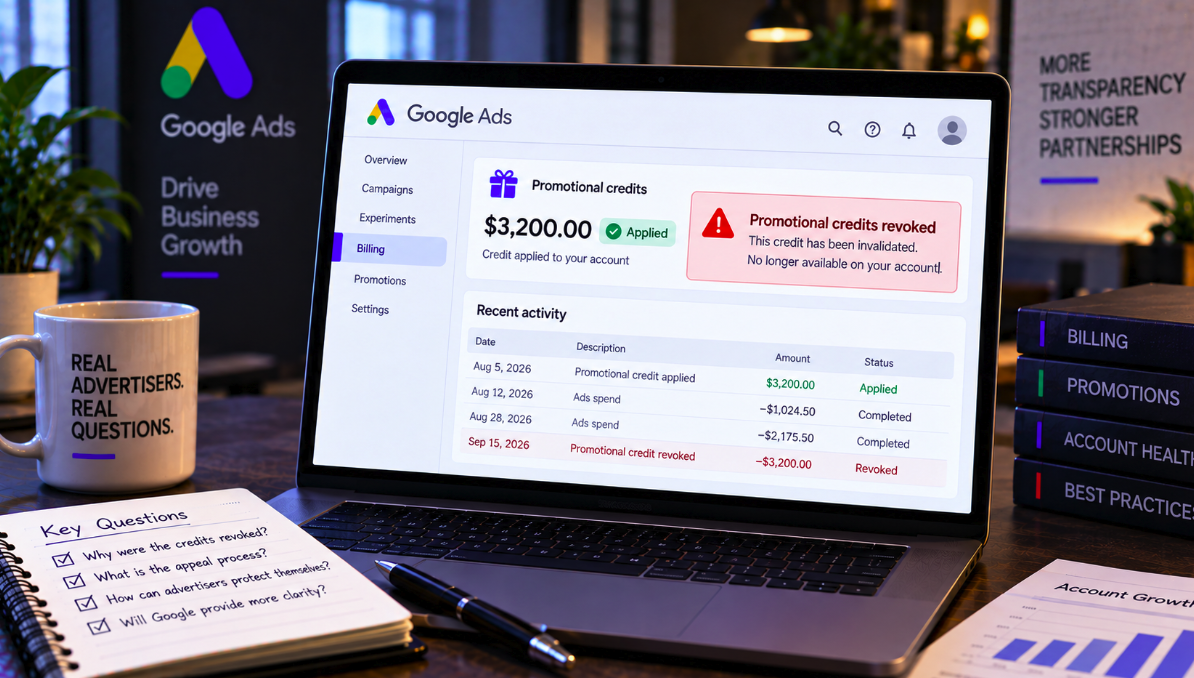
Promotional credits are designed to make the first dollars of an advertising campaign easier to commit. But two cases reported by a PPC consultant expose the opposite risk: what happens when an advertiser increases spending in reliance on a credit, uses it, and then sees the promotion invalidated weeks later?
Search Engine Roundtable reported on September 10 that consultant David Melamed had encountered the problem twice in a short period. In the example he highlighted, an advertiser expected a $3,200 Google Ads promotional credit and spent accordingly, only for the credit to be marked invalidated more than a month later. Melamed said the advertiser likely would not have committed the same initial spend without the promotion.
The allegation needs careful framing. These are two consultant-reported account incidents, not evidence that Google routinely revokes used credits across the advertising ecosystem. Melamed used much stronger language in his complaint, but there is not yet a public Google explanation establishing why the two credits were invalidated. Google Ads Liaison Ginny Marvin responded that she had passed the case to the team, leaving the underlying eligibility or billing issue unresolved in the public record at the time of publication.
The real problem is not simply losing a coupon—it is losing budget certainty
A promotional offer can change an advertiser’s economic decision before the credit is ever consumed. If a business understands an offer as effectively subsidizing part of its initial campaign, it may raise bids, extend the campaign or accept a level of gross spend that would otherwise be outside its budget. Once those auctions have occurred, the media spend cannot be reversed merely because the promotional treatment later changes.
That is why a $3,200 invalidation can be materially different from an ordinary unused coupon expiring. The advertiser may have entered auctions under the assumption that part of future advertising costs would be covered by the credit. If the promotion is later removed, the effective out-of-pocket economics of the campaign can change after the decision that generated the spend has already been made.
In one of Melamed’s cases, he said a brand-new advertiser lost eligibility because his billing profile from the manager account had initially been used to set up the account. He said he did not yet know the reason for the second invalidation. Those details suggest that eligibility or account configuration may be relevant, but they do not establish a common cause for both cases.
Google’s published terms make eligibility conditional, but do not explain these two incidents
Google’s official promotional-offer documentation makes clear that credits are conditional rather than guaranteed cash rebates. Offers can have different spending requirements and eligibility rules, and Google says that after the required spend is reached, eligibility processing can take up to 35 days before a qualifying credit is applied. Promotional credits cover future advertising costs rather than reimbursing costs accumulated before the credit becomes available.
Google also documents situations in which promotional eligibility can be lost. For example, certain billing-configuration changes can invalidate a promotion, while offers for new advertisers depend on the account and business meeting specific new-customer requirements. The company’s promotional-offer policy emphasizes that terms vary by offer and location and that advertisers must satisfy all applicable conditions.
Those rules matter, but citing them does not resolve the reported cases. The unanswered question is whether the accounts violated a clearly disclosed eligibility condition, whether a verification system made a delayed determination, or whether something else occurred. Without an account-specific explanation from Google, it would be premature either to describe the invalidations as arbitrary or to assume the advertisers clearly breached the promotion terms.
A delayed eligibility decision creates a difficult user-experience problem
The timing is what makes the dispute particularly important. Eligibility checks are understandable when promotional programs need to prevent duplicate accounts, abuse or businesses repeatedly presenting themselves as new advertisers. But if the platform allows a promotion to appear available, lets an advertiser plan spending around it and only much later determines that the account was ineligible, the verification process can transfer substantial uncertainty to the advertiser.
That uncertainty is amplified when the reason is difficult to identify or challenge. Melamed said he knew of no obvious way to appeal the invalidated credit. Google does provide support and troubleshooting resources for promotional offers, but the public report does not describe a dedicated appeal path that resolved these particular cases. Marvin’s escalation to the Ads team is therefore significant, although it should not be mistaken for an admission that Google made an error.
For agencies and consultants, the issue also creates an expectation-management problem. A promotional offer may influence a client’s approved budget, yet account ownership, manager-account relationships, billing profiles and prior advertising history can all potentially matter to eligibility. If those dependencies are not obvious when the offer is accepted, the agency can find itself explaining an unexpected bill after the campaign has already run.
Advertisers should treat promotional documentation as part of the billing record
Until Google clarifies the reported cases, advertisers relying on a large promotion have a practical reason to preserve more evidence than they might for an ordinary discount. The original offer, its eligibility terms, screenshots of promotion status, dates when spending thresholds were reached, billing-profile configuration and subsequent transaction history can all become important if the credit changes status later.
That does not eliminate the financial risk, but it creates a clearer record for support escalation and helps distinguish an eligibility dispute from a platform error. Agencies should also verify who owns and configures the billing profile before activating a new-advertiser promotion, especially when a manager account is involved, rather than assuming that a client’s newly created Ads account automatically satisfies every definition of “new advertiser.”
The broader lesson is that promotional credits are not equivalent to cash already deposited in an account. Google’s own documentation makes them conditional on offer-specific terms, and advertisers should budget with that distinction in mind. At the same time, once a credit is presented and spending decisions are made around it, delayed invalidation becomes more than a minor promotional inconvenience.
For now, the headline is a reported billing dispute rather than a proven systemic practice: two advertisers allegedly saw credits invalidated more than a month later, one involving $3,200, and Google’s Ads liaison has escalated the matter internally. What advertisers still need is the missing part of the story—an account-specific explanation of why those credits were revoked and a clear path for resolving a case when the advertiser believes the decision is wrong.