
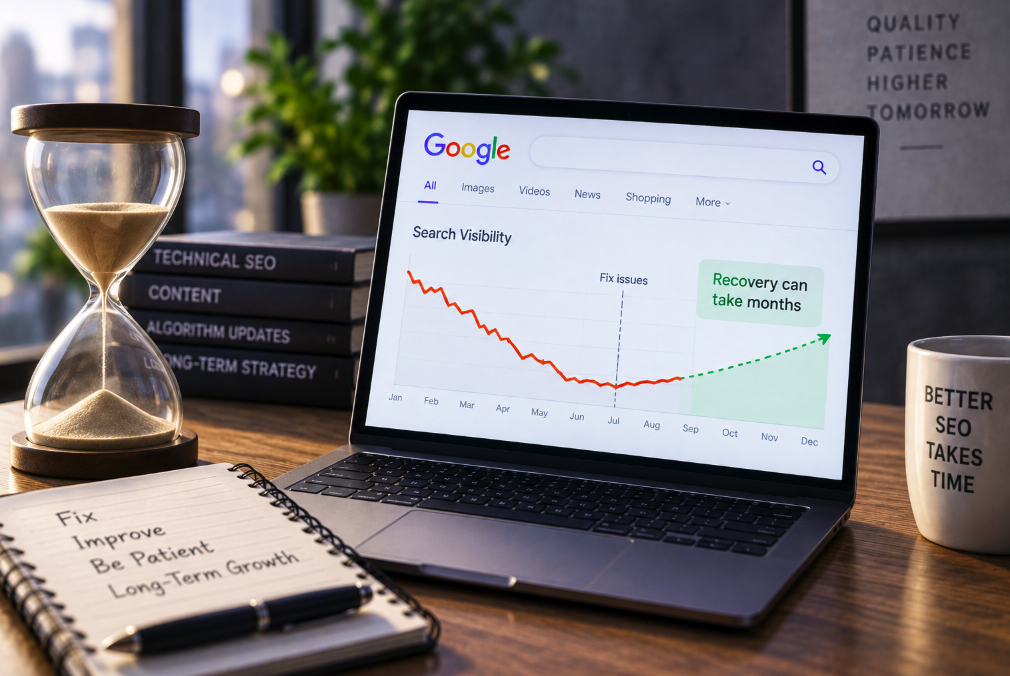
One of the hardest messages to communicate after a major organic traffic loss is that correcting the underlying SEO problem does not necessarily reset rankings. A site can make the right technical or quality improvements, deploy them successfully and still spend months waiting for Google’s systems to reassess what changed. New comments from Google Search Advocate John Mueller reinforce that distinction between fixing a problem and recovering from its ranking effects.
Search Engine Journal reported on September 3 that Mueller told a site owner that issues associated with larger algorithmic changes can take “sometimes many months” before their effects become visible after fixes. His comments came in response to a complicated case involving a Google Business Profile suspension, a link disavow file and a subsequent organic ranking decline. Rather than accepting the site owner’s assumed cause, Mueller encouraged a broader diagnosis and warned that an algorithm-related recovery should not be expected to happen immediately.
A ranking drop can have more than one plausible cause
The site owner described discovering more than 800 links they considered toxic and submitting a disavow file. Organic rankings then fell sharply within roughly two weeks, leading them to suspect that useful links had accidentally been disavowed. Mueller did not dismiss the disavow tool entirely, but he said disavowing a handful of links would not normally cause a site to disappear from Search. His recommendation was to correct the file so that it reflected what was genuinely needed and, importantly, investigate other potential explanations.
One possibility Mueller raised was a broader spam update occurring around the same period. He also suggested checking for major technical failures—not minor canonical imperfections, but site-wide problems capable of fundamentally restricting Google’s access or understanding. That diagnostic framing matters because timing alone is weak evidence of causation. SEO teams often associate the most recent change they made with the next traffic movement they observe, even when a Google update, competitor change, technical deployment or another factor may have occurred at nearly the same time.
The practical lesson is to separate diagnosis from remediation. Before asking how quickly rankings will return, a site needs reasonable confidence that it has identified the cause of the decline. Reversing the wrong change can add more noise to an already difficult investigation.
Google’s systems may need months to reassess a site
Mueller’s timeline is consistent with Google’s published guidance. The company’s current documentation on core updates says that some improvements can influence Search within days, but it may take several months for Google’s systems to learn and confirm that a site as a whole is consistently producing helpful, reliable, people-first content. If several months pass without a visible effect, Google says a site may need to wait for another core update.
That does not mean every recovery is locked to the next major announced update. Google recently clarified that it continuously changes its search algorithms, including smaller core updates that are not publicly announced. Those systems can recognize improvements between major updates. The important point is that there is no universal recovery clock: some changes can be reflected quickly, while broader quality or algorithmic reassessments can take substantially longer.
This difference explains why a simple technical mistake and a site-wide algorithmic loss should not be managed with the same expectations. If an entire site is accidentally blocked from crawling and the block is removed, Google can begin recrawling and processing accessible pages relatively directly. When the issue concerns a broader assessment of content quality, trust, usefulness or spam-related signals, Google may need to observe and reprocess changes across a much larger portion of the site before rankings meaningfully shift.
Implementation is not the same as reassessment
SEO recovery is often discussed as though it were a two-step process: identify the problem, then fix it. In practice there is a third stage that site owners do not control—Google has to detect, process and evaluate the new state of the website. That delay is why a technically correct fix can appear to have “failed” when the real issue is that the relevant ranking systems have not yet fully reassessed the site.
For larger websites, this can involve recrawling many URLs, refreshing indexed information and incorporating changed signals into ranking systems. For quality improvements, the process can be even less immediate because Google is not merely checking whether a line of code changed. Its systems are trying to determine whether the site now demonstrates a materially different pattern over time.
This is also why aggressive week-to-week reactions can become counterproductive. If a team makes a major content overhaul, waits ten days, sees no recovery and immediately reverses or replaces the strategy, it becomes difficult to know which version Google ultimately evaluated. Constantly changing titles, templates, internal linking, content structures and large sections of a site can make both measurement and diagnosis harder.
Recovery is not guaranteed even after the right fixes
Time is only part of the equation. Google explicitly warns that improvements do not guarantee a return to previous rankings. Search positions are not fixed assets reserved for sites that once held them. While one publisher is improving, competitors are publishing new material, user expectations are changing and Google’s ranking systems continue to evolve.
That makes “recovery” a potentially misleading objective if it is defined as returning to an exact historical traffic level. A site that lost rankings six months ago is competing in today’s search environment, not the one that existed before the decline. Even if the original weakness has been corrected, the pages that replaced it may now be stronger or more relevant.
A better benchmark is whether the site is regaining qualified visibility across the topics, pages and queries that matter to its business. That may eventually resemble the old traffic profile, but it can also produce a different distribution of rankings and landing pages. SEO teams should therefore measure progress across impressions, query coverage, average positions, crawling and indexing patterns, conversions and the performance of improved content rather than waiting for a single graph to return to its former peak.
The disavow case also highlights a common SEO risk
The original discussion is useful beyond recovery timelines because it illustrates how third-party labels such as “toxic links” can lead site owners toward unnecessary interventions. Google’s disavow tool is a specialized mechanism, not a routine backlink-cleaning feature. Google has long advised that most sites do not need it, particularly because its systems are generally capable of handling ordinary spammy links without manual action from the site owner.
Removing or disavowing links based only on a third-party toxicity score can therefore create avoidable uncertainty. If a site has participated in manipulative link building or has a link-related manual action, the situation is different. But a collection of suspicious-looking backlinks is not automatically evidence that those links are responsible for a ranking decline.
Mueller’s broader recommendation—to look for other potential reasons—may be the most valuable part of the exchange. Major SEO losses often attract a single-cause narrative because it is psychologically and operationally easier to solve one visible problem. In reality, a decline can coincide with algorithm updates, technical changes, content quality issues, shifts in search demand and competitive improvements at the same time.
How SEO teams should manage a long recovery window
When evidence points to a broad algorithmic issue, recovery planning should operate on a longer horizon. Document the date of the decline, relevant Google updates, technical releases and major content changes. Establish a baseline before remediation, then keep a clear record of what was changed and when. That history becomes essential when performance begins moving weeks or months later.
Teams should also distinguish quick verification metrics from final ranking outcomes. A technical fix can often be checked relatively quickly: pages become crawlable, canonicals resolve correctly, server errors disappear or updated content is recrawled. Those are signs that implementation worked, not proof that rankings should already be restored. The ranking response may follow on a very different timeline.
Most importantly, a slow response should not become an excuse to stop improving the site. Google’s guidance focuses on sustained helpfulness and reliability rather than isolated SEO patches. If a major ranking change exposed weaknesses in thin content, originality, user experience or site-wide focus, the goal should be to make the website genuinely stronger, not simply to perform the smallest edit that might trigger a reversal.
SEO fixes can be immediate; Google’s verdict is not
Mueller’s comments are a reminder that search recovery has two clocks. The first belongs to the site owner: how quickly the team can diagnose and correct a genuine problem. The second belongs to Google: how long its systems take to recrawl, reprocess and reassess the changed site. Only the first is under direct control.
That makes patience part of technical SEO strategy, but not passive patience. The months after a major fix should be used to validate implementation, monitor relevant query groups, improve content and rule out additional causes rather than repeatedly changing direction because rankings have not returned immediately. Fixing the problem is necessary. In modern Google Search, it is not the same thing as receiving an instant restoration of the rankings that were lost.