
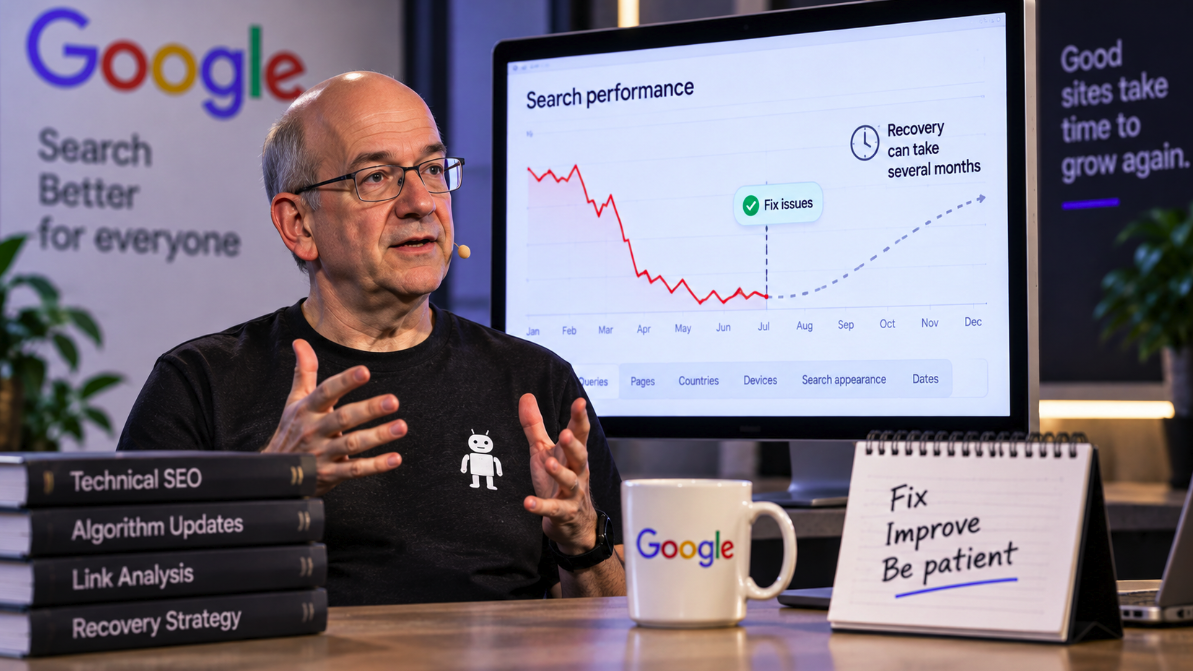
Fixing the problem that caused a major Google ranking loss does not necessarily start an immediate climb back to the previous position. According to Google’s John Mueller, sites affected by larger algorithmic issues can wait months after making the right changes before the effects become visible in search.
The clarification came in response to a site owner who was trying to diagnose a steep organic ranking decline after submitting a disavow file. As Search Engine Journal reported on September 3, Mueller advised looking beyond the most obvious recent action and considering whether the loss aligned with a broader spam update or another significant problem.
His central message is an important one for recovery work: correlation in an SEO timeline is not enough to establish causation, and remediation does not guarantee a fast algorithmic reassessment.
A ranking drop two weeks after a disavow is not automatically caused by the disavow
The site owner had reviewed the backlink profile, identified more than 800 links considered toxic and submitted a disavow file. Roughly two weeks later, organic rankings fell sharply. Because the two events were close together, the disavow became the leading suspect.
Mueller did not dismiss the disavow tool as meaningless. He explicitly said it has a place, a time and effects. But he also warned that disavowing a relatively small number of links is not the kind of change that should normally make an entire site disappear from search. His recommendation was to correct the disavow file so that it contains only what is genuinely intended—which could mean an empty file—and then investigate other potential causes.
That distinction matters because backlink tools can label large numbers of links as toxic even when Google does not require site owners to disavow them. A sudden ranking loss can tempt teams to treat the most recent SEO action as the explanation, particularly when the action involved something as consequential-sounding as removing links from consideration. Mueller’s response argues for a wider diagnostic process.
Algorithmic recovery can take “many months”
Mueller pointed to a broader spam update as one possible factor, while noting that he did not have the dates needed to establish whether the events actually aligned. He then set expectations for what happens if a major algorithmic change really was involved: correcting the underlying issues can take a long time to translate into visible recovery, sometimes many months.
This is not the same as saying every ranking loss requires months to fix. Mueller separately suggested checking for large technical failures, using the example of accidentally blocking an entire site rather than a small canonical mistake. A catastrophic technical configuration can sometimes be identified and corrected directly. A site-wide algorithmic reassessment is a different process.
The practical lesson is that “fixed” has at least two meanings in SEO. The website can be fixed from the publisher’s perspective because the problematic content, technical configuration or spam pattern has been corrected. Google’s systems may still need time to recrawl, reprocess and reassess enough signals to reflect those changes in rankings.
Google has described this delay before
Mueller’s September comments are consistent with earlier explanations of how long broad site changes can take to register. In previous guidance reported by Search Engine Journal, he explained that larger websites can require several months of recrawling, reindexing and reprocessing before Google fully understands substantial changes and adjusts search visibility accordingly.
He has made a similar point about quality-related recovery. In another discussion covered by Search Engine Journal, Mueller said that understanding significant changes in a site’s overall quality can take months and, in some circumstances, even longer. Quality is not necessarily a switch that Google reevaluates the moment a publisher uploads a revised page.
These comments help explain why recovery graphs often do not resemble an immediate reversal of the original decline. The site owner may implement a meaningful improvement on one date, yet the search system can incorporate the resulting signals gradually.
Disavow timing makes rapid cause-and-effect claims especially risky
The disavow tool adds another timing problem. Google does not instantly recalculate a site’s link graph the moment a new file is uploaded. Mueller has previously explained that disavowed links are taken into account as Google reprocesses links pointing to the website, with effects developing incrementally over a period of months.
Search Engine Journal’s report cites earlier guidance in which Mueller estimated that this process could unfold over roughly three to six months. In that context, a dramatic visibility change within days—or even a very short number of weeks—should not automatically be attributed to the disavow submission.
This does not prove a disavow can never contribute to ranking changes. If a site owner tells Google to disregard links that were genuinely helping the site, the file can have consequences as those links are reprocessed. The point is about diagnosis: the expected processing timeline should be compared with the observed ranking timeline before assigning blame.
Recovery work needs two timelines, not one
SEO teams responding to a major loss often focus on a single chronology: rankings dropped, changes were made, and rankings should therefore recover. Mueller’s comments suggest separating that into two timelines.
The first is the remediation timeline. When was the technical problem corrected? When was low-quality or problematic content improved? When was the disavow file changed? When were important templates, internal links or site-wide elements updated? These dates document what the publisher controls.
The second is the search-system timeline. When did Google crawl the changed pages? Did the decline coincide with a confirmed broad or spam update? Is the affected section being recrawled frequently? Does the problem look like a direct technical block or a broader algorithmic reassessment? Those questions help establish whether an immediate recovery is realistic.
Keeping the two timelines separate reduces the temptation to undo good changes simply because rankings did not return within a few days.
A slow recovery does not prove the fix failed
This is perhaps the most important operational implication. When a team makes a substantial correction and sees no immediate improvement, it may conclude that the diagnosis was wrong. Sometimes it was. But absence of rapid recovery is not sufficient evidence by itself, particularly when the original loss appears tied to a broad algorithmic change.
The better response is to verify the fix independently. If the issue was technical, confirm that Google can crawl and index the affected pages. If it was content quality, evaluate whether the revised site genuinely resolves the underlying user and search-quality problems rather than merely changing surface-level SEO elements. If a disavow file was incorrect, make sure the file now represents the links the site owner actually intends to disavow.
Then monitor the site without assuming that every short-term fluctuation is a verdict on the remediation. Algorithmic systems can require enough new observations to reassess the site in context.
Not every drop should be diagnosed as a backlink problem
The episode also illustrates the risk of letting third-party backlink classifications drive recovery strategy. A report showing hundreds of “toxic” links can create a strong sense that those links must explain a ranking loss, even when there is no direct evidence connecting them to the decline.
Mueller’s recommendation was broader: fix the disavow file as necessary, but look for other reasons. That can include major technical issues and the timing of broader Google updates. It can also mean examining which pages and queries actually lost visibility rather than treating the site as a single ranking number.
A site-wide collapse, a section-level decline and the loss of one competitive keyword are different diagnostic patterns. Comparing affected page types, search intent, countries, devices and query groups can reveal whether the problem is broad enough to support the suspected explanation.
The fastest recovery strategy starts with better diagnosis
There is no guaranteed shortcut for restoring rankings after a major algorithmic loss. If Google needs months to reassess the signals that changed, publishing more updates or repeatedly modifying a disavow file may simply create additional variables that make the situation harder to interpret.
The more disciplined approach is to rule out severe technical failures first, establish whether the timing corresponds with a known update, audit the site for the kinds of substantive problems that could plausibly explain the loss and correct those problems without relying on cosmetic changes. Backlink actions should be based on evidence rather than a generic toxicity score.
Mueller’s September guidance ultimately separates two events that SEO teams often expect to happen together. A site can resolve the issue today, while Google’s visible response arrives much later. Fixing the cause is still necessary; it simply does not control the speed of the search engine’s reassessment.
For businesses watching a severe traffic decline, that delay is uncomfortable, but it is strategically important. A ranking graph that remains flat for weeks after a legitimate fix does not automatically mean the work failed—and a drop that appeared shortly after a disavow does not automatically mean the disavow caused it. In recovery SEO, timing is evidence, but it is not proof.