
Google’s AI search experience has always carried a difficult promise: answer the question directly while still giving users meaningful routes back to the open web. A new round of early testing around Gemini 3.8 Flash suggests that balance may be shifting, at least in some AI Mode responses. If the observation holds up, the implications would extend well beyond interface design and into one of the most sensitive questions in modern SEO: how much visibility publishers receive when their information helps an AI answer a query.
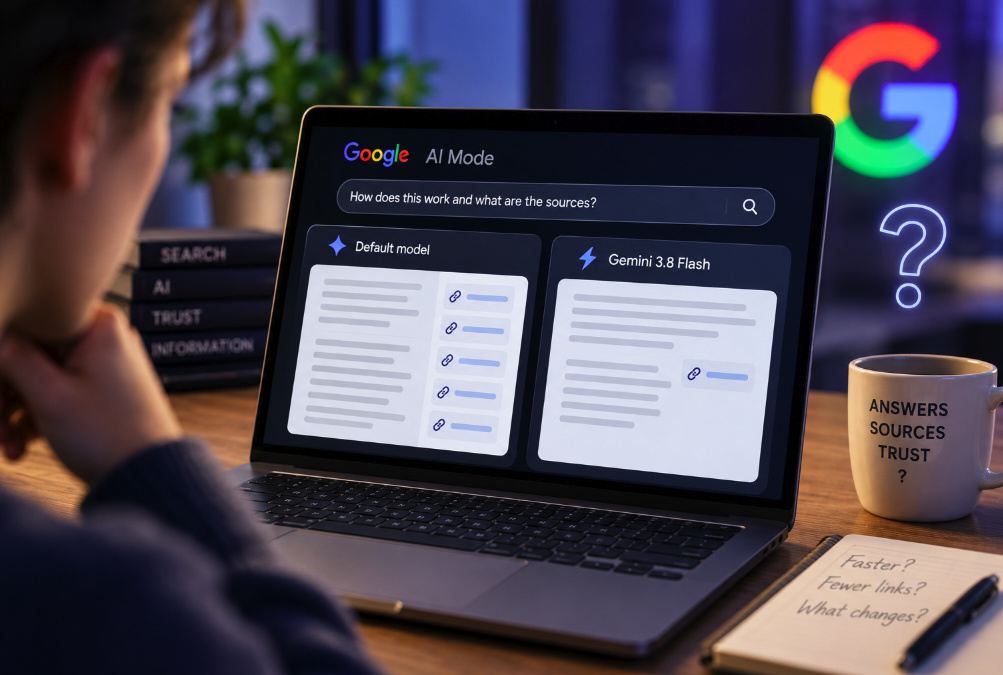
Search Engine Roundtable reported on September 3 that early testers were seeing substantially fewer links and citations when using Gemini 3.8 Flash in AI Mode than with the default model. The examples cited by the publication included top-of-funnel searches that reportedly returned answers without links or citations, as well as side-by-side observations from search marketers comparing Flash with the default experience. This is an early, anecdotal signal rather than evidence of a confirmed product policy, and Google has not announced that Gemini 3.8 Flash is intentionally designed to reduce citations.
A faster model enters Google Search
The timing makes the issue particularly interesting. Google introduced Gemini 3.8 Flash on September 2, describing it as its latest Flash workhorse model with significant improvements in software engineering, agentic tasks and complex multi-step reasoning. The company says it retains the speed and introductory pricing of Gemini 3.7 Flash while improving intelligence, and it made the model available to Google AI Pro and Ultra subscribers in AI Mode in Search, among other products.
That positioning matters because Flash models are designed around the combination of capability, latency and efficiency. Search is an especially demanding environment for that trade-off: users expect answers almost instantly, yet AI Mode can perform multiple searches, reason across information and generate a synthesized response. Any change in how the model chooses to retrieve, display or surface supporting sources can therefore affect both the user experience and the economics of publisher visibility.
The evidence is preliminary
It is important not to turn a handful of tests into a sweeping conclusion. Search interfaces are dynamic, model behavior can vary by query, and Google routinely experiments with layouts, retrieval strategies and AI experiences. The tests highlighted by Search Engine Roundtable do not establish that Gemini 3.8 Flash systematically produces fewer citations across all query categories, languages, users or sessions. Nor do they establish whether any observed difference comes from the model itself, the AI Mode orchestration layer, an experiment, the types of queries tested or another factor.
Google’s own documentation continues to describe AI Mode as an experience grounded in the web. Its AI Mode help documentation says the system can break questions into subtopics, search them concurrently and use high-quality web content to support responses. Google also says AI Mode can provide web links when appropriate. Nothing in the Gemini 3.8 Flash launch announcement states that the company is changing that principle or deliberately reducing source attribution.
That distinction is essential. The accurate headline today is not that Google has removed citations from AI Mode. It is that early comparisons have raised a credible question about whether responses generated with the newly available Gemini 3.8 Flash configuration may, in some circumstances, expose fewer visible links than the default model.
Why citation density matters to publishers
For users, citations are a mechanism for verification and deeper reading. For publishers, they are also one of the remaining bridges between generative answers and referral traffic. AI search can satisfy a large portion of informational intent directly on the results page. If an answer incorporates knowledge from the web but offers fewer obvious paths to the underlying sources, the economic tension between AI-generated search and content creation becomes sharper.
This is particularly important for informational and top-of-funnel queries. Those searches have historically introduced users to publishers, specialist sites and brands before a commercial decision is made. A conventional search results page distributes attention across multiple links. An AI answer can instead synthesize those sources into a single response. In that environment, citation placement, prominence and frequency are not cosmetic details; they can determine whether source visibility survives the transition from ranked results to generated answers.
Fewer citations would not necessarily mean that fewer web sources were used behind the scenes. Retrieval and presentation are separate issues. An AI system could consult numerous pages while exposing only a small number of them to the user. From an SEO perspective, however, invisible influence is difficult to monetize or even measure. A publisher can contribute useful information to an answer without receiving the click, impression pattern or attribution that historically made search visibility observable.
Google has also been moving toward more source visibility
The early Flash observations are notable because they sit alongside other Google efforts intended to make sources more visible in AI-powered search. In May, Google announced new ways to surface preferred and original sources in AI Search, including expansion of Preferred Sources and additional mechanisms designed to highlight high-quality content and firsthand perspectives.
That broader direction suggests the citation question is unlikely to be reducible to a simple strategy of removing links. Google has incentives on both sides. It wants AI Mode to feel fast, coherent and useful enough that people choose it for complex questions, while Search still depends on a healthy web ecosystem that produces the information those systems retrieve. Too many links can make a generated answer visually cluttered; too few can weaken transparency, verification and the publisher value exchange.
What SEOs should measure now
The most useful response for search teams is measurement rather than panic. Tests should compare the same prompts across the default AI Mode experience and Gemini 3.8 Flash, repeat queries over time and separate informational, commercial, local and navigational intent. Citation count alone is not enough. Teams should record which domains appear, where citations are placed, whether links are inline or grouped elsewhere, whether the answer changes after follow-up questions and whether cited pages correspond to the sources that rank organically.
It is also worth tracking whether citation behavior differs for queries where freshness or factual verification is especially important. A model may behave differently when answering an evergreen explanatory question than when addressing news, product comparisons or subjects that require current web retrieval. Without that segmentation, averages can obscure the mechanisms that actually matter.
Publishers should also resist optimizing for citation volume as though it were a new version of keyword density. The durable strategy remains producing material that gives retrieval systems a reason to use and expose the source: original reporting, distinctive data, expert analysis, clear factual structure and information that cannot be replicated by rewriting what dozens of other sites already say.
AI search is becoming a visibility negotiation
Gemini 3.8 Flash arrives as Google continues to make Search more conversational, more agentic and more dependent on model-generated interfaces. The early citation tests highlight an unresolved consequence of that transition. Model improvements are usually discussed in terms of reasoning quality, latency and cost, but publishers experience them through a different metric: whether users can still see and visit the sources behind an answer.
For now, there is not enough evidence to say that Google AI Mode is broadly becoming less citation-friendly. There is enough evidence to make the question worth testing carefully. If repeated analysis eventually shows that faster or newer models consistently expose fewer sources, the change would be more than a UI detail. It would reshape how SEO visibility is defined in an era where the search engine increasingly answers first and links second.