
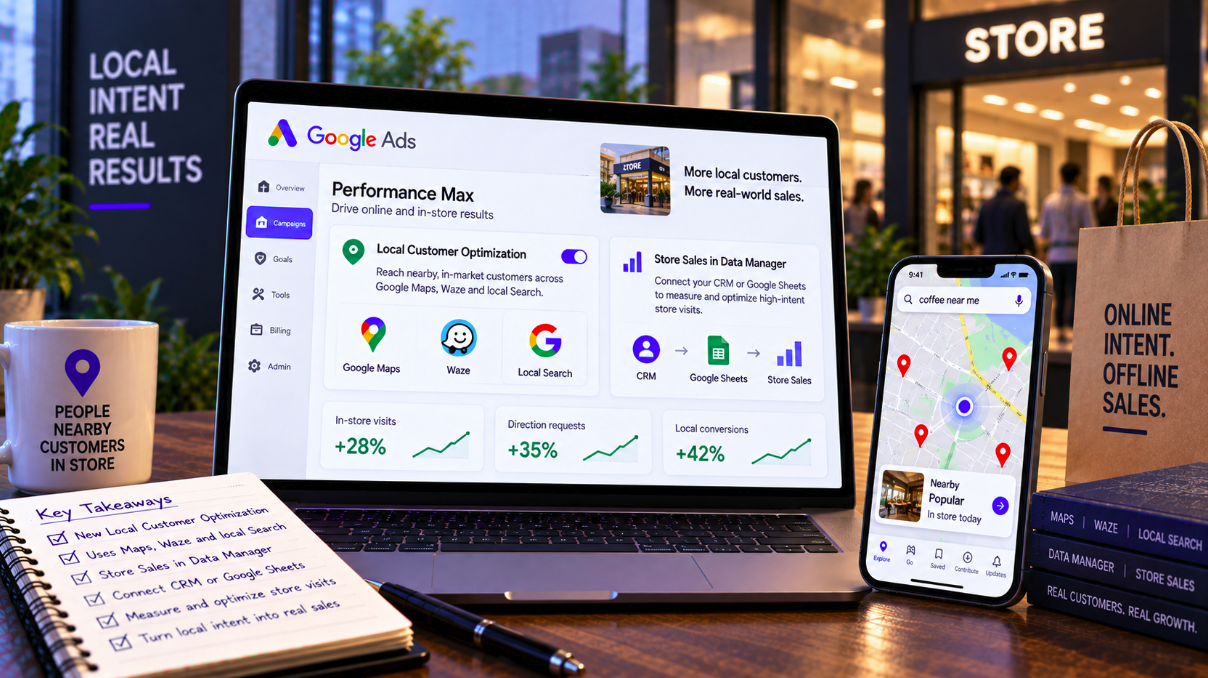
Google Ads is tightening one of the most difficult loops in local advertising: identifying consumers who appear ready to visit a physical business, spending campaign budget to reach them at that moment, and then feeding store revenue back into the system that decides whom to target next. Two new features for multi-location retailers, restaurants and local services are designed to make that online-to-offline cycle easier to operate.
Barry Schwartz reported the rollout on September 9 after Google Ads Liaison Ginny Marvin outlined Local Customer Optimization and Store Sales in Data Manager. The first adds a campaign-level toggle to Performance Max campaigns built for store goals. The second reduces the technical work required to send in-store sales data into Google Ads by allowing businesses to connect sources such as a CRM or Google Sheets through Data Manager.
Taken together, the features bring two different signals closer together. At the front of the journey, Google can prioritize people who are nearby or showing immediate local intent while using Maps, Waze or local Search. At the back, advertisers can supply transaction data that helps measure and optimize toward offline outcomes. That does not mean Google is handing advertisers a deterministic record connecting an individual Maps search to an individual cash-register purchase; it means the campaign and measurement systems can use local-intent and store-sales signals within the same broader optimization workflow.
Performance Max gets a more explicit local-intent switch
Google’s official documentation for Local Customer Optimization describes the feature as part of Performance Max campaigns for store goals. When enabled, it prioritizes potential customers who are close to or interested in a business area and appear ready to act, including people actively navigating, planning a trip or searching for a service in a particular location. Google specifically names Google Maps, Waze and local formats on Google Search as surfaces where campaign budget can be directed toward those users.
The distinction from ordinary geographic targeting is important. The feature is not simply “show ads to everyone within a radius.” Its stated purpose is to combine proximity or area interest with signals that suggest immediate action, such as navigation and location-oriented search behavior. For a restaurant, retailer or service business, that can shift Performance Max toward the moments closest to a physical visit rather than treating every person in the surrounding geography as equally valuable.
There are also meaningful boundaries. Google says Local Customer Optimization works with Performance Max campaigns optimizing only toward offline store goals and is not compatible with online campaign goals or Performance Max campaigns that use Merchant Center products. Advertisers can choose store-oriented conversion goals such as store visits, store sales, hosted contacts or hosted directions, but the new toggle should not be interpreted as a universal Performance Max setting or a guarantee that nearby exposure will produce incremental foot traffic.
Store Sales in Data Manager closes more of the measurement loop
The second update addresses the harder part of local advertising: what happened after the user arrived. According to Google’s announcement as reported by Search Engine Roundtable, Store Sales in Data Manager will let advertisers connect a CRM or Google Sheets directly through Data Manager, reducing the technical burden of sharing in-store transaction data with Google Ads. Google says advertisers can then measure and optimize toward their highest-potential walk-in customers.
This builds on an existing Store Sales measurement and bidding system rather than creating offline measurement from scratch. Google’s Smart Bidding documentation already allows eligible advertisers to incorporate store-sales conversions and values into bidding for supported Search, Shopping and Performance Max campaigns. By making the data connection easier, Data Manager can lower an implementation barrier that has historically made offline revenue signals more difficult to operationalize than ecommerce conversions captured directly on a website.
Access is not universal, however. Google’s Store Sales eligibility documentation describes allowlisting, supported verticals and volume requirements that vary by measurement configuration. Advertisers therefore should not assume that connecting a spreadsheet instantly unlocks the full Store Sales product. The quality and eligibility of the underlying first-party transaction data still matter, as do Google’s privacy and measurement requirements.
The bigger change is optimization around business outcomes, not local clicks
The combined workflow points toward a more consequential model for local advertising. A campaign can identify high-intent moments on Maps, Waze and Search, prioritize budget toward those moments, ingest offline revenue and then use store outcomes as part of Smart Bidding. For businesses whose most important conversion happens at a counter rather than a checkout page, that is much closer to the economic objective than optimizing around clicks, direction requests or other intermediate actions alone.
It also changes how local campaign performance should be evaluated. A navigation request can be valuable without becoming a sale, while a consumer exposed to an ad may purchase later through a journey that cannot be reduced to a single visible click. Store-sales measurement provides a way to move optimization farther down the funnel, but advertisers still need to distinguish measured or modeled attribution from true incrementality. Feeding revenue back into bidding helps the system pursue observed high-value outcomes; it does not by itself prove how many of those purchases would have happened without the advertising.
The privacy distinction is equally important. The appealing shorthand is that Google can now connect Maps and Waze intent “directly” with store sales, but advertisers should not read that as access to person-level navigation histories matched to receipts. The practical connection happens through Google Ads’ campaign, first-party data and measurement infrastructure, where offline conversion reporting can involve aggregation and modeling as well as advertiser-supplied transaction signals.
For multi-location marketers, the strategic opportunity is nevertheless clear. Local advertising has often been strongest at generating signals of intent and weakest at proving what those signals were worth at the cash register. Local Customer Optimization and the easier Store Sales connection attack those two sides of the same problem: spend more intelligently when a consumer appears ready to act nearby, then return real store outcomes to the system instead of optimizing indefinitely around proxies.
That makes the update less about Maps or Waze as isolated ad placements and more about the feedback loop behind them. Google is bringing immediate local intent and offline revenue into a tighter Performance Max workflow. The businesses that benefit most will be those able to supply reliable store-sales data and evaluate the system against incremental business results—not simply those that accumulate the largest number of local interactions.